
Agent Engineering is actually Organizational Engineering
Agent Engineering is actually Organizational Engineering
Jayanth Krishnaprakash

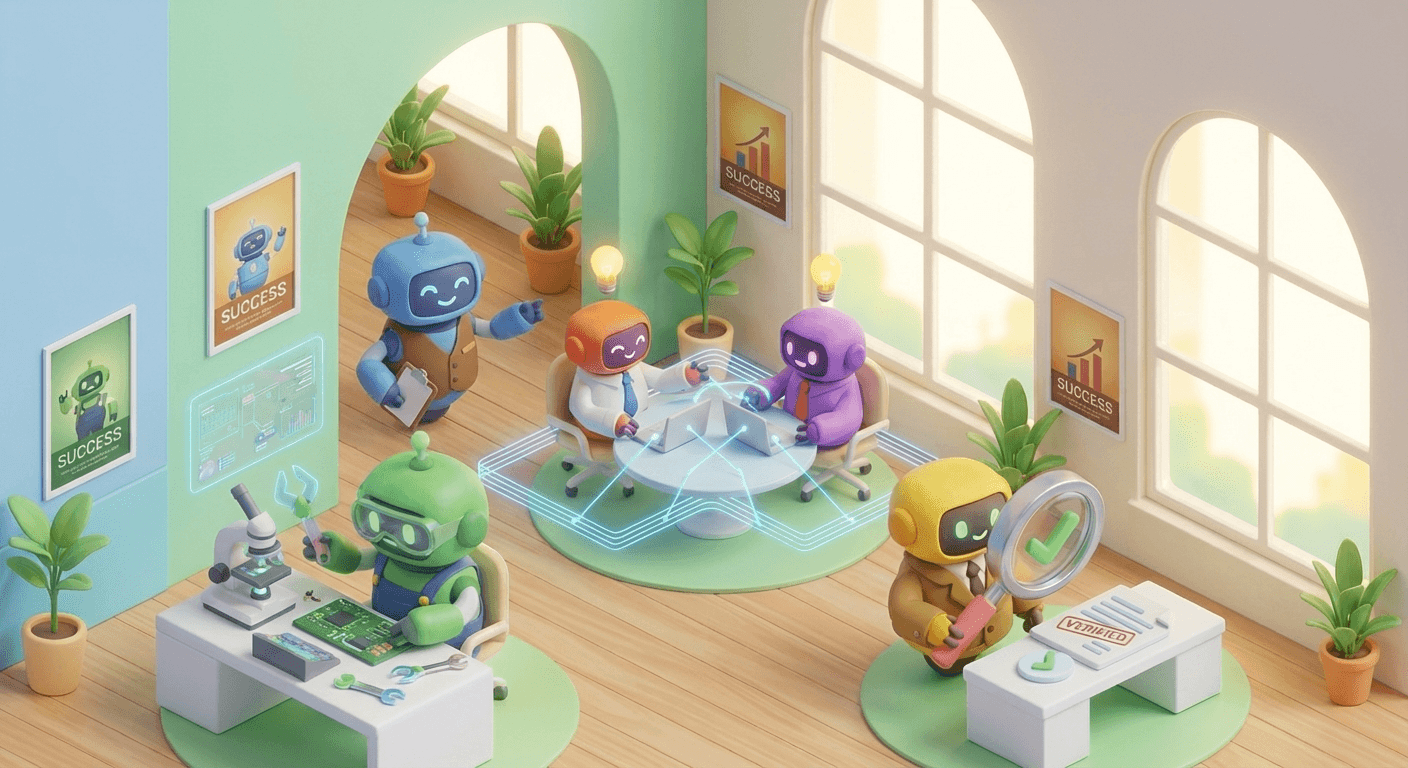
When a complex Multi-Agent System (MAS) breaks down, our first instinct is to blame the model. We assume the LLM was not smart enough, or that it hallucinated. The usual response is predictable: upgrade to a larger model, add more agents, or tweak the prompt.
But here is the uncomfortable truth: making models smarter won’t fix this. Multi-agent systems fail for the same reasons companies fail. It is rarely because the “employees” (the agents) are dumb; it is because the “company” (the system) is poorly structured. These aren’t hallucinations, but these are organizational failures.
What an Agent Actually Is
To understand why MAS fails, we need to be precise about what an agent is in a production setting. An agent is not a chatbot. An agent is an entity that moves a task from an initial state to a final state, operating inside an environment, using tools, memory, and past context.
Once you move from a Single Agent System to a Multi-Agent System, you are no longer just writing code. You are designing a workforce. That workforce must delegate, coordinate, share context, verify outcomes, and decide when a task is complete. If the organizational structure governing those interactions is flawed, the system will fail regardless of how powerful the underlying model is.
This is why MAS failures persist even as models improve. The failure mode is not intelligence. It is structure.
MAS Failure isn’t Model Failure
In management theory, there is a well-understood phenomenon: a company can fail even if every employee is brilliant. Poor communication paths, unclear responsibilities, weak quality control, and bad escalation mechanisms will sink even the smartest organization. The same principle applies to AI systems.
To build reliable agentic systems, we must learn from High-Reliability Organizations (HROs) like nuclear power plants, air-traffic control towers, aircraft carrier decks. These organizations operate in high-stakes environments not because they assume perfection, but because they are explicitly designed to contain human error.
As the analogy goes, even if the employee is smart, the company fails due to poor structure.
The Three Categories of Organizational Failure
Across real-world agent systems, failures consistently fall into three categories. If your MAS is misbehaving, the root cause almost always lives in one of these buckets.
Specification and System Design Failure
This is a failure of leadership. The system does not clearly define what each agent is and is not allowed to do. Agents forget who they are, ignore core rules of the assignment, or drift into roles they were never meant to perform. In poorly designed systems, agents also get stuck in loops because there is no clear termination condition. The result is the “never-ending agent” continuously generating output long after the task is complete.
Inter-Agent Misalignment
This is a failure of teamwork. Agents may all be competent individually, but they are misaligned as a group. One agent guesses instead of asking for clarification. Another holds critical information but does not proactively share it. Conversations restart from scratch mid-flow, agents talk without listening, or worse, they say the right thing but do the wrong thing. These are not reasoning failures; they are coordination failures.
Task Verification and Termination Failure
This is a failure of quality control. A checker agent exists, but it is lazy or wrong. It rubber-stamps results instead of validating them. In other cases, agents cannot agree on what “done” looks like, leading to premature exits or endless debate. The system either quits too early or never finishes at all. The pattern is consistent: wrong setup, wrong teamwork, or wrong quality control.
A Manifesto for Organizational Design
If we treat agents like employees, we must design systems the way high-reliability organizations do. This is how you move from an experimental swarm to a production-grade system.
High-reliability systems are preoccupied with failure. They do not ask, “Will this work?” They ask, “How will this fail?” This is why MAS needs dedicated critic or red-team agents whose only job is to find flaws, not agree with the plan.
They show reluctance to simplify. Agents are prone to hallucinating simple solutions to complex problems. Strong systems force deep verification instead of accepting the first plausible answer.
They maintain sensitivity to operations. Orchestrators should have real-time visibility into what agents are doing, who is stuck, who is looping, and where context is drifting. Early intervention prevents system-level collapse.
They are built with a commitment to resilience. Errors in long-running agent workflows compound. Systems must support checkpointing, rollback, and re-planning so that one agent’s mistake does not bring the entire organization down.
Finally, they practice deference to expertise. Decisions should be made by the agent with the most relevant knowledge, not the highest rank. Expertise should be allowed to surface proactively, not only when explicitly asked.
We are entering a new era of engineering, where there’s a shift from writing deterministic code to managing probabilistic agents. You are no longer just a builder, you are an organizational designer. Building agents is not prompt engineering. It’s organizational engineering. If your “company” of agents is failing, don’t just hire a smarter model. Build a better organization :)
When a complex Multi-Agent System (MAS) breaks down, our first instinct is to blame the model. We assume the LLM was not smart enough, or that it hallucinated. The usual response is predictable: upgrade to a larger model, add more agents, or tweak the prompt.
But here is the uncomfortable truth: making models smarter won’t fix this. Multi-agent systems fail for the same reasons companies fail. It is rarely because the “employees” (the agents) are dumb; it is because the “company” (the system) is poorly structured. These aren’t hallucinations, but these are organizational failures.
What an Agent Actually Is
To understand why MAS fails, we need to be precise about what an agent is in a production setting. An agent is not a chatbot. An agent is an entity that moves a task from an initial state to a final state, operating inside an environment, using tools, memory, and past context.
Once you move from a Single Agent System to a Multi-Agent System, you are no longer just writing code. You are designing a workforce. That workforce must delegate, coordinate, share context, verify outcomes, and decide when a task is complete. If the organizational structure governing those interactions is flawed, the system will fail regardless of how powerful the underlying model is.
This is why MAS failures persist even as models improve. The failure mode is not intelligence. It is structure.
MAS Failure isn’t Model Failure
In management theory, there is a well-understood phenomenon: a company can fail even if every employee is brilliant. Poor communication paths, unclear responsibilities, weak quality control, and bad escalation mechanisms will sink even the smartest organization. The same principle applies to AI systems.
To build reliable agentic systems, we must learn from High-Reliability Organizations (HROs) like nuclear power plants, air-traffic control towers, aircraft carrier decks. These organizations operate in high-stakes environments not because they assume perfection, but because they are explicitly designed to contain human error.
As the analogy goes, even if the employee is smart, the company fails due to poor structure.
The Three Categories of Organizational Failure
Across real-world agent systems, failures consistently fall into three categories. If your MAS is misbehaving, the root cause almost always lives in one of these buckets.
Specification and System Design Failure
This is a failure of leadership. The system does not clearly define what each agent is and is not allowed to do. Agents forget who they are, ignore core rules of the assignment, or drift into roles they were never meant to perform. In poorly designed systems, agents also get stuck in loops because there is no clear termination condition. The result is the “never-ending agent” continuously generating output long after the task is complete.
Inter-Agent Misalignment
This is a failure of teamwork. Agents may all be competent individually, but they are misaligned as a group. One agent guesses instead of asking for clarification. Another holds critical information but does not proactively share it. Conversations restart from scratch mid-flow, agents talk without listening, or worse, they say the right thing but do the wrong thing. These are not reasoning failures; they are coordination failures.
Task Verification and Termination Failure
This is a failure of quality control. A checker agent exists, but it is lazy or wrong. It rubber-stamps results instead of validating them. In other cases, agents cannot agree on what “done” looks like, leading to premature exits or endless debate. The system either quits too early or never finishes at all. The pattern is consistent: wrong setup, wrong teamwork, or wrong quality control.
A Manifesto for Organizational Design
If we treat agents like employees, we must design systems the way high-reliability organizations do. This is how you move from an experimental swarm to a production-grade system.
High-reliability systems are preoccupied with failure. They do not ask, “Will this work?” They ask, “How will this fail?” This is why MAS needs dedicated critic or red-team agents whose only job is to find flaws, not agree with the plan.
They show reluctance to simplify. Agents are prone to hallucinating simple solutions to complex problems. Strong systems force deep verification instead of accepting the first plausible answer.
They maintain sensitivity to operations. Orchestrators should have real-time visibility into what agents are doing, who is stuck, who is looping, and where context is drifting. Early intervention prevents system-level collapse.
They are built with a commitment to resilience. Errors in long-running agent workflows compound. Systems must support checkpointing, rollback, and re-planning so that one agent’s mistake does not bring the entire organization down.
Finally, they practice deference to expertise. Decisions should be made by the agent with the most relevant knowledge, not the highest rank. Expertise should be allowed to surface proactively, not only when explicitly asked.
We are entering a new era of engineering, where there’s a shift from writing deterministic code to managing probabilistic agents. You are no longer just a builder, you are an organizational designer. Building agents is not prompt engineering. It’s organizational engineering. If your “company” of agents is failing, don’t just hire a smarter model. Build a better organization :)