
AI Agents: Why More is Not Always Better
AI Agents: Why More is Not Always Better
Jayanth Krishnaprakash

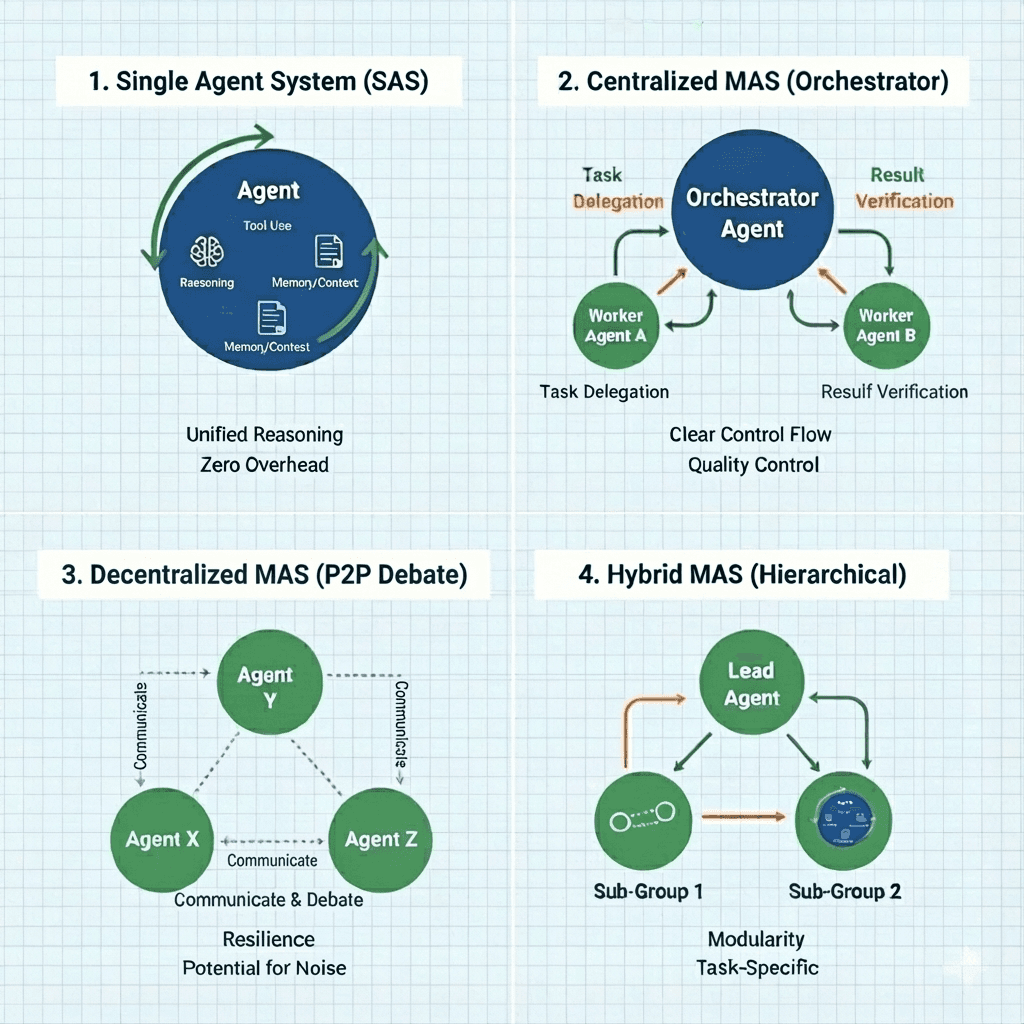
In the current AI landscape, there is a massive rush toward building complex multi-agent “swarms.” The prevailing hype suggests that if one agent is good, ten agents must be ten times better. This intuition is borrowed from distributed systems and microservices, but agentic systems do not obey the same laws.
As we move toward a science of scaling agent systems, we must confront an uncomfortable truth: architecture is not a free lunch. It is a lever. And like all levers, it should be used sparingly. Every additional agent introduces coordination cost, communication overhead, and new failure modes.
The Promise vs. Reality of Multi-Agent Systems
Multi-Agent Systems (MAS) are designed to solve complex problems through:
Task decomposition: breaking a goal into subgoals
Parallelization: executing multiple steps concurrently
Context isolation: preventing one subtask from polluting another
In theory, this sounds compelling. A large goal can be split into smaller, well-defined problems. Specialized agents can focus narrowly, redundancy can reduce error, and the collective system can outperform any single agent. In practice, this promise is routinely over-applied.
Many developers implicitly assume MAS scales like microservices. It does not. Traditional scaling laws don’t apply because agent performance is not dominated by compute or throughput, it is dominated by reasoning coherence. While data processing parallelizes cleanly, reasoning does not. Splitting reasoning across agents often fragments context, intent, and constraints.
As a result, performance becomes highly domain-specific. MAS can help in some tasks and actively harm others.
So the key observations are:
More agents is not better
Performance is highly domain-specific
Traditional scaling laws don’t apply
A Taxonomy of Agent Architectures
Choosing the right architecture matters far more than choosing the “most advanced” one. What determines success is communication topology, not agent count.
A Single Agent System is the most streamlined architecture possible:
One reasoning locus
Zero communication overhead
Unified memory
Because there is only one “brain,” there is no ambiguity about goals, constraints, or intermediate conclusions. There are no handoff failures, no misinterpretations, and no context loss during delegation. For most reasoning-heavy tasks, SAS is the gold standard. It is also the baseline against which every MAS should be justified.
MAS introduces multiple agents to complete a task. The common variants are:
Independent MAS: Multiple parallel agents work on the same task and their outputs are later merged. This improves speed and diversity but struggles with interdependent logic.
Centralized MAS (Orchestrator): A lead agent decomposes the task, assigns subtasks, verifies results, and aggregates outcomes. This is typically the most stable and controllable MAS pattern.
Decentralized MAS (P2P / Debate): Agents communicate peer-to-peer, exchanging ideas and debating solutions. While intellectually appealing, these systems are the most prone to hallucination loops and runaway chatter.
Hybrid MAS: A hierarchical structure with peer-to-peer components. Powerful, but also complex and easy to misconfigure.
The key takeaway is simple:
Communication topology matters more than the number of agents.
The Cost Model Nobody Talks About
Every time you add an agent, you aren't just adding intelligence; you are adding "tax." A Multi-Agent System only succeeds if the following equation remains positive:
Benefit (Intelligence + Parallelism + Redundancy) > Cost (Overhead + Error Propagation + Tool Complexity)
Benefit (Intelligence + Parallelism + Redundancy) > Cost (Overhead + Error Propagation + Tool Complexity)
Benefit (Intelligence + Parallelism + Redundancy) > Cost (Overhead + Error Propagation + Tool Complexity)
When the cost side overtakes the benefit, the system does not fail loudly. It fails silently and unpredictably, producing plausible outputs that are subtly wrong, brittle, or impossible to debug after the fact.
The first hidden cost is what we call the Chatter Tax. In multi-agent systems, communication does not scale linearly with task difficulty. In fact, the pattern is counterintuitive: complex tasks are quiet, simple tasks are noisy. In decentralized setups, trivial problems often trigger excessive back-and-forth as agents over-explain, debate, and restate obvious conclusions. This unnecessary communication wastes tokens, increases latency, and injects confusion without adding any real intelligence.
The second cost is Context Pollution. As agents talk to one another, the context window rapidly fills with coordination artifacts, right from agent-to-agent messages, verbose tool descriptions, to intermediate reasoning traces. Over time, the context becomes dominated by how agents are coordinating rather than what they are trying to solve. The signal-to-noise ratio collapses, and the model loses focus on the core task.
The final cost is Tool Explosion. It is a persistent myth that more tools automatically make an agent more capable. In reality, too many tools → performance ↓. As the toolset grows, agents struggle to select the right function at the right moment. Misfires increase, reasoning degrades, and the system becomes brittle under even mild distribution shifts.
These taxes compound. And once they do, no amount of additional agents will save the system.
When SAS Beats MAS
One of the most significant findings in recent research is that as base models improve, SAS > MAS. As models like GPT-5 or Claude 4.5 become more capable of long-form reasoning, the need to "break tasks down" for them decreases. If a single agent can handle a task, using a multi-agent system actually makes performance worse. This is because the coordination cost exceeds the diminishing improvement plateau. A clever multi-agent engineering setup cannot fix a "dumb" model; intelligence remains the primary driver of performance.
“If the expert can do it, don’t hire a committee.”
“Smart single agent > team of weak agents.”
Intelligence is the driver for performance.
Practical Decision Rule
To choose the right architecture, evaluate your task against this simple framework. Avoid the temptation to build "cool" systems in favor of "reliable" ones. Here’s a simple decision matrix that you can use:
Architecture | Use When... | Avoid When... |
|---|---|---|
SAS | The task has a single reasoning locus and requires unified memory. | The task is too large for the context window or requires massive parallel execution. |
Centralized MAS | You need a "Lead Agent" to act as quality control and prevent error amplification. | The task is simple; the overhead will result in a "negative result." |
Decentralized MAS | The task is highly decomposable and requires diverse perspectives or "debate." | You are on a "fixed computational budget" or have tool-heavy tasks. |
Building agentic systems is an exercise in restraint. The most elegant solution is often the one with the fewest moving parts. Before adding a second agent to your workflow, ask if your first agent could be smarter, if your prompt could be clearer, or if your tools could be more precise.
“Architecture is a lever. Use it sparingly.”
In the current AI landscape, there is a massive rush toward building complex multi-agent “swarms.” The prevailing hype suggests that if one agent is good, ten agents must be ten times better. This intuition is borrowed from distributed systems and microservices, but agentic systems do not obey the same laws.
As we move toward a science of scaling agent systems, we must confront an uncomfortable truth: architecture is not a free lunch. It is a lever. And like all levers, it should be used sparingly. Every additional agent introduces coordination cost, communication overhead, and new failure modes.
The Promise vs. Reality of Multi-Agent Systems
Multi-Agent Systems (MAS) are designed to solve complex problems through:
Task decomposition: breaking a goal into subgoals
Parallelization: executing multiple steps concurrently
Context isolation: preventing one subtask from polluting another
In theory, this sounds compelling. A large goal can be split into smaller, well-defined problems. Specialized agents can focus narrowly, redundancy can reduce error, and the collective system can outperform any single agent. In practice, this promise is routinely over-applied.
Many developers implicitly assume MAS scales like microservices. It does not. Traditional scaling laws don’t apply because agent performance is not dominated by compute or throughput, it is dominated by reasoning coherence. While data processing parallelizes cleanly, reasoning does not. Splitting reasoning across agents often fragments context, intent, and constraints.
As a result, performance becomes highly domain-specific. MAS can help in some tasks and actively harm others.
So the key observations are:
More agents is not better
Performance is highly domain-specific
Traditional scaling laws don’t apply
A Taxonomy of Agent Architectures
Choosing the right architecture matters far more than choosing the “most advanced” one. What determines success is communication topology, not agent count.
A Single Agent System is the most streamlined architecture possible:
One reasoning locus
Zero communication overhead
Unified memory
Because there is only one “brain,” there is no ambiguity about goals, constraints, or intermediate conclusions. There are no handoff failures, no misinterpretations, and no context loss during delegation. For most reasoning-heavy tasks, SAS is the gold standard. It is also the baseline against which every MAS should be justified.
MAS introduces multiple agents to complete a task. The common variants are:
Independent MAS: Multiple parallel agents work on the same task and their outputs are later merged. This improves speed and diversity but struggles with interdependent logic.
Centralized MAS (Orchestrator): A lead agent decomposes the task, assigns subtasks, verifies results, and aggregates outcomes. This is typically the most stable and controllable MAS pattern.
Decentralized MAS (P2P / Debate): Agents communicate peer-to-peer, exchanging ideas and debating solutions. While intellectually appealing, these systems are the most prone to hallucination loops and runaway chatter.
Hybrid MAS: A hierarchical structure with peer-to-peer components. Powerful, but also complex and easy to misconfigure.
The key takeaway is simple:
Communication topology matters more than the number of agents.
The Cost Model Nobody Talks About
Every time you add an agent, you aren't just adding intelligence; you are adding "tax." A Multi-Agent System only succeeds if the following equation remains positive:
Benefit (Intelligence + Parallelism + Redundancy) > Cost (Overhead + Error Propagation + Tool Complexity)
Benefit (Intelligence + Parallelism + Redundancy) > Cost (Overhead + Error Propagation + Tool Complexity)
Benefit (Intelligence + Parallelism + Redundancy) > Cost (Overhead + Error Propagation + Tool Complexity)
When the cost side overtakes the benefit, the system does not fail loudly. It fails silently and unpredictably, producing plausible outputs that are subtly wrong, brittle, or impossible to debug after the fact.
The first hidden cost is what we call the Chatter Tax. In multi-agent systems, communication does not scale linearly with task difficulty. In fact, the pattern is counterintuitive: complex tasks are quiet, simple tasks are noisy. In decentralized setups, trivial problems often trigger excessive back-and-forth as agents over-explain, debate, and restate obvious conclusions. This unnecessary communication wastes tokens, increases latency, and injects confusion without adding any real intelligence.
The second cost is Context Pollution. As agents talk to one another, the context window rapidly fills with coordination artifacts, right from agent-to-agent messages, verbose tool descriptions, to intermediate reasoning traces. Over time, the context becomes dominated by how agents are coordinating rather than what they are trying to solve. The signal-to-noise ratio collapses, and the model loses focus on the core task.
The final cost is Tool Explosion. It is a persistent myth that more tools automatically make an agent more capable. In reality, too many tools → performance ↓. As the toolset grows, agents struggle to select the right function at the right moment. Misfires increase, reasoning degrades, and the system becomes brittle under even mild distribution shifts.
These taxes compound. And once they do, no amount of additional agents will save the system.
When SAS Beats MAS
One of the most significant findings in recent research is that as base models improve, SAS > MAS. As models like GPT-5 or Claude 4.5 become more capable of long-form reasoning, the need to "break tasks down" for them decreases. If a single agent can handle a task, using a multi-agent system actually makes performance worse. This is because the coordination cost exceeds the diminishing improvement plateau. A clever multi-agent engineering setup cannot fix a "dumb" model; intelligence remains the primary driver of performance.
“If the expert can do it, don’t hire a committee.”
“Smart single agent > team of weak agents.”
Intelligence is the driver for performance.
Practical Decision Rule
To choose the right architecture, evaluate your task against this simple framework. Avoid the temptation to build "cool" systems in favor of "reliable" ones. Here’s a simple decision matrix that you can use:
Architecture | Use When... | Avoid When... |
|---|---|---|
SAS | The task has a single reasoning locus and requires unified memory. | The task is too large for the context window or requires massive parallel execution. |
Centralized MAS | You need a "Lead Agent" to act as quality control and prevent error amplification. | The task is simple; the overhead will result in a "negative result." |
Decentralized MAS | The task is highly decomposable and requires diverse perspectives or "debate." | You are on a "fixed computational budget" or have tool-heavy tasks. |
Building agentic systems is an exercise in restraint. The most elegant solution is often the one with the fewest moving parts. Before adding a second agent to your workflow, ask if your first agent could be smarter, if your prompt could be clearer, or if your tools could be more precise.
“Architecture is a lever. Use it sparingly.”