
What an AI-native company feels like
What an AI-native company feels like
Ankit Sanghvi

My objective with this article is to encourage more people to reimagine processes in a new era of how businesses work, and make them leverage AI in a way that cuts down cost and increases profits.
This article is as much for the tech startup founder, as much as it is for the cottage-industry owner, to a medium sized business looking to expand.
This essay will have 2 parts → the mindset, and the immediate 2min actionable you can start with.
The mindset
“If you give me 6hrs to cut a tree, I’ll spend the first 5 sharpening the axe” ~ Anonymous
First it’s important to understand what AI has changed for businesses. It’s basically done 3 key things -
Complete automation of ops - “Automated information organization and communication work”. Let’s call this “Instruction work”.
Semi automation of strategy - “Made information analysis work easier and faster”. Let’s call this “Strategy work”.
Creative aid - “Given tools to amplify creative work”. Let’s call this “Creative work”.
Let’s take a basic example - previously - if you were a fashion store owner - here’s what you would do:
Instruction work - You (or your team) would spend time doing operational work of listing new products on website, going through order-requests, maintain balance sheets and invoices, maintain order statuses, continuously communicate with your supplier and customer, followup for customer support etc.
Strategy work - You would manually try to go over cost, pricing and revenue sheets of past couple months to brainstorm and come up with the next quarter’s growth plan. You would go readup on the industry statistics and competitors in the space to get an understanding of what next things you should launch or trends you need to be prepared for.
Creative work - You would come up with creative marketing content copy, designs for clothes, design of website etc.
Now what I listed above for a basic fashion business is no different from what even a food-delivery startup, or a B2B SaaS AI company, or an AI lab would do. Just the definitions of task, strategy and creative work change.
For an AI lab - ops work would be handling data-labelling at scale, strategy work might be - which market to target with their model release and creative work would be how to change the underlying architecture of their AI model.
Now that we’ve understood what’s changed - the most common mistake people most people make is trying to bolt AI onto existing teams and workflows. It’s like starting with a hammer and searching for a nail.
The approach people should be taking is asking where is my instruction work the most and how would I completely reimagine it with today’s AI capabilities? What would the team around it even look like. And that’s how we see some of the most successful use-cases of AI being customer-support automation because that’s where instruction work is the maximum. It instantly reduces cost and it makes business sense. And as Sam Walton says, every dollar you save in cost, you pass on to your customer in savings so you both can grow better.
AI is still nascent in strategy work, and more like a aid for creative work. Used right - it enables engineers to be 10x more productive, designers and business analysts to prototype 10x faster.
When do you know you’re AI-native as an org?
It’s simple - just ask yourself post adoption -
Would your org’s balance sheet (revenue and costs), be directly affected if AI would cease to function one-fine day? If yes, then you’re probably there already.
To illustrate, here’s what our company Riverline’s version of AI native org (as of April 2026) feels like. Riverline is in the business of making debt-collections systematic and scalable for banks in India. Here’s how we approach it by just asking - given a new problem, what’s the best AI-tool out there that could do this?
Instruction work - cost savings over past 3 months would be easily 15% given that we have a 2x more volume-handling customer-call-center. Less operational resource deployed on this lean setup allows us to pass on these cost savings to customers and grow fast.
Strategy work - cost savings over past 3 months, using AI saved us the cost, overhead, hiring and training effort for a standard business analyst (bringing down burn by 5%). Also, this analysis allows us to combine patterns and mix signals that are impossible to solve via a single business analyst, and attributes to revenue generation to better decisions.
Creative work - cost savings over past 3 months amount to >10% of our burn (assuming Claude code replaced 2 SDEs and had our designer create videos with AI)
All the above numbers are calculated by comparing to what we ourselves would’ve spent a year prior to get to similar business outcomes. We’ve done all of the above through a set of OpenClaw agents that operate like real employees and drive business value for us through innovation - Demo 1, Demo 2, Demo 3, Demo 4
And the above costs and benefits keep driving harder and harder, as the models keep getting better. It’s exactly what happened to the PC business back in the 80s as the silicon semiconductors kept following Murphy’s Law.
Another reason why being an early-adopter makes sense is because technology first brands historically have found better pools in talent and in partners because everyone likes to work with what’s at the forefront and learn. While this doesn’t directly show up on the balance sheet, it pretty much forms the foundation of the work.
The next actionables
So, if you want to get to said outcome - when encountering a problem, just bucket it as an instruction task, a strategy task, or a creative task and ask any favorite AI-agent of yours what tools/workflows serve your purpose the best.
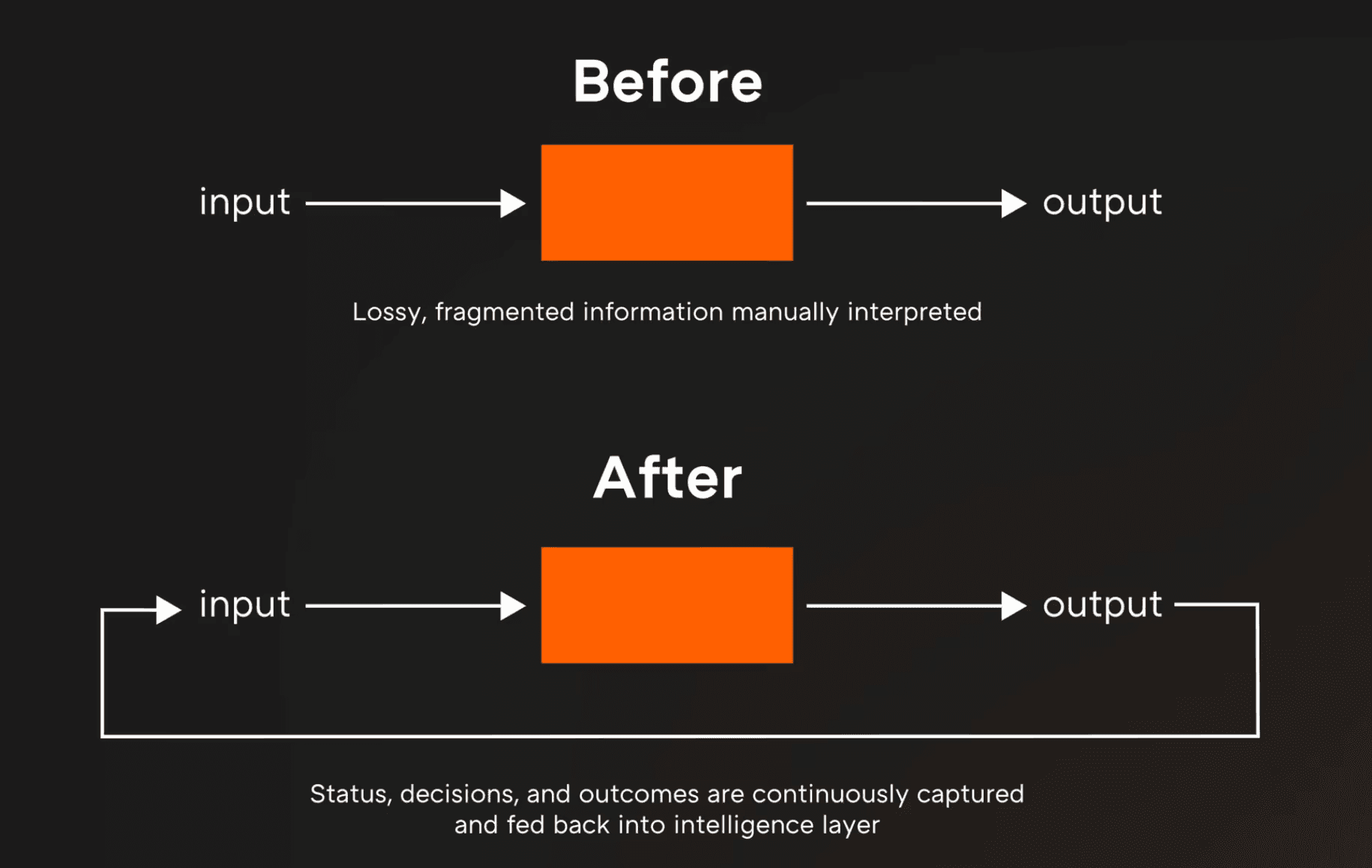
And 1 another way to design for continuous self-improvement of organization via using AI is capture useful data points across all kinds of work and have AI agents analyse multiple characteristics of these data-streams and help you improve everything from Sales, Ops, Engg, Product, Finance, etc.
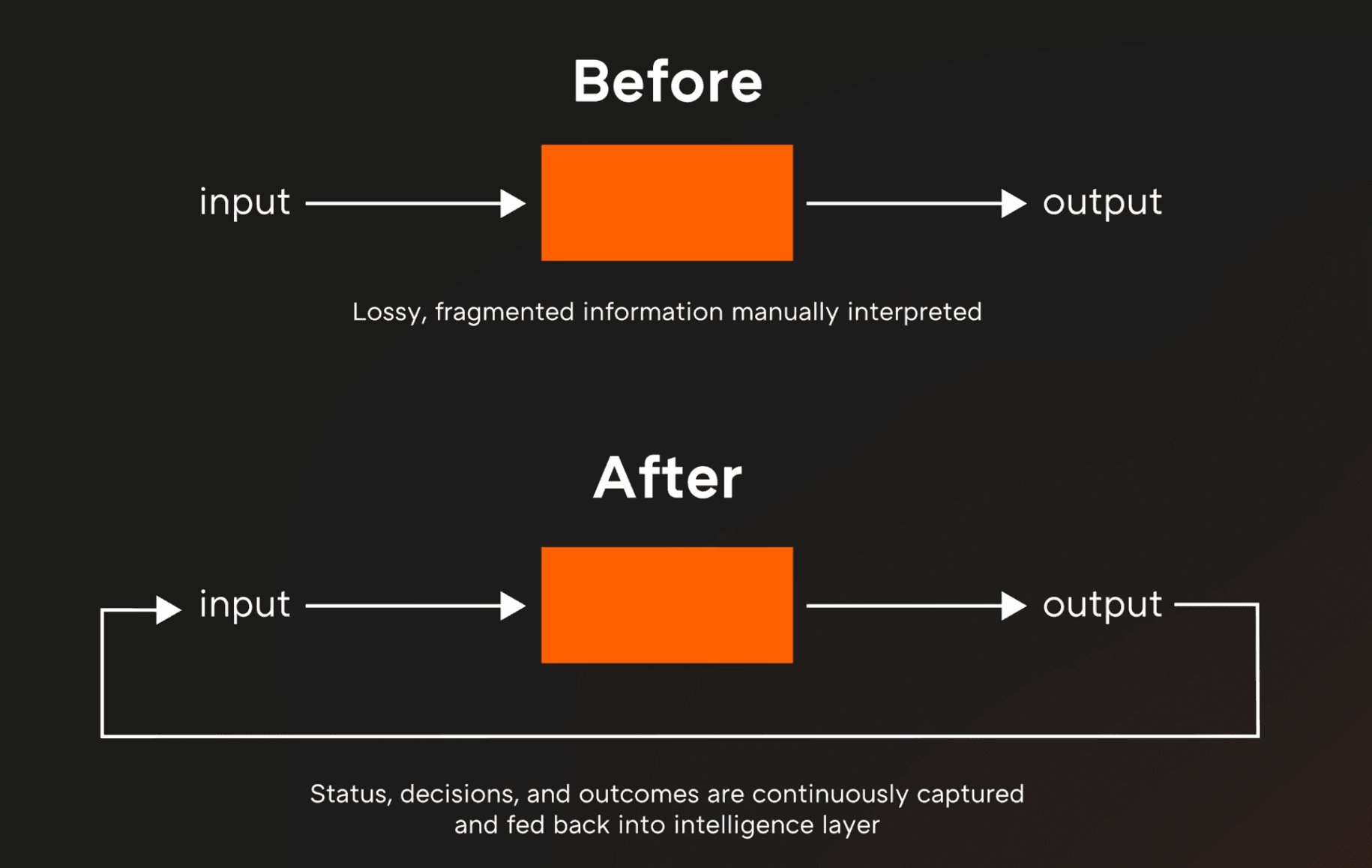
(Image Credits: Diana Hu's slide, in her YCombinator talk on AI Native companies)
At Riverline too, what we’re definitely focussing on next is building an intelligence layer of AI-agents that monitors different divisions and helps improve the organization via cadences and useful updates by analysing data-streams for us. Talk about a company that self-improves while the entire team sleeps 🛌
Hope this helps you also build the right mindset and a resourceful AI-native company :)
References
You can also create your team of AI-employees today with this - https://sanghvian.notion.site/The-new-age-of-AI-employees-30c381d768d6804ab56beb7f927c783b
Diana hu’s talk on building intelligence loops using AI-agents in a company -
My objective with this article is to encourage more people to reimagine processes in a new era of how businesses work, and make them leverage AI in a way that cuts down cost and increases profits.
This article is as much for the tech startup founder, as much as it is for the cottage-industry owner, to a medium sized business looking to expand.
This essay will have 2 parts → the mindset, and the immediate 2min actionable you can start with.
The mindset
“If you give me 6hrs to cut a tree, I’ll spend the first 5 sharpening the axe” ~ Anonymous
First it’s important to understand what AI has changed for businesses. It’s basically done 3 key things -
Complete automation of ops - “Automated information organization and communication work”. Let’s call this “Instruction work”.
Semi automation of strategy - “Made information analysis work easier and faster”. Let’s call this “Strategy work”.
Creative aid - “Given tools to amplify creative work”. Let’s call this “Creative work”.
Let’s take a basic example - previously - if you were a fashion store owner - here’s what you would do:
Instruction work - You (or your team) would spend time doing operational work of listing new products on website, going through order-requests, maintain balance sheets and invoices, maintain order statuses, continuously communicate with your supplier and customer, followup for customer support etc.
Strategy work - You would manually try to go over cost, pricing and revenue sheets of past couple months to brainstorm and come up with the next quarter’s growth plan. You would go readup on the industry statistics and competitors in the space to get an understanding of what next things you should launch or trends you need to be prepared for.
Creative work - You would come up with creative marketing content copy, designs for clothes, design of website etc.
Now what I listed above for a basic fashion business is no different from what even a food-delivery startup, or a B2B SaaS AI company, or an AI lab would do. Just the definitions of task, strategy and creative work change.
For an AI lab - ops work would be handling data-labelling at scale, strategy work might be - which market to target with their model release and creative work would be how to change the underlying architecture of their AI model.
Now that we’ve understood what’s changed - the most common mistake people most people make is trying to bolt AI onto existing teams and workflows. It’s like starting with a hammer and searching for a nail.
The approach people should be taking is asking where is my instruction work the most and how would I completely reimagine it with today’s AI capabilities? What would the team around it even look like. And that’s how we see some of the most successful use-cases of AI being customer-support automation because that’s where instruction work is the maximum. It instantly reduces cost and it makes business sense. And as Sam Walton says, every dollar you save in cost, you pass on to your customer in savings so you both can grow better.
AI is still nascent in strategy work, and more like a aid for creative work. Used right - it enables engineers to be 10x more productive, designers and business analysts to prototype 10x faster.
When do you know you’re AI-native as an org?
It’s simple - just ask yourself post adoption -
Would your org’s balance sheet (revenue and costs), be directly affected if AI would cease to function one-fine day? If yes, then you’re probably there already.
To illustrate, here’s what our company Riverline’s version of AI native org (as of April 2026) feels like. Riverline is in the business of making debt-collections systematic and scalable for banks in India. Here’s how we approach it by just asking - given a new problem, what’s the best AI-tool out there that could do this?
Instruction work - cost savings over past 3 months would be easily 15% given that we have a 2x more volume-handling customer-call-center. Less operational resource deployed on this lean setup allows us to pass on these cost savings to customers and grow fast.
Strategy work - cost savings over past 3 months, using AI saved us the cost, overhead, hiring and training effort for a standard business analyst (bringing down burn by 5%). Also, this analysis allows us to combine patterns and mix signals that are impossible to solve via a single business analyst, and attributes to revenue generation to better decisions.
Creative work - cost savings over past 3 months amount to >10% of our burn (assuming Claude code replaced 2 SDEs and had our designer create videos with AI)
All the above numbers are calculated by comparing to what we ourselves would’ve spent a year prior to get to similar business outcomes. We’ve done all of the above through a set of OpenClaw agents that operate like real employees and drive business value for us through innovation - Demo 1, Demo 2, Demo 3, Demo 4
And the above costs and benefits keep driving harder and harder, as the models keep getting better. It’s exactly what happened to the PC business back in the 80s as the silicon semiconductors kept following Murphy’s Law.
Another reason why being an early-adopter makes sense is because technology first brands historically have found better pools in talent and in partners because everyone likes to work with what’s at the forefront and learn. While this doesn’t directly show up on the balance sheet, it pretty much forms the foundation of the work.
The next actionables
So, if you want to get to said outcome - when encountering a problem, just bucket it as an instruction task, a strategy task, or a creative task and ask any favorite AI-agent of yours what tools/workflows serve your purpose the best.
And 1 another way to design for continuous self-improvement of organization via using AI is capture useful data points across all kinds of work and have AI agents analyse multiple characteristics of these data-streams and help you improve everything from Sales, Ops, Engg, Product, Finance, etc.
(Image Credits: Diana Hu's slide, in her YCombinator talk on AI Native companies)
At Riverline too, what we’re definitely focussing on next is building an intelligence layer of AI-agents that monitors different divisions and helps improve the organization via cadences and useful updates by analysing data-streams for us. Talk about a company that self-improves while the entire team sleeps 🛌
Hope this helps you also build the right mindset and a resourceful AI-native company :)
References
You can also create your team of AI-employees today with this - https://sanghvian.notion.site/The-new-age-of-AI-employees-30c381d768d6804ab56beb7f927c783b
Diana hu’s talk on building intelligence loops using AI-agents in a company -