

Cheque Bounce in India: Day-by-Day Timeline (and How to Settle Before Court)
Cheque Bounce in India: Day-by-Day Timeline (and How to Settle Before Court)
Abhishek Kumar

The cheque you wrote three months ago, for ₹2.4 lakh, to clear a vendor's invoice bounced last Tuesday. You found out from a courier-served notice. There's something about "Section 138" and "two years imprisonment." The notice gives you 15 days.
You haven't slept properly in three days.
Here's what nobody tells you: under Section 138 of the Negotiable Instruments Act, 1881, the 15-day window in the demand notice is actually the most important moment in the process. The system is designed to give the drawer a final chance to pay before criminal proceedings begin. Most cases that go to court could have been resolved in this window.
Let me walk you through the legal timeline, day by day.
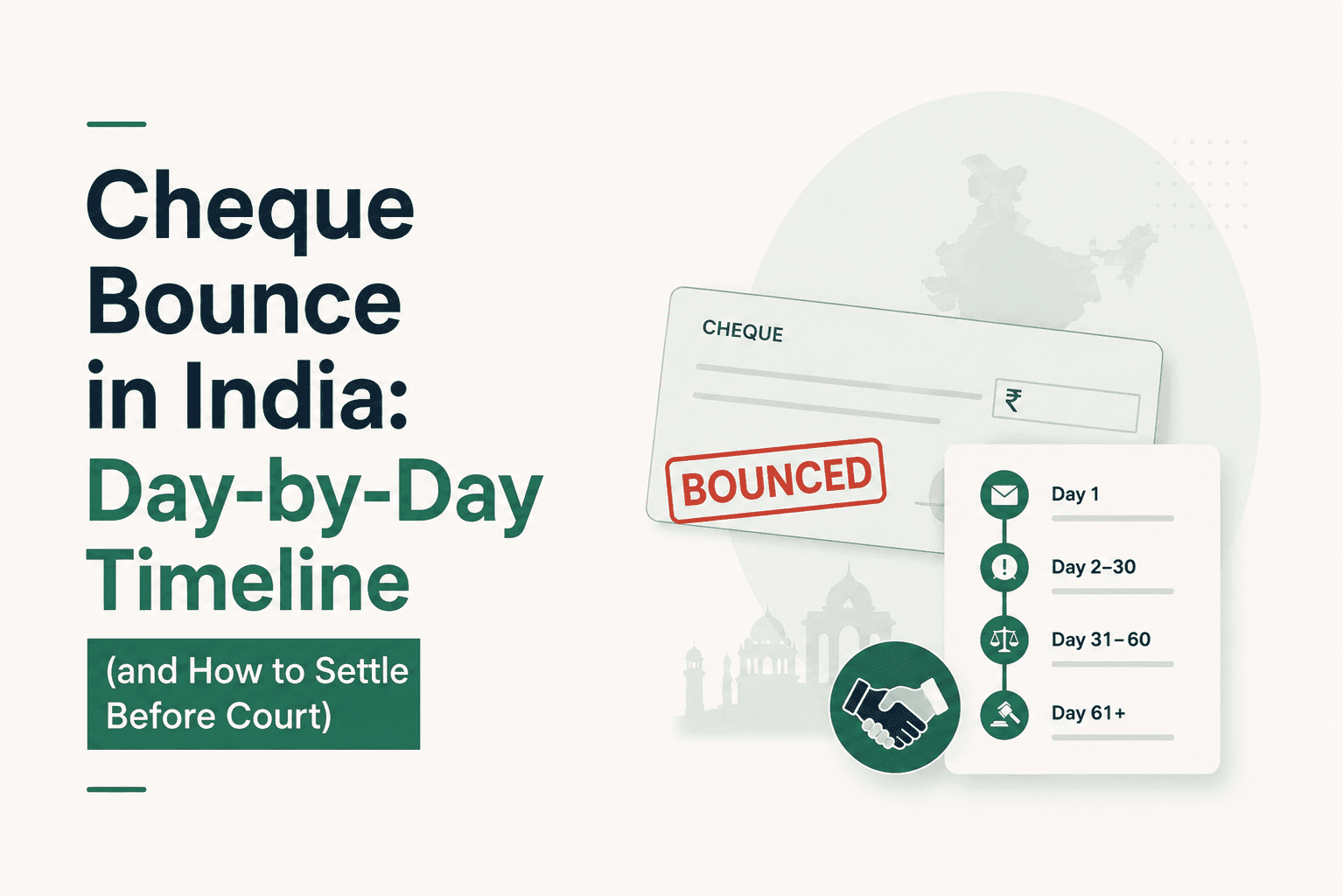
Day 0 — The cheque bounces. The bank returns the cheque with a "reason" memo. The most common reasons: insufficient funds, signature mismatch, account closed, payment stopped. The payee (the person who deposited your cheque) collects this memo from their bank. This is the document that starts every Section 138 case.
Day 1 to 30 — The 30-day notice window opens. Under Section 138(b) of the Act, the payee has 30 days from the date of the bounce memo to send you a formal demand notice via registered post. If they miss this 30-day window, the criminal cause of action under Section 138 lapses. Most don't miss it.
Day 30 to 45 — The demand notice reaches you. This is the document that gives you 15 days to pay. Whatever the cheque was for, you now owe that amount immediately.
This is the critical window. Under Section 138(c), if you pay the full amount within 15 days of receiving the demand notice, the criminal case under Section 138 cannot be filed against you. The case dies before it starts.
Day 45 to 75 — If you didn't pay, the case is filed. The payee has 30 days from the end of your 15-day window to file a complaint before a Judicial Magistrate First Class. Once filed, you're now in the criminal justice system.
Day 75 to 120 — Court summons arrives. You receive a summons. You hire a lawyer. The case enters the court's docket.
Day 120 onwards — The hearings. Cheque bounce cases in India typically take 1 to 3 years through repeated hearings, though the Supreme Court has on several occasions urged expedited disposal.
Throughout — settlement is always possible. At any stage — even after summons, even during trial — you can settle by paying the principal amount along with any damages the court awards. Many Section 138 cases are compounded or settled during proceedings.
What to actually do
If you've just received a demand notice:
Read it carefully. Confirm the amount, the date of the bounced cheque, and the 15-day window.
Pay the full amount within the 15 days if you can. Send it via NEFT/RTGS to a verified bank account, with a covering letter stating "in full and final settlement of bounced cheque dated [date] for ₹[amount]." Get the payee to sign a receipt acknowledging this.
If you can't pay in full, write to the payee within the 15 days proposing a payment schedule. Many payees prefer guaranteed money to a multi-year court case and accept negotiated settlements, but this is at their discretion.
If the payee refuses and a complaint is filed, hire a lawyer immediately. The case is defensible if you have evidence of a bona fide commercial dispute (you didn't intend to deceive), though defence is fact-specific.
The jail question. Section 138 provides for imprisonment of up to two years, or a fine which may extend to twice the amount of the cheque, or both. In practice, sentences vary widely by court and circumstance. Some courts impose fines; others impose imprisonment, especially in repeat-offender or fraud cases. The penalty is real — but court outcomes are not predictable by category. Ignoring the notice is genuinely dangerous: a non-bailable warrant can be issued for non-appearance.
The bottom line. A cheque bounce is best resolved as a financial problem rather than a criminal one — and the cleanest way is to pay within 15 days of the demand notice. Beyond that window, settlement is still possible at every stage of the case, but you've added years and legal fees to the process. Pay early if you can.
A note from Riverline. This article is for educational purposes only and is not legal or financial advice. Statutes and credit-bureau rules cited are accurate as of May 2026 and may be amended later. Specific facts vary by case — for action on your situation, consult a qualified advocate, chartered accountant, or RBI-recognised credit counsellor.
Primary sources referenced: Negotiable Instruments Act 1881 · Indian Contract Act 1872 · Chit Funds Act 1982 · The Tamil Nadu Money Lending Entities (Prevention of Coercive Actions) Act, 2025 (Act 40 of 2025) · Bharatiya Nyaya Sanhita 2023 · RBI Fair Practices Code for Lenders · CIBIL/TransUnion India dispute portal at cibil.com.
The cheque you wrote three months ago, for ₹2.4 lakh, to clear a vendor's invoice bounced last Tuesday. You found out from a courier-served notice. There's something about "Section 138" and "two years imprisonment." The notice gives you 15 days.
You haven't slept properly in three days.
Here's what nobody tells you: under Section 138 of the Negotiable Instruments Act, 1881, the 15-day window in the demand notice is actually the most important moment in the process. The system is designed to give the drawer a final chance to pay before criminal proceedings begin. Most cases that go to court could have been resolved in this window.
Let me walk you through the legal timeline, day by day.
Day 0 — The cheque bounces. The bank returns the cheque with a "reason" memo. The most common reasons: insufficient funds, signature mismatch, account closed, payment stopped. The payee (the person who deposited your cheque) collects this memo from their bank. This is the document that starts every Section 138 case.
Day 1 to 30 — The 30-day notice window opens. Under Section 138(b) of the Act, the payee has 30 days from the date of the bounce memo to send you a formal demand notice via registered post. If they miss this 30-day window, the criminal cause of action under Section 138 lapses. Most don't miss it.
Day 30 to 45 — The demand notice reaches you. This is the document that gives you 15 days to pay. Whatever the cheque was for, you now owe that amount immediately.
This is the critical window. Under Section 138(c), if you pay the full amount within 15 days of receiving the demand notice, the criminal case under Section 138 cannot be filed against you. The case dies before it starts.
Day 45 to 75 — If you didn't pay, the case is filed. The payee has 30 days from the end of your 15-day window to file a complaint before a Judicial Magistrate First Class. Once filed, you're now in the criminal justice system.
Day 75 to 120 — Court summons arrives. You receive a summons. You hire a lawyer. The case enters the court's docket.
Day 120 onwards — The hearings. Cheque bounce cases in India typically take 1 to 3 years through repeated hearings, though the Supreme Court has on several occasions urged expedited disposal.
Throughout — settlement is always possible. At any stage — even after summons, even during trial — you can settle by paying the principal amount along with any damages the court awards. Many Section 138 cases are compounded or settled during proceedings.
What to actually do
If you've just received a demand notice:
Read it carefully. Confirm the amount, the date of the bounced cheque, and the 15-day window.
Pay the full amount within the 15 days if you can. Send it via NEFT/RTGS to a verified bank account, with a covering letter stating "in full and final settlement of bounced cheque dated [date] for ₹[amount]." Get the payee to sign a receipt acknowledging this.
If you can't pay in full, write to the payee within the 15 days proposing a payment schedule. Many payees prefer guaranteed money to a multi-year court case and accept negotiated settlements, but this is at their discretion.
If the payee refuses and a complaint is filed, hire a lawyer immediately. The case is defensible if you have evidence of a bona fide commercial dispute (you didn't intend to deceive), though defence is fact-specific.
The jail question. Section 138 provides for imprisonment of up to two years, or a fine which may extend to twice the amount of the cheque, or both. In practice, sentences vary widely by court and circumstance. Some courts impose fines; others impose imprisonment, especially in repeat-offender or fraud cases. The penalty is real — but court outcomes are not predictable by category. Ignoring the notice is genuinely dangerous: a non-bailable warrant can be issued for non-appearance.
The bottom line. A cheque bounce is best resolved as a financial problem rather than a criminal one — and the cleanest way is to pay within 15 days of the demand notice. Beyond that window, settlement is still possible at every stage of the case, but you've added years and legal fees to the process. Pay early if you can.
A note from Riverline. This article is for educational purposes only and is not legal or financial advice. Statutes and credit-bureau rules cited are accurate as of May 2026 and may be amended later. Specific facts vary by case — for action on your situation, consult a qualified advocate, chartered accountant, or RBI-recognised credit counsellor.
Primary sources referenced: Negotiable Instruments Act 1881 · Indian Contract Act 1872 · Chit Funds Act 1982 · The Tamil Nadu Money Lending Entities (Prevention of Coercive Actions) Act, 2025 (Act 40 of 2025) · Bharatiya Nyaya Sanhita 2023 · RBI Fair Practices Code for Lenders · CIBIL/TransUnion India dispute portal at cibil.com.