
Smaller is better: Moving from LLMs to SLMs
Smaller is better: Moving from LLMs to SLMs
Jayanth Krishnaprakash

n the early days of the AI boom (just 3 years back), the playbook was straightforward: if you wanted better results, you reached for a bigger model. Large Language Models (LLMs) were treated like all-knowing generalists capable of reasoning, coding, analyzing, summarizing, and chatting, all in one body. Bigger meant smarter, and smarter meant better.
That logic is starting to break down. As we move from demos to production systems, it’s becoming clear that bigger is not always better. The future of agentic AI is not about ever-expanding generalists. It is about specialization at scale. This is the Specialist Revolution.
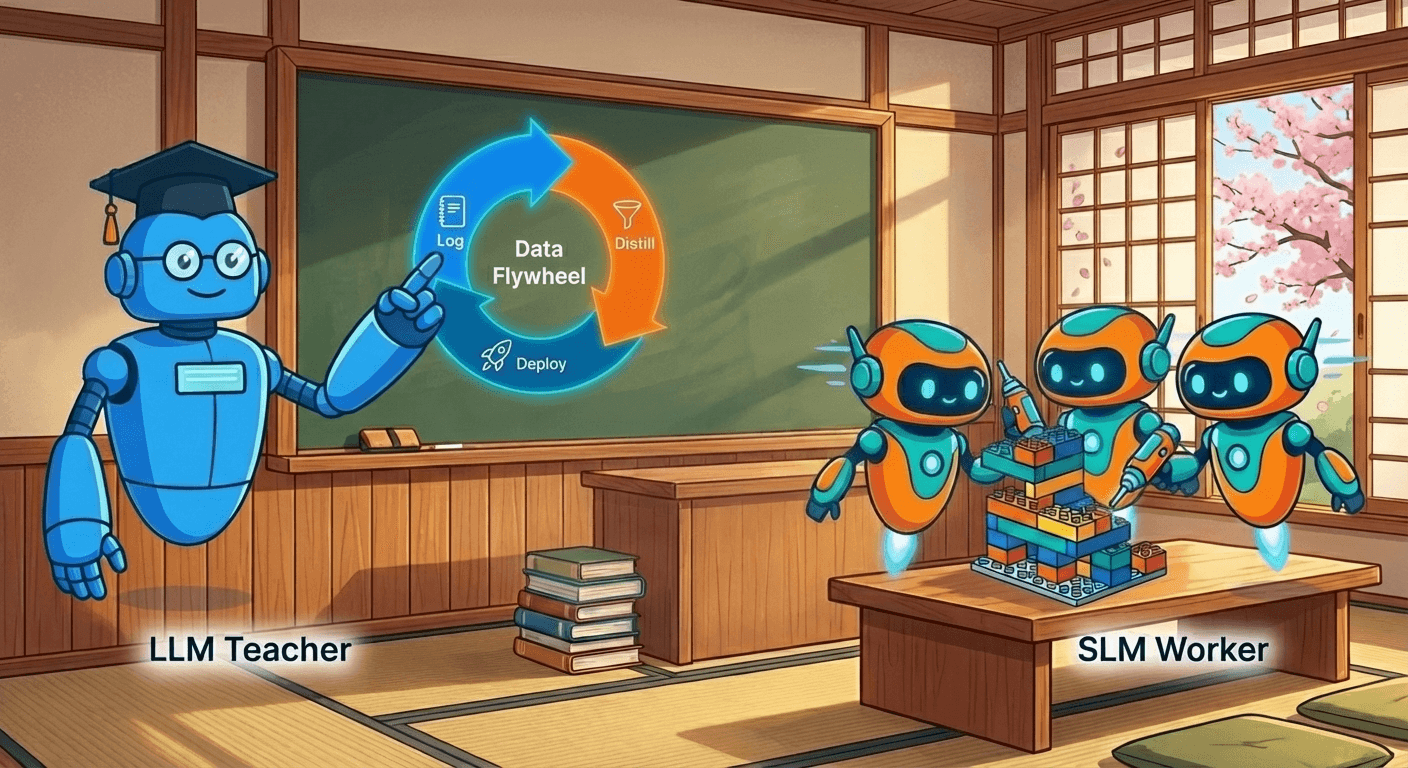
To put it simple, LLMs are teachers and SLMs are workers.
The Generalist Trap
Today, much of the industry is stuck in what can only be described as the Generalist Trap. We routinely deploy frontier models with billions of parameters to perform narrow, repetitive, and highly specific tasks like data extraction, classification, routing, validation. These models can do the job, but they are doing it inefficiently. Using an LLM for such tasks is like asking:
“Why employ a PhD in literature to do data entry?”
The PhD can do it, but they are overqualified, expensive, and slow relative to a trained specialist. In the same way, we are choosing a generalist over a superior specialist, paying for excess intelligence we neither need nor effectively use. The result is higher latency, higher cost, and systems that are operationally fragile. This is not a model capability problem. It is an architecture problem.
Agents as Narrow Interfaces
To escape the Generalist Trap, we need to rethink what an agent actually is. It is a gateway that allows a generalist model to temporarily act like a specialist while we learn the task. When you first build an agent, you absolutely should use an LLM. The LLM is excellent at exploring solution space, handling edge cases, and figuring out how a task should be done. But this phase is transitional.
Every interaction an LLM has with your tools, data, and users produces something valuable: training data. Inputs, outputs, reasoning traces, failures, and corrections form a data flywheel. By logging everything, you are implicitly collecting the dataset required to train a smaller model that can perform the same task deterministically and cheaply. The core shift is using LLMs not as permanent workers, but as teachers that bootstrap specialization.
The LLM to SLM Pipeline
Moving from a generalist teacher to a specialist worker is not accidental. It follows a deliberate pipeline:
First, log everything. Every prompt, tool call, response, and failure case must be captured. This is not observability for debugging, but it is data collection for distillation.
Next, distill and fine-tune. The logged interactions are used to train a Small Language Model (SLM) to replicate the correct behavior of the LLM on that narrow task. The goal is not general intelligence; it is task mastery.
Then, verify and evaluate. The SLM must be tested against the same benchmarks and edge cases that the LLM handled. If it cannot match specialist performance, it does not ship.
Finally, deploy. The expensive generalist is replaced with a lean, fast, specialized worker.
In short: log everything, distill, verify, deploy. This is how agent systems become sustainable instead of perpetually experimental.
Why SLMs Win Operationally
The real advantage of SLMs is operational sustainability. When you move to a Lego-like composition of specialized experts, the system changes fundamentally.
Latency collapses. SLMs run in milliseconds, not seconds, and they do not stall under load. Throughput increases because they can be deployed cheaply and replicated freely.
Cost drops dramatically. An SLM fine-tuned for a single task is orders of magnitude cheaper than routing every request through a frontier model API.
Deployment becomes flexible. SLMs are small enough to run on cheaper hardware, on-prem setups, or edge devices. This reduces dependency on centralized providers and improves data privacy.
This is why SLMs are the future of AI. They allow systems to scale in volume without scaling cost linearly with usage.
Handling the Hard Cases: The Hybrid Design
While we talk about SLMs, the obvious concern is correctness. What happens when an SLM encounters an input outside its comfort zone or an unexpected edge case the LLM would have handled gracefully? The answer is not to abandon specialization, but to design for fallback.
In a hybrid architecture, the SLM produces not just an output, but a confidence score. When confidence is high, the SLM executes autonomously. When confidence falls below a threshold, the system escalates. But below a threshold we can ask the LLM to handle it.
This pattern preserves correctness while retaining efficiency. The SLM handles the majority of traffic quickly and cheaply, while the LLM is reserved for genuinely hard cases. The PhD is still available, but only when needed.
The era of brute-forcing AI with ever-larger models is ending. As systems become more complex and more embedded in real workflows, intelligence becomes most valuable when it is focused. The future is not bigger models, but it’s better specialization.
n the early days of the AI boom (just 3 years back), the playbook was straightforward: if you wanted better results, you reached for a bigger model. Large Language Models (LLMs) were treated like all-knowing generalists capable of reasoning, coding, analyzing, summarizing, and chatting, all in one body. Bigger meant smarter, and smarter meant better.
That logic is starting to break down. As we move from demos to production systems, it’s becoming clear that bigger is not always better. The future of agentic AI is not about ever-expanding generalists. It is about specialization at scale. This is the Specialist Revolution.
To put it simple, LLMs are teachers and SLMs are workers.
The Generalist Trap
Today, much of the industry is stuck in what can only be described as the Generalist Trap. We routinely deploy frontier models with billions of parameters to perform narrow, repetitive, and highly specific tasks like data extraction, classification, routing, validation. These models can do the job, but they are doing it inefficiently. Using an LLM for such tasks is like asking:
“Why employ a PhD in literature to do data entry?”
The PhD can do it, but they are overqualified, expensive, and slow relative to a trained specialist. In the same way, we are choosing a generalist over a superior specialist, paying for excess intelligence we neither need nor effectively use. The result is higher latency, higher cost, and systems that are operationally fragile. This is not a model capability problem. It is an architecture problem.
Agents as Narrow Interfaces
To escape the Generalist Trap, we need to rethink what an agent actually is. It is a gateway that allows a generalist model to temporarily act like a specialist while we learn the task. When you first build an agent, you absolutely should use an LLM. The LLM is excellent at exploring solution space, handling edge cases, and figuring out how a task should be done. But this phase is transitional.
Every interaction an LLM has with your tools, data, and users produces something valuable: training data. Inputs, outputs, reasoning traces, failures, and corrections form a data flywheel. By logging everything, you are implicitly collecting the dataset required to train a smaller model that can perform the same task deterministically and cheaply. The core shift is using LLMs not as permanent workers, but as teachers that bootstrap specialization.
The LLM to SLM Pipeline
Moving from a generalist teacher to a specialist worker is not accidental. It follows a deliberate pipeline:
First, log everything. Every prompt, tool call, response, and failure case must be captured. This is not observability for debugging, but it is data collection for distillation.
Next, distill and fine-tune. The logged interactions are used to train a Small Language Model (SLM) to replicate the correct behavior of the LLM on that narrow task. The goal is not general intelligence; it is task mastery.
Then, verify and evaluate. The SLM must be tested against the same benchmarks and edge cases that the LLM handled. If it cannot match specialist performance, it does not ship.
Finally, deploy. The expensive generalist is replaced with a lean, fast, specialized worker.
In short: log everything, distill, verify, deploy. This is how agent systems become sustainable instead of perpetually experimental.
Why SLMs Win Operationally
The real advantage of SLMs is operational sustainability. When you move to a Lego-like composition of specialized experts, the system changes fundamentally.
Latency collapses. SLMs run in milliseconds, not seconds, and they do not stall under load. Throughput increases because they can be deployed cheaply and replicated freely.
Cost drops dramatically. An SLM fine-tuned for a single task is orders of magnitude cheaper than routing every request through a frontier model API.
Deployment becomes flexible. SLMs are small enough to run on cheaper hardware, on-prem setups, or edge devices. This reduces dependency on centralized providers and improves data privacy.
This is why SLMs are the future of AI. They allow systems to scale in volume without scaling cost linearly with usage.
Handling the Hard Cases: The Hybrid Design
While we talk about SLMs, the obvious concern is correctness. What happens when an SLM encounters an input outside its comfort zone or an unexpected edge case the LLM would have handled gracefully? The answer is not to abandon specialization, but to design for fallback.
In a hybrid architecture, the SLM produces not just an output, but a confidence score. When confidence is high, the SLM executes autonomously. When confidence falls below a threshold, the system escalates. But below a threshold we can ask the LLM to handle it.
This pattern preserves correctness while retaining efficiency. The SLM handles the majority of traffic quickly and cheaply, while the LLM is reserved for genuinely hard cases. The PhD is still available, but only when needed.
The era of brute-forcing AI with ever-larger models is ending. As systems become more complex and more embedded in real workflows, intelligence becomes most valuable when it is focused. The future is not bigger models, but it’s better specialization.