


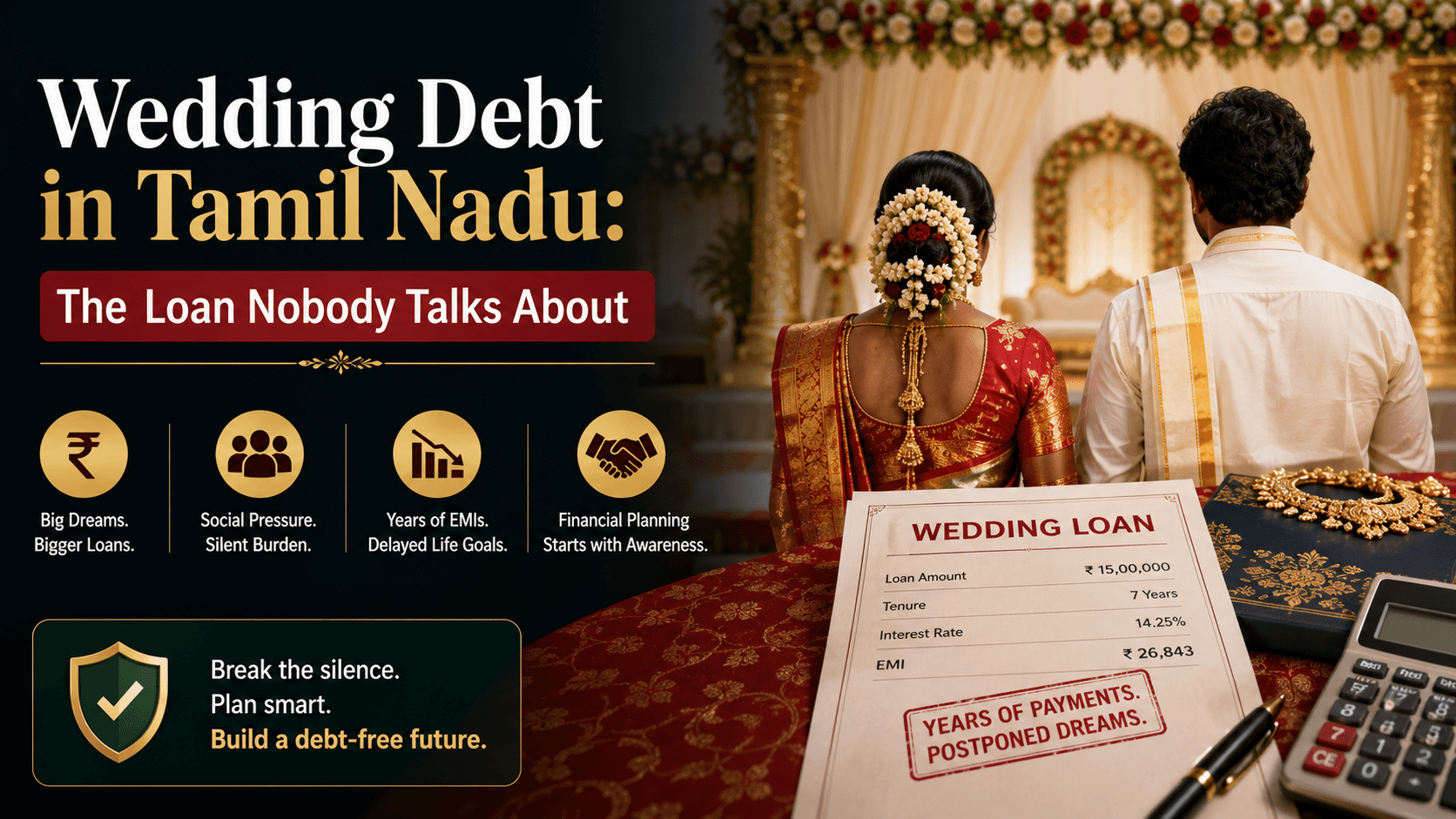
A friend's family in Tirunelveli recently wrapped up a "modest" wedding. Hall, catering, gold, two reception dinners, photographer, three sets of clothes for the bride, the mandatory return-gift bundles. Final spend: ₹14 lakh. Of that, ₹9 lakh was borrowed gold loan on the mother's jewellery, a personal loan in the father's name, a top-up on the brother's home loan, and an informal hand from a neighbour at 24%.
The wedding lasted three days. The EMIs will last seven years.
This isn't a rare story. It is, quietly, one of the most common forms of household debt distress in Tamil Nadu, and almost nobody talks about it because the social cost of doing the wedding "small" feels worse than the financial cost of doing it big.
Why wedding debt is uniquely dangerous
A wedding loan looks like any other loan on paper. It is not.
It funds consumption, not an asset. A home loan buys a house that can be sold or rented. A wedding loan buys a memory.
It bunches across multiple lenders. Most families take three or four loans for one event. None of the lenders knows the full picture.
It is repaid out of post-wedding income that often has not been planned for. A new son-in-law's salary is assumed to cover what the bride's family borrowed. He often hasn't agreed to this.
It is taboo to discuss. Families that would happily complain about a car-loan EMI never mention the wedding EMI to friends or relatives.
The result, the burden ratio inside many TN households post-wedding sits between 50% and 80%, well into the distress range, without anyone outside the family knowing.
What a right-sized wedding budget looks like
There is no rule that says a wedding must cost what the social expectation says. A useful rule of thumb borrowed from financial planners:
Total wedding spend should not exceed one year of net household income.
A family with combined take-home of ₹6 lakh a year should plan a wedding under ₹6 lakh. That can absolutely include a hall, catering, gold within reason, and a respectable reception. What it cannot include is competing with the neighbours.
The harder rule — borrowed money for the wedding should not exceed 30% of total spend. That keeps the EMI-to-income ratio inside a survivable range.
If the wedding has already happened, and the debt is heavy
This is the situation most families come to us in. Six months in, the EMIs are stacking, the new couple is figuring out their own household, and the parents are quietly skipping medication to keep up.
The playbook is the same as for any other debt distress:
Lay out every loan on one page: lender, outstanding, EMI, rate, missed EMIs. Most families have never done this for the wedding stack because the loans were taken separately.
Compute the burden ratio: total EMIs ÷ household income. If it's above 60%, intervention is needed.
Consolidate where possible. The expensive informal loan (24%+) should be replaced first, possibly with a gold-loan top-up or a properly-priced personal loan.
Restructure the formal loans. Banks restructure if you ask before you default. Approach the recovery desk with a hardship letter.
Bring the couple into the conversation. Most parents try to absorb the burden silently. The couple usually wants to help once they know.
For the next wedding in the family
Three things to do before the budget gets approved.
Write down the cap before any vendor conversations. Once the hall is booked at ₹3 lakh, everything else inflates to match it.
Decide who is borrowing what, and in whose name. Loans taken "for the family" without a clear repayment owner are the ones that destroy households later.
Have one honest conversation with the in-laws about expectations. This is the hardest conversation and the one that saves the most money.
The bottom line. The wedding is one day. The marriage is the rest of your life. The debt is somewhere in between and it should not outlast either.
A friend's family in Tirunelveli recently wrapped up a "modest" wedding. Hall, catering, gold, two reception dinners, photographer, three sets of clothes for the bride, the mandatory return-gift bundles. Final spend: ₹14 lakh. Of that, ₹9 lakh was borrowed gold loan on the mother's jewellery, a personal loan in the father's name, a top-up on the brother's home loan, and an informal hand from a neighbour at 24%.
The wedding lasted three days. The EMIs will last seven years.
This isn't a rare story. It is, quietly, one of the most common forms of household debt distress in Tamil Nadu, and almost nobody talks about it because the social cost of doing the wedding "small" feels worse than the financial cost of doing it big.
Why wedding debt is uniquely dangerous
A wedding loan looks like any other loan on paper. It is not.
It funds consumption, not an asset. A home loan buys a house that can be sold or rented. A wedding loan buys a memory.
It bunches across multiple lenders. Most families take three or four loans for one event. None of the lenders knows the full picture.
It is repaid out of post-wedding income that often has not been planned for. A new son-in-law's salary is assumed to cover what the bride's family borrowed. He often hasn't agreed to this.
It is taboo to discuss. Families that would happily complain about a car-loan EMI never mention the wedding EMI to friends or relatives.
The result, the burden ratio inside many TN households post-wedding sits between 50% and 80%, well into the distress range, without anyone outside the family knowing.
What a right-sized wedding budget looks like
There is no rule that says a wedding must cost what the social expectation says. A useful rule of thumb borrowed from financial planners:
Total wedding spend should not exceed one year of net household income.
A family with combined take-home of ₹6 lakh a year should plan a wedding under ₹6 lakh. That can absolutely include a hall, catering, gold within reason, and a respectable reception. What it cannot include is competing with the neighbours.
The harder rule — borrowed money for the wedding should not exceed 30% of total spend. That keeps the EMI-to-income ratio inside a survivable range.
If the wedding has already happened, and the debt is heavy
This is the situation most families come to us in. Six months in, the EMIs are stacking, the new couple is figuring out their own household, and the parents are quietly skipping medication to keep up.
The playbook is the same as for any other debt distress:
Lay out every loan on one page: lender, outstanding, EMI, rate, missed EMIs. Most families have never done this for the wedding stack because the loans were taken separately.
Compute the burden ratio: total EMIs ÷ household income. If it's above 60%, intervention is needed.
Consolidate where possible. The expensive informal loan (24%+) should be replaced first, possibly with a gold-loan top-up or a properly-priced personal loan.
Restructure the formal loans. Banks restructure if you ask before you default. Approach the recovery desk with a hardship letter.
Bring the couple into the conversation. Most parents try to absorb the burden silently. The couple usually wants to help once they know.
For the next wedding in the family
Three things to do before the budget gets approved.
Write down the cap before any vendor conversations. Once the hall is booked at ₹3 lakh, everything else inflates to match it.
Decide who is borrowing what, and in whose name. Loans taken "for the family" without a clear repayment owner are the ones that destroy households later.
Have one honest conversation with the in-laws about expectations. This is the hardest conversation and the one that saves the most money.
The bottom line. The wedding is one day. The marriage is the rest of your life. The debt is somewhere in between and it should not outlast either.