


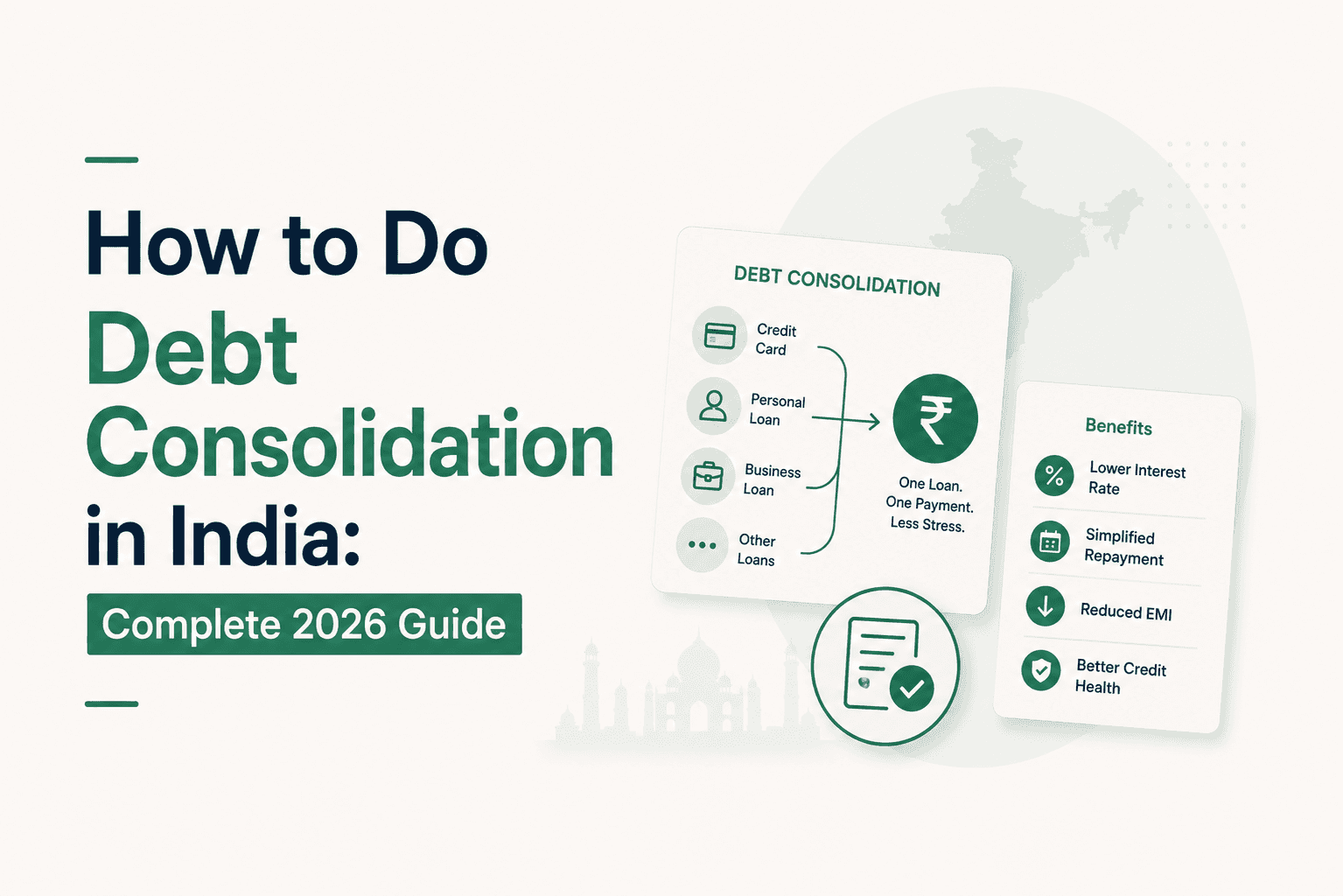
You have a personal loan at 18%, a credit card rolling at 36%, a two-wheeler loan at 14%, and maybe a gold loan you took during an emergency. Four different EMI dates, four different interest rates, four different apps sending you reminders. It's exhausting and it's costing you more than you think.
Debt consolidation means combining multiple debts into a single payment, usually at a lower interest rate. Done right, it can save you ₹50,000-2,00,000 in interest and turn financial chaos into one manageable monthly outflow.
But here's what most guides won't tell you: not every consolidation method works for every situation. The right approach depends on your total debt, your credit score, and whether your debts are overdue. This guide covers all your options — honestly.
What Is Debt Consolidation and How Does It Work?
Debt consolidation is straightforward: you take one new loan (or use one strategy) to pay off multiple existing debts. Instead of paying 4-5 different EMIs at different interest rates, you pay one EMI at one rate.
The math is simple. Say you have:
• Credit card: ₹1.5 lakh at 36% APR (₹7,500/month minimum)
• Personal loan: ₹3 lakh at 18% (₹7,350/month EMI)
• Two-wheeler loan: ₹1 lakh at 14% (₹2,800/month EMI)
• Total: ₹5.5 lakh across 3 debts, ₹17,650/month total
A consolidation loan at 12% for 5 years: one EMI of ₹12,240/month. That's ₹5,410 less per month, and you'll save over ₹1.2 lakh in total interest.
5 Debt Consolidation Options in India (Ranked by Situation)
Option 1: Personal Loan for Debt Consolidation
Best for: People with credit scores above 700, total debt under ₹10 lakh
This is the most common approach. You take a new personal loan at a lower interest rate and use it to pay off all your higher-interest debts.
Interest rates: 10.5%-16% (vs. 24-42% on credit cards)
Tenure: 1-5 years
Eligibility: Minimum credit score 700+, stable income, employment for 1+ years
Banks that offer debt consolidation personal loans may approve scores down to 650 but at higher rates (14-22%).
Pros: Lowest interest rate option, fixed EMI, clear payoff date
Cons: Requires good credit score, adds a new loan to your report
Option 2: Balance Transfer (Credit Card Debt)
Best for: People with credit card debt who can get a new card with a 0% transfer offer
Some banks offer balance transfer credit cards with 0% interest for 3-6 months on transferred balances. After the promotional period, the rate reverts to the standard 36-42%.
Where to find these offers: Major private-sector and foreign banks periodically offer balance-transfer promotions on select credit cards.
Transfer fee: 1-3% of the transferred amount
Critical rule: You MUST pay off the transferred balance before the promotional period ends, or you're worse off than before.
Pros: Can be 0% interest for months
Cons: Only for credit card debt, short window, requires good score for approval
Option 3: Loan Against Property or Gold Loan
Best for: People with assets but poor credit scores
If your credit score is too low for an unsecured personal loan, a secured loan against your property or gold can consolidate your debts at much lower rates.
Gold loan rates: 7-12% (Major Public and Private sector banks)
Loan against property rates: 8.5-12%
Risk: You could lose your asset if you default
Pros: Available even with poor credit, lowest interest rates
Cons: Puts your asset at risk, longer processing time
Option 4: Debt Management Plan (DMP)
Best for: People who are already behind on payments and can't get new credit
A debt management plan involves working with a credit counselor who negotiates with your lenders for lower interest rates, waived fees, or extended repayment periods. You make one monthly payment to the counselor, who distributes it to your creditors.
Riverline's AI-powered counselors (planned to roll out in July 2026) would negotiate across multiple lenders simultaneously, often achieving better terms because the AI analyzes thousands of similar cases to find the optimal negotiation strategy.
Pros: Available even with poor credit and overdue accounts, can reduce total debt
Cons: May temporarily affect credit score, takes 12-36 months
Option 5: Debt Settlement (For Severely Overdue Debts)
Best for: People with debts in default or NPA status who cannot pay the full amount
When you genuinely can't repay the full amount, debt settlement lets you negotiate to pay 40-70% of what you owe and close the account. This is different from consolidation — you're reducing the total debt, not just restructuring it.
Typical settlements: 40-70% of outstanding amount
Timeline: 2-6 months
Credit impact: Settlement hurts your score (-75 to -100 points) but is much better than write-off (-150 to -200 points), and it stops the bleeding
Pros: Reduces total debt, available for worst-case situations
Cons: Credit score impact, not all lenders agree to settle
How to Choose the Right Debt Consolidation Method
Here's a quick decision tree:
Is your credit score above 700? → Personal consolidation loan (Option 1)
Is your debt mainly credit cards? → Balance transfer (Option 2)
Do you have gold or property? → Secured loan (Option 3)
Are you behind on payments but can still pay monthly? → Debt management plan (Option 4)
Are debts in default and you can't pay the full amount? → Debt settlement (Option 5)
Step-by-Step: How to Do Debt Consolidation in India
Step 1: List all your debts
Write down every debt: amount, interest rate, monthly payment, and status (current, overdue, defaulted). Total them up. This is your baseline.
Step 2: Check your credit score
Download your free Credit report. Your score determines which consolidation options are available to you.
Step 3: Calculate the math
For each consolidation option, calculate: new monthly payment, total interest over the loan term, and total cost vs. current path. Only consolidate if the math actually saves you money.
Step 4: Apply for the right option
Based on your score and situation, apply for one consolidation method. Don't apply to multiple lenders simultaneously — each hard inquiry drops your score.
Step 5: Pay off existing debts immediately
Once the consolidation loan is disbursed, pay off all existing debts the same day. Don't keep the money in your account — the temptation to spend it is real.
Step 6: Don't create new debt
This is the hardest part. Cut up the credit cards you just paid off (but don't close the accounts — they help your credit age). Consolidation only works if you stop accumulating new debt.
Common Mistakes People Make With Debt Consolidation
Mistake 1: Consolidating without fixing the habit
If overspending caused the debt, a consolidation loan just delays the problem. Fix the spending first.
Mistake 2: Choosing a longer tenure to reduce EMI
A 7-year tenure means lower EMIs but much more total interest. Always pick the shortest tenure you can afford.
Mistake 3: Taking a consolidation loan and keeping old credit active
Paying off credit cards with a consolidation loan then running up the cards again is the fastest path to financial disaster.
Mistake 4: Not comparing enough options
Interest rates vary 3-8% between lenders. A 3% rate difference on ₹5 lakh over 5 years = ₹48,000 in savings. Compare at least 3-4 lenders.
The Bottom Line
Debt consolidation isn't magic, it's math. If you can get a lower interest rate and stick to the repayment plan, it works. If your debts are severely overdue, settlement might be the better path, reducing what you owe rather than just restructuring it.
The worst thing you can do? Nothing. Every month you juggle high-interest debts is money burned. Pick the option that fits your situation, do the math, and act.
You have a personal loan at 18%, a credit card rolling at 36%, a two-wheeler loan at 14%, and maybe a gold loan you took during an emergency. Four different EMI dates, four different interest rates, four different apps sending you reminders. It's exhausting and it's costing you more than you think.
Debt consolidation means combining multiple debts into a single payment, usually at a lower interest rate. Done right, it can save you ₹50,000-2,00,000 in interest and turn financial chaos into one manageable monthly outflow.
But here's what most guides won't tell you: not every consolidation method works for every situation. The right approach depends on your total debt, your credit score, and whether your debts are overdue. This guide covers all your options — honestly.
What Is Debt Consolidation and How Does It Work?
Debt consolidation is straightforward: you take one new loan (or use one strategy) to pay off multiple existing debts. Instead of paying 4-5 different EMIs at different interest rates, you pay one EMI at one rate.
The math is simple. Say you have:
• Credit card: ₹1.5 lakh at 36% APR (₹7,500/month minimum)
• Personal loan: ₹3 lakh at 18% (₹7,350/month EMI)
• Two-wheeler loan: ₹1 lakh at 14% (₹2,800/month EMI)
• Total: ₹5.5 lakh across 3 debts, ₹17,650/month total
A consolidation loan at 12% for 5 years: one EMI of ₹12,240/month. That's ₹5,410 less per month, and you'll save over ₹1.2 lakh in total interest.
5 Debt Consolidation Options in India (Ranked by Situation)
Option 1: Personal Loan for Debt Consolidation
Best for: People with credit scores above 700, total debt under ₹10 lakh
This is the most common approach. You take a new personal loan at a lower interest rate and use it to pay off all your higher-interest debts.
Interest rates: 10.5%-16% (vs. 24-42% on credit cards)
Tenure: 1-5 years
Eligibility: Minimum credit score 700+, stable income, employment for 1+ years
Banks that offer debt consolidation personal loans may approve scores down to 650 but at higher rates (14-22%).
Pros: Lowest interest rate option, fixed EMI, clear payoff date
Cons: Requires good credit score, adds a new loan to your report
Option 2: Balance Transfer (Credit Card Debt)
Best for: People with credit card debt who can get a new card with a 0% transfer offer
Some banks offer balance transfer credit cards with 0% interest for 3-6 months on transferred balances. After the promotional period, the rate reverts to the standard 36-42%.
Where to find these offers: Major private-sector and foreign banks periodically offer balance-transfer promotions on select credit cards.
Transfer fee: 1-3% of the transferred amount
Critical rule: You MUST pay off the transferred balance before the promotional period ends, or you're worse off than before.
Pros: Can be 0% interest for months
Cons: Only for credit card debt, short window, requires good score for approval
Option 3: Loan Against Property or Gold Loan
Best for: People with assets but poor credit scores
If your credit score is too low for an unsecured personal loan, a secured loan against your property or gold can consolidate your debts at much lower rates.
Gold loan rates: 7-12% (Major Public and Private sector banks)
Loan against property rates: 8.5-12%
Risk: You could lose your asset if you default
Pros: Available even with poor credit, lowest interest rates
Cons: Puts your asset at risk, longer processing time
Option 4: Debt Management Plan (DMP)
Best for: People who are already behind on payments and can't get new credit
A debt management plan involves working with a credit counselor who negotiates with your lenders for lower interest rates, waived fees, or extended repayment periods. You make one monthly payment to the counselor, who distributes it to your creditors.
Riverline's AI-powered counselors (planned to roll out in July 2026) would negotiate across multiple lenders simultaneously, often achieving better terms because the AI analyzes thousands of similar cases to find the optimal negotiation strategy.
Pros: Available even with poor credit and overdue accounts, can reduce total debt
Cons: May temporarily affect credit score, takes 12-36 months
Option 5: Debt Settlement (For Severely Overdue Debts)
Best for: People with debts in default or NPA status who cannot pay the full amount
When you genuinely can't repay the full amount, debt settlement lets you negotiate to pay 40-70% of what you owe and close the account. This is different from consolidation — you're reducing the total debt, not just restructuring it.
Typical settlements: 40-70% of outstanding amount
Timeline: 2-6 months
Credit impact: Settlement hurts your score (-75 to -100 points) but is much better than write-off (-150 to -200 points), and it stops the bleeding
Pros: Reduces total debt, available for worst-case situations
Cons: Credit score impact, not all lenders agree to settle
How to Choose the Right Debt Consolidation Method
Here's a quick decision tree:
Is your credit score above 700? → Personal consolidation loan (Option 1)
Is your debt mainly credit cards? → Balance transfer (Option 2)
Do you have gold or property? → Secured loan (Option 3)
Are you behind on payments but can still pay monthly? → Debt management plan (Option 4)
Are debts in default and you can't pay the full amount? → Debt settlement (Option 5)
Step-by-Step: How to Do Debt Consolidation in India
Step 1: List all your debts
Write down every debt: amount, interest rate, monthly payment, and status (current, overdue, defaulted). Total them up. This is your baseline.
Step 2: Check your credit score
Download your free Credit report. Your score determines which consolidation options are available to you.
Step 3: Calculate the math
For each consolidation option, calculate: new monthly payment, total interest over the loan term, and total cost vs. current path. Only consolidate if the math actually saves you money.
Step 4: Apply for the right option
Based on your score and situation, apply for one consolidation method. Don't apply to multiple lenders simultaneously — each hard inquiry drops your score.
Step 5: Pay off existing debts immediately
Once the consolidation loan is disbursed, pay off all existing debts the same day. Don't keep the money in your account — the temptation to spend it is real.
Step 6: Don't create new debt
This is the hardest part. Cut up the credit cards you just paid off (but don't close the accounts — they help your credit age). Consolidation only works if you stop accumulating new debt.
Common Mistakes People Make With Debt Consolidation
Mistake 1: Consolidating without fixing the habit
If overspending caused the debt, a consolidation loan just delays the problem. Fix the spending first.
Mistake 2: Choosing a longer tenure to reduce EMI
A 7-year tenure means lower EMIs but much more total interest. Always pick the shortest tenure you can afford.
Mistake 3: Taking a consolidation loan and keeping old credit active
Paying off credit cards with a consolidation loan then running up the cards again is the fastest path to financial disaster.
Mistake 4: Not comparing enough options
Interest rates vary 3-8% between lenders. A 3% rate difference on ₹5 lakh over 5 years = ₹48,000 in savings. Compare at least 3-4 lenders.
The Bottom Line
Debt consolidation isn't magic, it's math. If you can get a lower interest rate and stick to the repayment plan, it works. If your debts are severely overdue, settlement might be the better path, reducing what you owe rather than just restructuring it.
The worst thing you can do? Nothing. Every month you juggle high-interest debts is money burned. Pick the option that fits your situation, do the math, and act.