


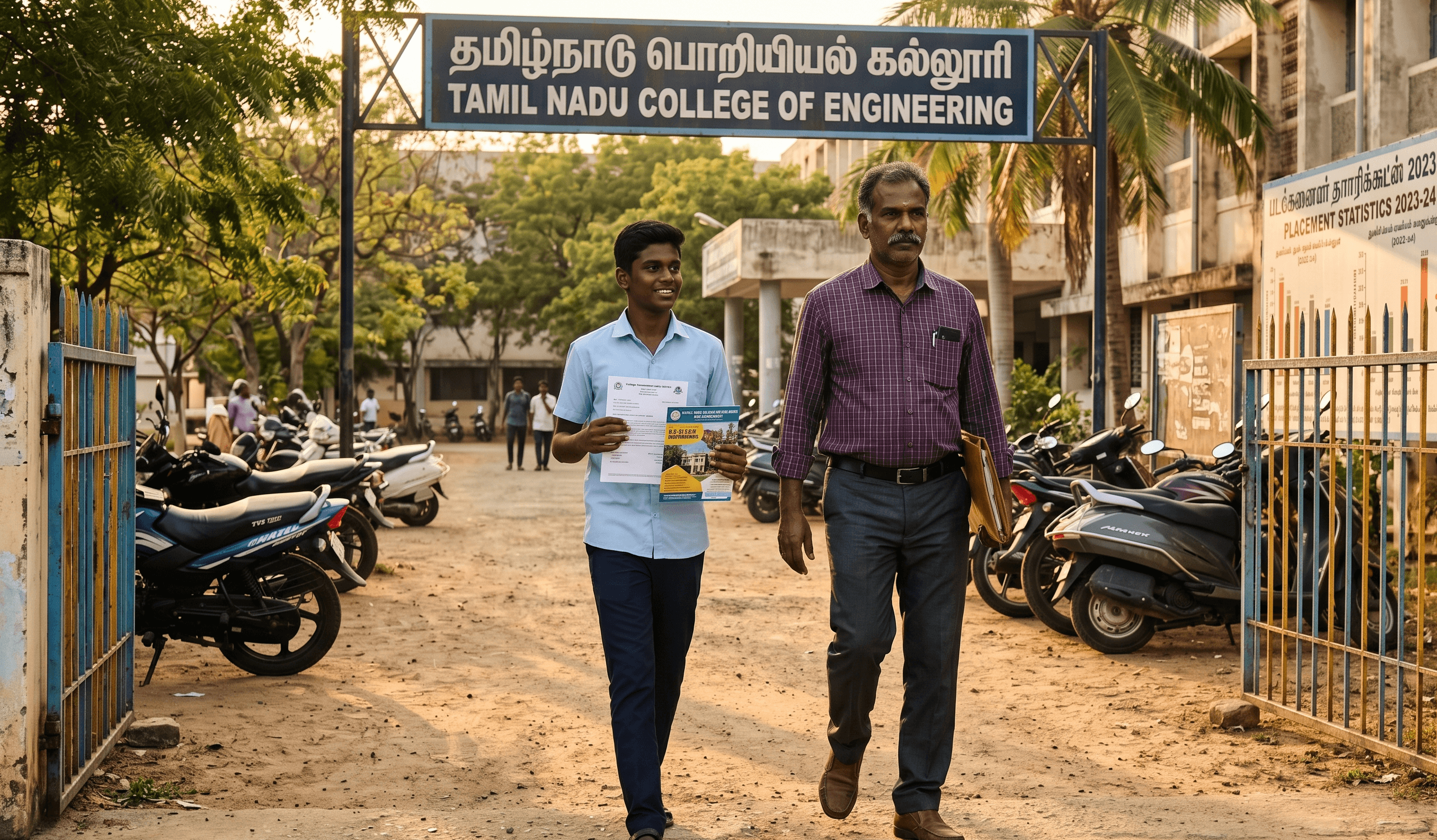
You got the seat. Your parents signed the loan papers. The bank cleared ₹6 lakh into the college account. Four years later, your degree is on the wall, and your first salary at a Sriperumbudur supplier unit is ₹14,000 a month. The EMI on that loan is ₹6,800. The maths doesn't work. Now what?
Most articles will tell you what an education loan is and which bank offers the best rate. Useful, but not where the actual problem lives. Let me tell you what they don't.
The good news first. Education loans in Tamil Nadu for engineering are widely available, from ₹3 lakh to ₹15 lakh, at 9% to 14% a year. Public-sector banks lend at 9.15% to 11%. Private NBFCs lend at 11% to 14%, sometimes for larger amounts. For loans up to ₹4 lakh, you don't need collateral. Above that, you'll need either collateral or a strong co-signer's income proof. The repayment moratorium is generous, the bank doesn't ask for an EMI until you've finished your course plus twelve months. Apply with your admission letter, fee structure, your parents' income documents, and the loan sanctions in two to four weeks.
That was the brochure version. Here's the part that breaks people.
The brochures of private engineering colleges in Tamil Nadu promise 100% placement at ₹4 lakh per annum. The reality, for most non-tier-one colleges, is closer to 40% placement at ₹2.4 LPA, and that includes captive offers from low-wage suppliers around Chennai and Hosur. The loan was sized for the promised salary. The EMI was set on the promised salary. The actual salary is half. That's where the default starts.
If you're already in that gap, here's what to do, and what to do now. Apply for an extended moratorium — banks grant a one-time six-to-twelve-month extension if you cite job search. Ask for EMI restructuring to a longer tenure; the EMI drops, the total interest rises, but you stop bleeding monthly. If your family income is under ₹4.5 lakh, you may qualify for CSIS (Central Sector Interest Subsidy) which can take care of your interest during the moratorium years. For private-college courses, check TAMCO and the Adi Dravidar Welfare Department for state subsidies that most students don't know exist.
What you absolutely don't do is default silently. Education loan defaults damage CIBIL for seven years, and they hit the co-signer, usually your parents too. Restructure early, restructure formally, and keep a paper trail.
The bottom line. Borrow at a public-sector bank if you can the interest is 2–4% lower than NBFCs. Always negotiate the longest moratorium they'll grant. And if the EMI gets impossible after graduation, talk to the bank before they call you. Restructuring before default is a conversation. Restructuring after default is a fight.
You got the seat. Your parents signed the loan papers. The bank cleared ₹6 lakh into the college account. Four years later, your degree is on the wall, and your first salary at a Sriperumbudur supplier unit is ₹14,000 a month. The EMI on that loan is ₹6,800. The maths doesn't work. Now what?
Most articles will tell you what an education loan is and which bank offers the best rate. Useful, but not where the actual problem lives. Let me tell you what they don't.
The good news first. Education loans in Tamil Nadu for engineering are widely available, from ₹3 lakh to ₹15 lakh, at 9% to 14% a year. Public-sector banks lend at 9.15% to 11%. Private NBFCs lend at 11% to 14%, sometimes for larger amounts. For loans up to ₹4 lakh, you don't need collateral. Above that, you'll need either collateral or a strong co-signer's income proof. The repayment moratorium is generous, the bank doesn't ask for an EMI until you've finished your course plus twelve months. Apply with your admission letter, fee structure, your parents' income documents, and the loan sanctions in two to four weeks.
That was the brochure version. Here's the part that breaks people.
The brochures of private engineering colleges in Tamil Nadu promise 100% placement at ₹4 lakh per annum. The reality, for most non-tier-one colleges, is closer to 40% placement at ₹2.4 LPA, and that includes captive offers from low-wage suppliers around Chennai and Hosur. The loan was sized for the promised salary. The EMI was set on the promised salary. The actual salary is half. That's where the default starts.
If you're already in that gap, here's what to do, and what to do now. Apply for an extended moratorium — banks grant a one-time six-to-twelve-month extension if you cite job search. Ask for EMI restructuring to a longer tenure; the EMI drops, the total interest rises, but you stop bleeding monthly. If your family income is under ₹4.5 lakh, you may qualify for CSIS (Central Sector Interest Subsidy) which can take care of your interest during the moratorium years. For private-college courses, check TAMCO and the Adi Dravidar Welfare Department for state subsidies that most students don't know exist.
What you absolutely don't do is default silently. Education loan defaults damage CIBIL for seven years, and they hit the co-signer, usually your parents too. Restructure early, restructure formally, and keep a paper trail.
The bottom line. Borrow at a public-sector bank if you can the interest is 2–4% lower than NBFCs. Always negotiate the longest moratorium they'll grant. And if the EMI gets impossible after graduation, talk to the bank before they call you. Restructuring before default is a conversation. Restructuring after default is a fight.