


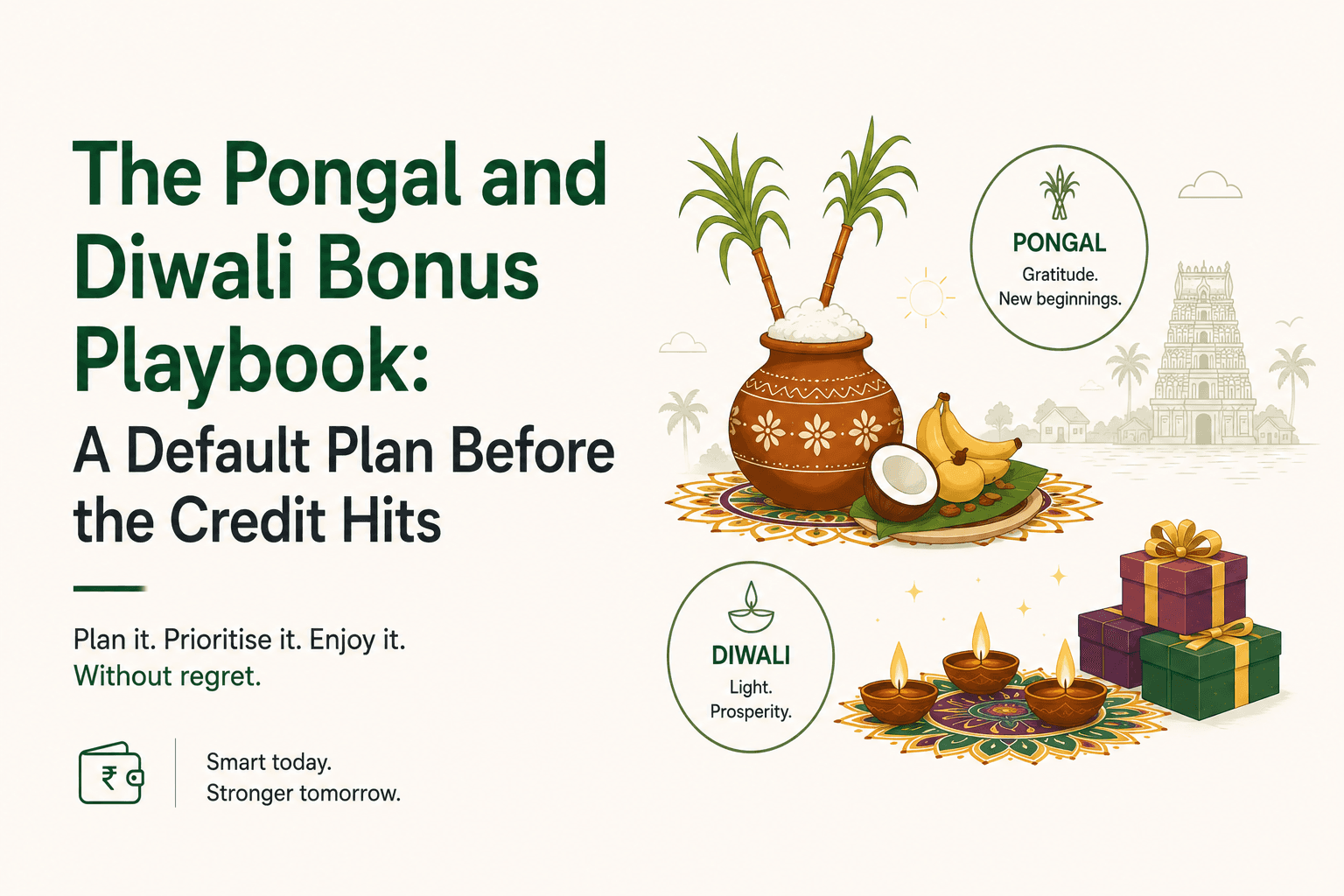
It arrives in mid-October for Diwali, or in mid-January for Pongal- the bonus that every salaried Tamil household quietly looks forward to all year. ₹40,000 for a junior engineer in Sholinganallur. ₹1.2 lakh for a mid-level manager in DLF Phase 2. ₹2 lakh for a senior at a US fintech in Mount Road. Performance bonus, festive bonus, ex-gratia, statutory bonus under the Payment of Bonus Act: different names, same psychological moment.
And almost the same financial pattern across households: within six weeks of the credit, the bonus is gone. Half on the festival itself, a third on planned but accumulating purchases, the rest absorbed quietly into the regular monthly drift.
Then January arrives, the credit-card bill arrives, the school-fee instalment arrives, and the EMI suddenly feels heavier than it did in October.
This is not a story about discipline. It is a story about not having a default plan for the bonus before it lands. The households that come out of festival season ahead aren't more frugal — they have a simple allocation rule they apply on credit day.
Why bonus money behaves differently from salary?
Behavioural economists call it "mental accounting." Money that comes in expected, regular form (salary) gets allocated to expected, regular spending (rent, EMIs, groceries). Money that arrives as a windfall (bonus, tax refund, gift) gets routed to a separate mental bucket - discretionary, celebratory, "we earned this."
The bucket is not wrong. The size of the bucket is.
The festive bonus, on average, represents two to four weeks of household income arriving in one transaction. Spent entirely on the festival, it constitutes the single largest discretionary spend of the year. Allocated thoughtfully, it can clear three months of high-interest debt, build a quarter's worth of emergency cushion, and still fund a meaningful festival celebration.
The rule that works is simple: decide the allocation before the credit hits the account.
The 50-30-20 bonus rule
For a household carrying any high-interest debt or without a fully-funded emergency cushion, a useful default - 50% to financial repair, 30% to the festival, 20% to a one-time investment.
It is not the only allocation. But it is a sensible default that prevents the bonus from disappearing while still leaving meaningful room to actually enjoy the festival.
50% : financial repair
The first half of the bonus does the work that compounds for the rest of the year.
The order of priority within this 50%, in plain language:
High-interest debt first. Credit-card outstanding being revolved, BNPL balances, personal loans at 14%+, informal loans. Every rupee paid against a 36-42% credit-card revolve outperforms every other financial decision the household can make in the same year.
Emergency-fund top-up second. If the household's emergency cushion is less than three months of expenses, this is where the next slice goes.
Single-tenure prepayment third. A one-time prepayment on a home loan or education loan reduces the future interest meaningfully. Most lenders allow free prepayment on floating-rate retail loans under RBI's customer-protection norms.
For a household with no high-interest debt and a fully funded emergency cushion, the 50% slice can flow into the long-term investment bucket instead.
30% : the festival itself
This is the part most articles get wrong. A festival is not an indulgence to be optimised away. It is a load-bearing part of how Tamil families maintain relationships, mark seasons, and remember each other.
Spend the 30% well- clothes, gifts for parents and in-laws, the new appliance the household has been putting off, a home meal the family will remember. The principle is simply that this slice has a cap. Once spent, the bonus's contribution to the festival is done. Anything else comes from regular salary.
Practical tools that help:
Pre-decide the gift list. Names and ballpark amounts written down before walking into the showroom.
Use a single payment method for festival spending, typically a credit card whose statement you will clear in full on the same day. The trail is easier to read.
Set the cap at 30% of net bonus, not 30% of gross. Tax is real.
20% : one-time investment
The third slice goes into a longer-term bucket. For most households, this means one of three things, all of which are educational categories rather than product recommendations:
A lump-sum into an existing SIP or mutual-fund folio.
A contribution toward a goal-linked instrument the household has already set up (children's higher education, retirement, an upcoming down payment).
A short-term fixed deposit or government small-savings instrument that aligns with a known near-term need (school fees in March, an insurance premium due in June).
The principle is that this slice does not get touched until the goal it was earmarked for.
A note on the credit-card "festival offer"
The two months around Pongal and Diwali are the most aggressive credit-card marketing season of the year. EMI conversions on appliances, "no-cost EMI" smartphone schemes, festive cashback on premium cards.
A small structural note. "No-cost EMI" is rarely costless. The discount that would otherwise have been offered on a cash purchase is converted into the implicit interest the manufacturer or merchant pays the bank to fund the EMI. A 6-month "no-cost EMI" on a ₹60,000 phone often translates to the same out-of-pocket cost as a cash purchase at a discount you didn't take.
This is not an argument against EMIs. It is an argument for doing the comparison, cash price vs EMI price vs cash-discount price, before clicking the EMI option at checkout.
What about the statutory bonus
Under the Payment of Bonus Act, 1965, employers in certain categories of establishments are required to pay an annual bonus to employees earning up to a defined wage threshold, calculated as a percentage of annual wages. The minimum is 8.33%; the maximum is 20%. This applies as a legal entitlement, not a discretionary perk.
For households where the festive bonus is largely or fully statutory, the 50-30-20 logic still applies — and so does the planning. The legal entitlement does not mean the money behaves any differently in the household budget once it lands.
The 30-minute exercise before the bonus arrives
This is the only step that actually changes outcomes.
Look up the credit date in payroll's communication or last year's bonus credit.
Decide the three slices in writing: 50% to financial repair, 30% to the festival, 20% to investment. Adjust the ratios for your household if you have no high-interest debt.
Pre-allocate the financial-repair slice to specific obligations: line item by line item, with rupee amounts.
Set the festival cap as a number, not a feeling. Tell your spouse the cap before the showroom visits begin.
Set up the investment slice as a standing instruction for credit day plus one.
Most households that do this once start doing it every season. The Diwali after the year you do this is meaningfully different from the Diwali before.
The bottom line. The bonus is not extra money. It is two to four weeks of your income arriving in a single transaction. Treated as a windfall, it disappears. Treated as four weeks of salary with a pre-decided allocation, it does more for the household balance sheet than any other financial decision made that year.
This article is for educational purposes only and does not constitute financial, legal, tax or investment advice. Specific facts vary by case. For decisions involving Wills, succession, nomination or family-asset transfers, consult a qualified advocate. For investment decisions, consult a SEBI-registered investment adviser. For insurance decisions, consult an IRDAI-registered intermediary. Statutes and rules referenced are accurate as of June 2026 and may be amended later — always verify with the primary source before relying on a specific provision.
It arrives in mid-October for Diwali, or in mid-January for Pongal- the bonus that every salaried Tamil household quietly looks forward to all year. ₹40,000 for a junior engineer in Sholinganallur. ₹1.2 lakh for a mid-level manager in DLF Phase 2. ₹2 lakh for a senior at a US fintech in Mount Road. Performance bonus, festive bonus, ex-gratia, statutory bonus under the Payment of Bonus Act: different names, same psychological moment.
And almost the same financial pattern across households: within six weeks of the credit, the bonus is gone. Half on the festival itself, a third on planned but accumulating purchases, the rest absorbed quietly into the regular monthly drift.
Then January arrives, the credit-card bill arrives, the school-fee instalment arrives, and the EMI suddenly feels heavier than it did in October.
This is not a story about discipline. It is a story about not having a default plan for the bonus before it lands. The households that come out of festival season ahead aren't more frugal — they have a simple allocation rule they apply on credit day.
Why bonus money behaves differently from salary?
Behavioural economists call it "mental accounting." Money that comes in expected, regular form (salary) gets allocated to expected, regular spending (rent, EMIs, groceries). Money that arrives as a windfall (bonus, tax refund, gift) gets routed to a separate mental bucket - discretionary, celebratory, "we earned this."
The bucket is not wrong. The size of the bucket is.
The festive bonus, on average, represents two to four weeks of household income arriving in one transaction. Spent entirely on the festival, it constitutes the single largest discretionary spend of the year. Allocated thoughtfully, it can clear three months of high-interest debt, build a quarter's worth of emergency cushion, and still fund a meaningful festival celebration.
The rule that works is simple: decide the allocation before the credit hits the account.
The 50-30-20 bonus rule
For a household carrying any high-interest debt or without a fully-funded emergency cushion, a useful default - 50% to financial repair, 30% to the festival, 20% to a one-time investment.
It is not the only allocation. But it is a sensible default that prevents the bonus from disappearing while still leaving meaningful room to actually enjoy the festival.
50% : financial repair
The first half of the bonus does the work that compounds for the rest of the year.
The order of priority within this 50%, in plain language:
High-interest debt first. Credit-card outstanding being revolved, BNPL balances, personal loans at 14%+, informal loans. Every rupee paid against a 36-42% credit-card revolve outperforms every other financial decision the household can make in the same year.
Emergency-fund top-up second. If the household's emergency cushion is less than three months of expenses, this is where the next slice goes.
Single-tenure prepayment third. A one-time prepayment on a home loan or education loan reduces the future interest meaningfully. Most lenders allow free prepayment on floating-rate retail loans under RBI's customer-protection norms.
For a household with no high-interest debt and a fully funded emergency cushion, the 50% slice can flow into the long-term investment bucket instead.
30% : the festival itself
This is the part most articles get wrong. A festival is not an indulgence to be optimised away. It is a load-bearing part of how Tamil families maintain relationships, mark seasons, and remember each other.
Spend the 30% well- clothes, gifts for parents and in-laws, the new appliance the household has been putting off, a home meal the family will remember. The principle is simply that this slice has a cap. Once spent, the bonus's contribution to the festival is done. Anything else comes from regular salary.
Practical tools that help:
Pre-decide the gift list. Names and ballpark amounts written down before walking into the showroom.
Use a single payment method for festival spending, typically a credit card whose statement you will clear in full on the same day. The trail is easier to read.
Set the cap at 30% of net bonus, not 30% of gross. Tax is real.
20% : one-time investment
The third slice goes into a longer-term bucket. For most households, this means one of three things, all of which are educational categories rather than product recommendations:
A lump-sum into an existing SIP or mutual-fund folio.
A contribution toward a goal-linked instrument the household has already set up (children's higher education, retirement, an upcoming down payment).
A short-term fixed deposit or government small-savings instrument that aligns with a known near-term need (school fees in March, an insurance premium due in June).
The principle is that this slice does not get touched until the goal it was earmarked for.
A note on the credit-card "festival offer"
The two months around Pongal and Diwali are the most aggressive credit-card marketing season of the year. EMI conversions on appliances, "no-cost EMI" smartphone schemes, festive cashback on premium cards.
A small structural note. "No-cost EMI" is rarely costless. The discount that would otherwise have been offered on a cash purchase is converted into the implicit interest the manufacturer or merchant pays the bank to fund the EMI. A 6-month "no-cost EMI" on a ₹60,000 phone often translates to the same out-of-pocket cost as a cash purchase at a discount you didn't take.
This is not an argument against EMIs. It is an argument for doing the comparison, cash price vs EMI price vs cash-discount price, before clicking the EMI option at checkout.
What about the statutory bonus
Under the Payment of Bonus Act, 1965, employers in certain categories of establishments are required to pay an annual bonus to employees earning up to a defined wage threshold, calculated as a percentage of annual wages. The minimum is 8.33%; the maximum is 20%. This applies as a legal entitlement, not a discretionary perk.
For households where the festive bonus is largely or fully statutory, the 50-30-20 logic still applies — and so does the planning. The legal entitlement does not mean the money behaves any differently in the household budget once it lands.
The 30-minute exercise before the bonus arrives
This is the only step that actually changes outcomes.
Look up the credit date in payroll's communication or last year's bonus credit.
Decide the three slices in writing: 50% to financial repair, 30% to the festival, 20% to investment. Adjust the ratios for your household if you have no high-interest debt.
Pre-allocate the financial-repair slice to specific obligations: line item by line item, with rupee amounts.
Set the festival cap as a number, not a feeling. Tell your spouse the cap before the showroom visits begin.
Set up the investment slice as a standing instruction for credit day plus one.
Most households that do this once start doing it every season. The Diwali after the year you do this is meaningfully different from the Diwali before.
The bottom line. The bonus is not extra money. It is two to four weeks of your income arriving in a single transaction. Treated as a windfall, it disappears. Treated as four weeks of salary with a pre-decided allocation, it does more for the household balance sheet than any other financial decision made that year.
This article is for educational purposes only and does not constitute financial, legal, tax or investment advice. Specific facts vary by case. For decisions involving Wills, succession, nomination or family-asset transfers, consult a qualified advocate. For investment decisions, consult a SEBI-registered investment adviser. For insurance decisions, consult an IRDAI-registered intermediary. Statutes and rules referenced are accurate as of June 2026 and may be amended later — always verify with the primary source before relying on a specific provision.