


A 32-year-old project engineer in Bengaluru took a ₹5 lakh personal loan two years ago. The lender's brochure mentioned the rate at "12% per annum." The total amount paid back over 36 months was ₹6.8 lakh. He assumed this was normal- ₹1.8 lakh of interest on a ₹5 lakh loan over three years felt roughly aligned with a 12% rate.
Six months later, comparing notes with a friend who had taken the same loan amount at a different lender, same headline 12% and ended up paying ₹6.1 lakh total, he realised the difference. His "12%" was a flat rate. His friend's "12%" was a reducing balance rate. The two numbers are not the same product. They are mathematically different ways of computing interest, and at the same headline number the flat rate costs roughly double the reducing balance.
This is one of the most consistently exploited information gaps in Indian retail lending. Here is what the three terms actually mean, and how to read the rate on any loan offer.
The three rate frameworks
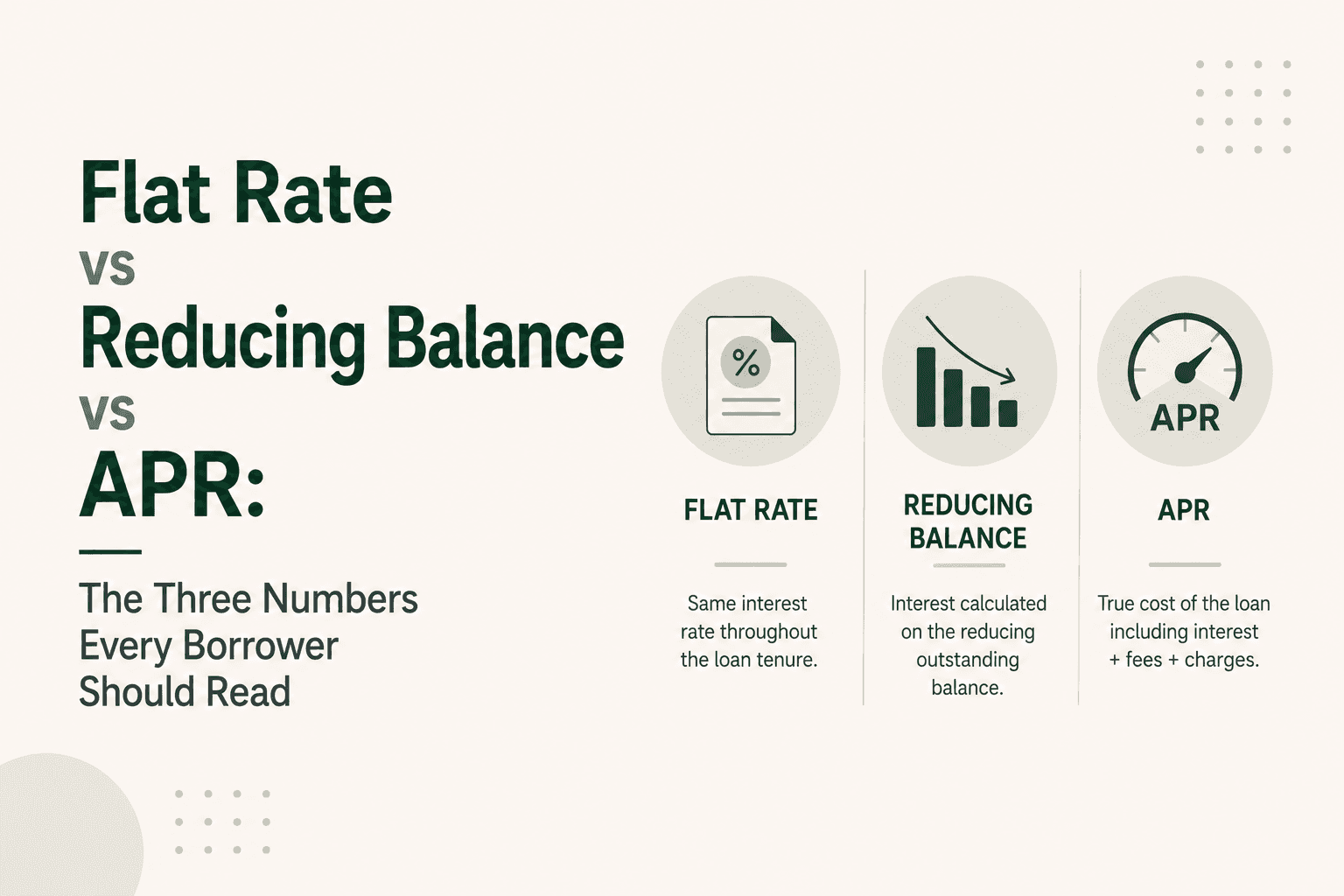
Reducing balance rate. Interest is charged each period on the outstanding principal at that point. As you repay principal, the interest portion of each EMI gradually decreases and the principal portion gradually increases. This is the framework used by all major home loans, most personal loans from PSU and large private banks, gold loans, and credit-card EMI conversions.
This is the "true" rate of the loan in the conventional economic sense. When you see a home loan quoted at "8.5%," it is almost always a reducing balance rate.
Flat rate. Interest is charged each period on the original principal, not the outstanding. The interest paid each month stays constant throughout the tenure, regardless of how much principal you have repaid. This framework is common in some commercial vehicle loans, some equipment finance, certain NBFC personal loans, and historically in tractor and two-wheeler loans.
A flat rate looks small but is misleadingly so. A "12% flat" loan is roughly equivalent to a 22% reducing balance loan on a 3-year tenure. The exact ratio depends on tenure.
APR (Annual Percentage Rate). A standardised computation that includes the interest rate plus processing fees plus other one-time charges, expressed as a single annualised number. APR is meant to be the true comparable rate across products. Most Indian retail loans do not publish APR prominently; some fintech apps do. The RBI's Key Facts Statement (KFS) framework, mandatory from April 2024, requires lenders to disclose the all-in cost in standardised form - close to an APR in practice.
The math, in three worked examples
Example A: ₹5 lakh loan at 12% reducing balance, 3-year tenure.
Monthly EMI: roughly ₹16,610. Total amount paid: ₹5,98,000. Total interest: ₹98,000. Effective annualised cost: about 12%.
Example B: ₹5 lakh loan at 12% flat rate, 3-year tenure.
Interest per year on ₹5 lakh at 12% flat: ₹60,000. Total interest over 3 years: ₹1,80,000. Monthly EMI: (₹5,00,000 + ₹1,80,000) ÷ 36 = ₹18,889. Total amount paid: ₹6,80,000.
Same headline "12%." Total cost differs by ₹82,000.
Example C: ₹5 lakh personal loan at 12% reducing balance + ₹15,000 processing fee + ₹2,700 GST on processing fee.
The interest math is as in Example A. But the all-in cost — the APR equivalent — bakes in the fees. APR is roughly 13.4% on this loan.
How to read any loan offer?
Three checks every borrower should run before signing.
1. Confirm whether the headline rate is reducing balance or flat. Ask in writing. The answer should be one word. If the answer is anything other than "reducing balance," ask for the reducing-balance equivalent. If the lender refuses or says "they're the same," walk away.
2. Get the Key Facts Statement (KFS). From April 2024, the RBI requires all retail loans from regulated lenders to come with a one-page KFS that lists the all-in cost: interest rate, processing fees, GST, prepayment terms, total amount payable. This is the document that lets you compare offers like-for-like. If the KFS is not provided, ask for it explicitly.
3. Compute the total amount payable. Beyond the rate framework, the bottom-line number is what you will pay back over the full tenure. Reducing balance, flat, APR- these are tools to get to that number. The number itself is the truth.
Where the gap shows up most often?
Three product categories where the flat vs reducing distinction is most often exploited.
Commercial vehicle and tractor loans. Historically dominated by flat-rate quoting. A truck finance company quoting "11% flat" is offering a loan with an effective reducing-balance rate of 19-21% depending on tenure. The borrower thinks they have a competitive rate; they don't.
Two-wheeler and used-car loans at dealer-arranged financing. The financing partner at the dealer often quotes flat rates without flagging the distinction. The same buyer walking into a bank for the same loan would have been quoted reducing balance.
Small-ticket NBFC personal loans. Some NBFCs quote flat or use a per-month rate (e.g., "1.5% per month") which is structurally similar to a flat rate framework. 1.5% per month sounds small; annualised, it is 18%, and on a flat basis the effective reducing equivalent can be 32-34%.
The honest comparison checklist
Before signing any loan agreement:
Is the quoted rate reducing balance, flat, or per-month? Get it in writing.
What is the processing fee? GST on processing fee?
What is the total amount payable over the full tenure?
What is the APR or KFS-disclosed all-in cost?
What is the prepayment / foreclosure charge? (For floating-rate retail loans to individuals, sanctioned on or after 1 January 2026, RBI's 2025 Pre-payment Charges Directions bar most prepayment charges.)
What is the EMI bounce charge? Late payment penalty?
A loan offer that scores well on the headline rate but poorly on these line items is often more expensive than a loan with a higher headline rate and cleaner terms. The honest number is the total amount payable.
A note on "ROI" advertising
Some lender advertisements use "Rate of Interest (ROI)" as a marketing term without specifying which framework. "ROI 9.99%" on a personal loan from an NBFC may be flat, monthly, or reducing depending on how the lender chooses to interpret it. The borrower's only protection is to ask the question explicitly and get the answer in writing before signing.
The bottom line. The "headline rate" on an Indian retail loan is sometimes a complete description of the cost and sometimes barely half of it. A flat rate at the same headline number costs roughly double a reducing-balance rate. The RBI's Key Facts Statement framework, in force since April 2024, is the single best tool the borrower has to make like-for-like comparisons. Ask for it, read it, and use the all-in-cost number to decide — not the headline.
This article is for educational purposes only and does not constitute financial, legal, tax or investment advice. Specific facts vary by case. For credit and loan-related decisions, work directly with an RBI-regulated lender or an RBI-recognised credit counsellor. For tax positions, consult a qualified chartered accountant. Statutes, RBI circulars, and tax provisions referenced are accurate as of June 2026 and may be amended later, always verify with the primary source before acting.
A 32-year-old project engineer in Bengaluru took a ₹5 lakh personal loan two years ago. The lender's brochure mentioned the rate at "12% per annum." The total amount paid back over 36 months was ₹6.8 lakh. He assumed this was normal- ₹1.8 lakh of interest on a ₹5 lakh loan over three years felt roughly aligned with a 12% rate.
Six months later, comparing notes with a friend who had taken the same loan amount at a different lender, same headline 12% and ended up paying ₹6.1 lakh total, he realised the difference. His "12%" was a flat rate. His friend's "12%" was a reducing balance rate. The two numbers are not the same product. They are mathematically different ways of computing interest, and at the same headline number the flat rate costs roughly double the reducing balance.
This is one of the most consistently exploited information gaps in Indian retail lending. Here is what the three terms actually mean, and how to read the rate on any loan offer.
The three rate frameworks
Reducing balance rate. Interest is charged each period on the outstanding principal at that point. As you repay principal, the interest portion of each EMI gradually decreases and the principal portion gradually increases. This is the framework used by all major home loans, most personal loans from PSU and large private banks, gold loans, and credit-card EMI conversions.
This is the "true" rate of the loan in the conventional economic sense. When you see a home loan quoted at "8.5%," it is almost always a reducing balance rate.
Flat rate. Interest is charged each period on the original principal, not the outstanding. The interest paid each month stays constant throughout the tenure, regardless of how much principal you have repaid. This framework is common in some commercial vehicle loans, some equipment finance, certain NBFC personal loans, and historically in tractor and two-wheeler loans.
A flat rate looks small but is misleadingly so. A "12% flat" loan is roughly equivalent to a 22% reducing balance loan on a 3-year tenure. The exact ratio depends on tenure.
APR (Annual Percentage Rate). A standardised computation that includes the interest rate plus processing fees plus other one-time charges, expressed as a single annualised number. APR is meant to be the true comparable rate across products. Most Indian retail loans do not publish APR prominently; some fintech apps do. The RBI's Key Facts Statement (KFS) framework, mandatory from April 2024, requires lenders to disclose the all-in cost in standardised form - close to an APR in practice.
The math, in three worked examples
Example A: ₹5 lakh loan at 12% reducing balance, 3-year tenure.
Monthly EMI: roughly ₹16,610. Total amount paid: ₹5,98,000. Total interest: ₹98,000. Effective annualised cost: about 12%.
Example B: ₹5 lakh loan at 12% flat rate, 3-year tenure.
Interest per year on ₹5 lakh at 12% flat: ₹60,000. Total interest over 3 years: ₹1,80,000. Monthly EMI: (₹5,00,000 + ₹1,80,000) ÷ 36 = ₹18,889. Total amount paid: ₹6,80,000.
Same headline "12%." Total cost differs by ₹82,000.
Example C: ₹5 lakh personal loan at 12% reducing balance + ₹15,000 processing fee + ₹2,700 GST on processing fee.
The interest math is as in Example A. But the all-in cost — the APR equivalent — bakes in the fees. APR is roughly 13.4% on this loan.
How to read any loan offer?
Three checks every borrower should run before signing.
1. Confirm whether the headline rate is reducing balance or flat. Ask in writing. The answer should be one word. If the answer is anything other than "reducing balance," ask for the reducing-balance equivalent. If the lender refuses or says "they're the same," walk away.
2. Get the Key Facts Statement (KFS). From April 2024, the RBI requires all retail loans from regulated lenders to come with a one-page KFS that lists the all-in cost: interest rate, processing fees, GST, prepayment terms, total amount payable. This is the document that lets you compare offers like-for-like. If the KFS is not provided, ask for it explicitly.
3. Compute the total amount payable. Beyond the rate framework, the bottom-line number is what you will pay back over the full tenure. Reducing balance, flat, APR- these are tools to get to that number. The number itself is the truth.
Where the gap shows up most often?
Three product categories where the flat vs reducing distinction is most often exploited.
Commercial vehicle and tractor loans. Historically dominated by flat-rate quoting. A truck finance company quoting "11% flat" is offering a loan with an effective reducing-balance rate of 19-21% depending on tenure. The borrower thinks they have a competitive rate; they don't.
Two-wheeler and used-car loans at dealer-arranged financing. The financing partner at the dealer often quotes flat rates without flagging the distinction. The same buyer walking into a bank for the same loan would have been quoted reducing balance.
Small-ticket NBFC personal loans. Some NBFCs quote flat or use a per-month rate (e.g., "1.5% per month") which is structurally similar to a flat rate framework. 1.5% per month sounds small; annualised, it is 18%, and on a flat basis the effective reducing equivalent can be 32-34%.
The honest comparison checklist
Before signing any loan agreement:
Is the quoted rate reducing balance, flat, or per-month? Get it in writing.
What is the processing fee? GST on processing fee?
What is the total amount payable over the full tenure?
What is the APR or KFS-disclosed all-in cost?
What is the prepayment / foreclosure charge? (For floating-rate retail loans to individuals, sanctioned on or after 1 January 2026, RBI's 2025 Pre-payment Charges Directions bar most prepayment charges.)
What is the EMI bounce charge? Late payment penalty?
A loan offer that scores well on the headline rate but poorly on these line items is often more expensive than a loan with a higher headline rate and cleaner terms. The honest number is the total amount payable.
A note on "ROI" advertising
Some lender advertisements use "Rate of Interest (ROI)" as a marketing term without specifying which framework. "ROI 9.99%" on a personal loan from an NBFC may be flat, monthly, or reducing depending on how the lender chooses to interpret it. The borrower's only protection is to ask the question explicitly and get the answer in writing before signing.
The bottom line. The "headline rate" on an Indian retail loan is sometimes a complete description of the cost and sometimes barely half of it. A flat rate at the same headline number costs roughly double a reducing-balance rate. The RBI's Key Facts Statement framework, in force since April 2024, is the single best tool the borrower has to make like-for-like comparisons. Ask for it, read it, and use the all-in-cost number to decide — not the headline.
This article is for educational purposes only and does not constitute financial, legal, tax or investment advice. Specific facts vary by case. For credit and loan-related decisions, work directly with an RBI-regulated lender or an RBI-recognised credit counsellor. For tax positions, consult a qualified chartered accountant. Statutes, RBI circulars, and tax provisions referenced are accurate as of June 2026 and may be amended later, always verify with the primary source before acting.