


A 71-year-old retired bank manager in Mylapore, Chennai, passed away last March from a sudden heart attack. He had been the model of financial discipline all his life: three savings accounts, a brokerage account, a small portfolio of FDs, a paid-off flat, two life insurance policies, an EPF balance still untouched.
His widow, 67, had signed on a few papers over forty years of marriage. She didn't know which papers covered what, what was in joint names, or which accounts named her as nominee.
Eighteen months later, the family is still inside the bank, the insurer, the depository, and the EPFO, fighting paperwork that should have taken three months. Two of the accounts are still frozen. The flat title is in his sole name. One of the life-insurance policies has gone unclaimed because nobody knows where the bond paper is.
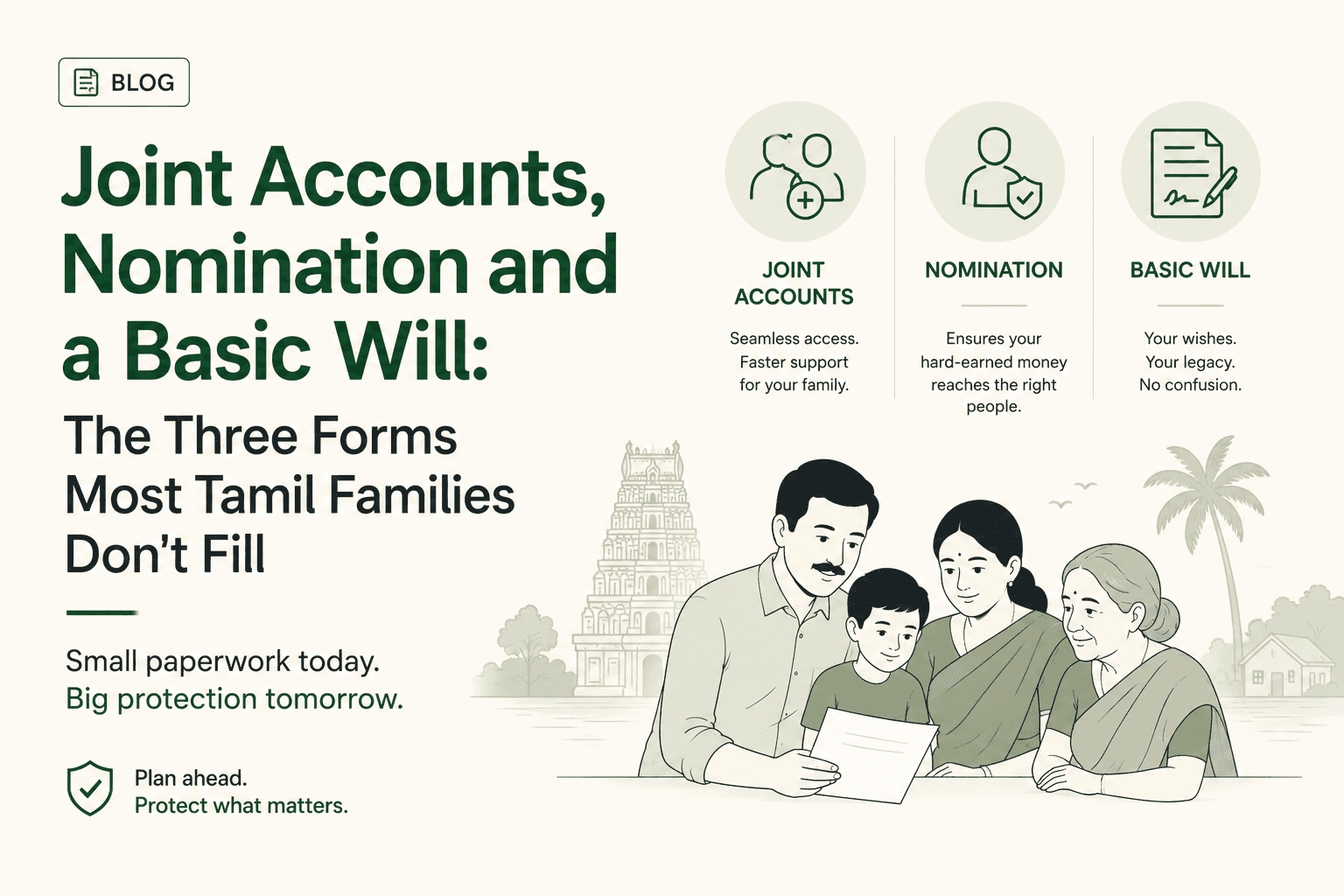
This isn't a story about a careless man. It's a story about three small forms most Indian families never fill - joint-account mode, nomination, and a basic Will. Each takes thirty minutes. Together they prevent a year of administrative anguish at the worst possible moment.
Form 1: Joint-account mode
Most Tamil families have joint bank accounts already. Few have the right operational mode set on them.
There are three common modes for a joint account:
Either or Survivor. Any joint holder can operate the account during all holders' lifetimes. On the death of any one, the survivor can operate freely. This is the mode most retired couples should use — and many do not.
Former or Survivor. Only the primary holder can operate during lifetime. On the primary's death, the survivor can operate. Useful when one spouse manages the finances actively.
Jointly. All holders must sign every transaction. Useful for trust or partnership accounts; almost always cumbersome for households.
The mode is set when the account opens. It can be changed later by a simple application at the branch. If you have an old joint account opened in the "Jointly" mode, the surviving spouse will need a succession process to operate it on the first death - a process that can take six months. Converting it to "Either or Survivor" today takes one branch visit.
Form 2: Nomination
Nomination is the simplest and most powerful single form in Indian personal finance.
Under Section 45ZA of the Banking Regulation Act, 1949, every bank account, FD, and locker can have a nominee. Under Section 39 of the Insurance Act, 1938, every life-insurance policy can name a nominee. Under SEBI's October 2023 directive, every demat account and mutual-fund folio must either nominate or opt out in writing. EPF and PPF accounts also accept nominees.
The nominee is not the legal heir. The nominee is the person to whom the institution will release the asset on the holder's death, on production of a death certificate and basic ID. Legal succession (under the Hindu Succession Act, 1956, the Indian Succession Act, 1925, or the relevant personal law) decides who finally owns the asset. The nominee's job is simply to receive it from the institution and pass it on per succession law - which usually means keeping it for themselves if they are the sole heir, or distributing per the family arrangement otherwise.
Without a nominee:
The bank freezes the account on death.
The family produces a legal heir certificate or a succession certificate, often after six to twelve months of court process.
The insurer waits for an indemnity bond, sometimes also a succession certificate.
The depository asks for a transmission process across the brokerage and registrar.
With a nominee, all four release the asset on a single visit with a death certificate, KYC, and a short claim form.
What to check today — for every bank account, FD, demat, mutual fund, life insurance policy, EPF, PPF, and small-savings account in the family, is a nominee on record? Most internet-banking dashboards now show nominee status. Where it says "Not registered" or "Opted out," fix it this week.
Form 3: A basic Will
A Will is not for the wealthy. A Will is for anyone who owns one asset that cannot be nominated - most commonly, an immovable property (a flat, a piece of land, a house) or a self-acquired business.
Nomination covers movables that have a nominee facility. Property does not. The flat in your sole name, on your death, passes by intestate succession under the Hindu Succession Act, 1956 (or the relevant personal law): among the spouse, children, and mother if she survives. The division can be amicable. It often isn't. The result is a frozen property title that no surviving family member can sell, mortgage, or even rent cleanly until a partition deed is signed by all heirs.
A basic Will, written in plain language and signed by you in front of two witnesses, prevents this. Three things make a Will valid in India under the Indian Succession Act, 1925:
It is in writing.
It is signed by the person making it (the testator).
It is attested by two witnesses who saw the testator sign and signed themselves.
Registration of the Will is optional but recommended. A registered Will is a public record, much harder to contest. The fee at the Sub-Registrar's office is modest — typically a few hundred rupees.
Three principles for a workable Will:
Be specific. "My flat at [address], Door No. [X], comprising [details]." Not "my Mylapore property."
Name an executor. A trusted person — often the spouse or eldest child — who is responsible for carrying out the Will.
Update it after every major life event. Marriage, the birth of children, a property purchase, a divorce — these are the moments a Will needs to be reviewed.
The Tamil family question: sthridhanam and the gold
Gold gifted to a daughter at marriage (sthridhanam) is, in law, her own separate property. It is not joint family property. The husband, in-laws, or anyone else does not have a claim on it.
In practice, much of this gold sits in joint bank lockers, gets pledged for family loans, or gets quietly consumed in family expenses without documentation. When a marriage ends- by death, divorce, or estrangement: the absence of documentation is what makes recovery difficult.
The educational point- keep a simple inventory of sthridhanam gold (a list with weights, descriptions, and photographs) and a note of where it is currently held. Update it once a year. This is not paranoia; it is the documentation that a court, a bank, or a family settlement will rely on if the question ever arises.
The 60-minute family exercise
Set aside one Sunday morning. With your spouse, parents, or children — whoever the household financial unit is; go through this checklist together.
List every account, policy and asset. Bank, FD, demat, mutual fund, EPF, PPF, life insurance, vehicle, property. One spreadsheet, one shared cloud folder.
Verify nominee status on each. Where missing, fix online or via the branch this week.
Verify joint-account mode on every joint account. Change "Jointly" to "Either or Survivor" if you intended it that way.
Decide whether a basic Will is needed. For any household with self-acquired immovable property or a sole-proprietorship business, the answer is almost always yes.
Tell each other where the documents are. A single sealed envelope in the home safe, with copies in a shared cloud folder, is enough.
The bottom line. Most family financial chaos after a death is not a wealth problem. It is a paperwork problem. The forms that prevent it are short, free, and available at every bank branch and every Sub-Registrar's office. The hour spent filling them is the most underrated gift one generation can leave to the next.
This article is for educational purposes only and does not constitute financial, legal, tax or investment advice. Specific facts vary by case. For decisions involving Wills, succession, nomination or family-asset transfers, consult a qualified advocate. For investment decisions, consult a SEBI-registered investment adviser. For insurance decisions, consult an IRDAI-registered intermediary. Statutes and rules referenced are accurate as of June 2026 and may be amended later — always verify with the primary source before relying on a specific provision.
A 71-year-old retired bank manager in Mylapore, Chennai, passed away last March from a sudden heart attack. He had been the model of financial discipline all his life: three savings accounts, a brokerage account, a small portfolio of FDs, a paid-off flat, two life insurance policies, an EPF balance still untouched.
His widow, 67, had signed on a few papers over forty years of marriage. She didn't know which papers covered what, what was in joint names, or which accounts named her as nominee.
Eighteen months later, the family is still inside the bank, the insurer, the depository, and the EPFO, fighting paperwork that should have taken three months. Two of the accounts are still frozen. The flat title is in his sole name. One of the life-insurance policies has gone unclaimed because nobody knows where the bond paper is.
This isn't a story about a careless man. It's a story about three small forms most Indian families never fill - joint-account mode, nomination, and a basic Will. Each takes thirty minutes. Together they prevent a year of administrative anguish at the worst possible moment.
Form 1: Joint-account mode
Most Tamil families have joint bank accounts already. Few have the right operational mode set on them.
There are three common modes for a joint account:
Either or Survivor. Any joint holder can operate the account during all holders' lifetimes. On the death of any one, the survivor can operate freely. This is the mode most retired couples should use — and many do not.
Former or Survivor. Only the primary holder can operate during lifetime. On the primary's death, the survivor can operate. Useful when one spouse manages the finances actively.
Jointly. All holders must sign every transaction. Useful for trust or partnership accounts; almost always cumbersome for households.
The mode is set when the account opens. It can be changed later by a simple application at the branch. If you have an old joint account opened in the "Jointly" mode, the surviving spouse will need a succession process to operate it on the first death - a process that can take six months. Converting it to "Either or Survivor" today takes one branch visit.
Form 2: Nomination
Nomination is the simplest and most powerful single form in Indian personal finance.
Under Section 45ZA of the Banking Regulation Act, 1949, every bank account, FD, and locker can have a nominee. Under Section 39 of the Insurance Act, 1938, every life-insurance policy can name a nominee. Under SEBI's October 2023 directive, every demat account and mutual-fund folio must either nominate or opt out in writing. EPF and PPF accounts also accept nominees.
The nominee is not the legal heir. The nominee is the person to whom the institution will release the asset on the holder's death, on production of a death certificate and basic ID. Legal succession (under the Hindu Succession Act, 1956, the Indian Succession Act, 1925, or the relevant personal law) decides who finally owns the asset. The nominee's job is simply to receive it from the institution and pass it on per succession law - which usually means keeping it for themselves if they are the sole heir, or distributing per the family arrangement otherwise.
Without a nominee:
The bank freezes the account on death.
The family produces a legal heir certificate or a succession certificate, often after six to twelve months of court process.
The insurer waits for an indemnity bond, sometimes also a succession certificate.
The depository asks for a transmission process across the brokerage and registrar.
With a nominee, all four release the asset on a single visit with a death certificate, KYC, and a short claim form.
What to check today — for every bank account, FD, demat, mutual fund, life insurance policy, EPF, PPF, and small-savings account in the family, is a nominee on record? Most internet-banking dashboards now show nominee status. Where it says "Not registered" or "Opted out," fix it this week.
Form 3: A basic Will
A Will is not for the wealthy. A Will is for anyone who owns one asset that cannot be nominated - most commonly, an immovable property (a flat, a piece of land, a house) or a self-acquired business.
Nomination covers movables that have a nominee facility. Property does not. The flat in your sole name, on your death, passes by intestate succession under the Hindu Succession Act, 1956 (or the relevant personal law): among the spouse, children, and mother if she survives. The division can be amicable. It often isn't. The result is a frozen property title that no surviving family member can sell, mortgage, or even rent cleanly until a partition deed is signed by all heirs.
A basic Will, written in plain language and signed by you in front of two witnesses, prevents this. Three things make a Will valid in India under the Indian Succession Act, 1925:
It is in writing.
It is signed by the person making it (the testator).
It is attested by two witnesses who saw the testator sign and signed themselves.
Registration of the Will is optional but recommended. A registered Will is a public record, much harder to contest. The fee at the Sub-Registrar's office is modest — typically a few hundred rupees.
Three principles for a workable Will:
Be specific. "My flat at [address], Door No. [X], comprising [details]." Not "my Mylapore property."
Name an executor. A trusted person — often the spouse or eldest child — who is responsible for carrying out the Will.
Update it after every major life event. Marriage, the birth of children, a property purchase, a divorce — these are the moments a Will needs to be reviewed.
The Tamil family question: sthridhanam and the gold
Gold gifted to a daughter at marriage (sthridhanam) is, in law, her own separate property. It is not joint family property. The husband, in-laws, or anyone else does not have a claim on it.
In practice, much of this gold sits in joint bank lockers, gets pledged for family loans, or gets quietly consumed in family expenses without documentation. When a marriage ends- by death, divorce, or estrangement: the absence of documentation is what makes recovery difficult.
The educational point- keep a simple inventory of sthridhanam gold (a list with weights, descriptions, and photographs) and a note of where it is currently held. Update it once a year. This is not paranoia; it is the documentation that a court, a bank, or a family settlement will rely on if the question ever arises.
The 60-minute family exercise
Set aside one Sunday morning. With your spouse, parents, or children — whoever the household financial unit is; go through this checklist together.
List every account, policy and asset. Bank, FD, demat, mutual fund, EPF, PPF, life insurance, vehicle, property. One spreadsheet, one shared cloud folder.
Verify nominee status on each. Where missing, fix online or via the branch this week.
Verify joint-account mode on every joint account. Change "Jointly" to "Either or Survivor" if you intended it that way.
Decide whether a basic Will is needed. For any household with self-acquired immovable property or a sole-proprietorship business, the answer is almost always yes.
Tell each other where the documents are. A single sealed envelope in the home safe, with copies in a shared cloud folder, is enough.
The bottom line. Most family financial chaos after a death is not a wealth problem. It is a paperwork problem. The forms that prevent it are short, free, and available at every bank branch and every Sub-Registrar's office. The hour spent filling them is the most underrated gift one generation can leave to the next.
This article is for educational purposes only and does not constitute financial, legal, tax or investment advice. Specific facts vary by case. For decisions involving Wills, succession, nomination or family-asset transfers, consult a qualified advocate. For investment decisions, consult a SEBI-registered investment adviser. For insurance decisions, consult an IRDAI-registered intermediary. Statutes and rules referenced are accurate as of June 2026 and may be amended later — always verify with the primary source before relying on a specific provision.