


Murugan, a 44-year-old farmer in Pudukkottai with three acres of paddy and a small banana patch, has been holding a Kisan Credit Card since 2018. He drew ₹1.8 lakh against it last season, the crop failed in the November rain, and the dues are now in their third month of overdue. The PACS secretary has been polite. The DCCB recovery officer has been less polite. Murugan has stopped opening the door when he sees the cooperative jeep.
This is the situation a few crore Indian farmers find themselves in some year of their KCC life. The system was built with this scenario in mind. Most farmers don't know how it is supposed to work.
What the KCC actually is?
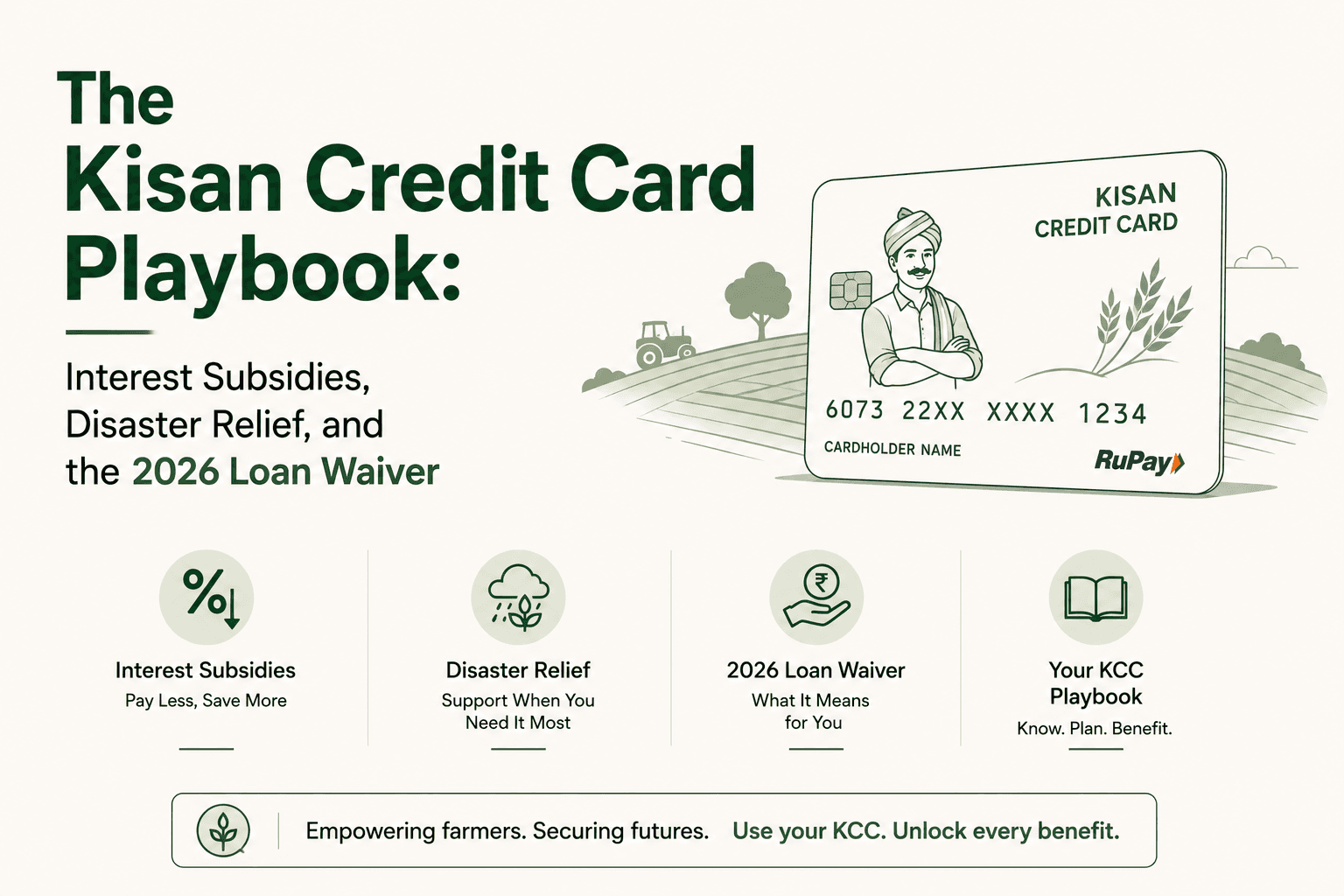
The Kisan Credit Card is not a credit card. It is a revolving short-term agricultural credit facility introduced in 1998-99 by NABARD and the Government of India. The Reserve Bank of India's Master Circular on KCC, last refreshed under the Modified Interest Subvention Scheme, is the operational rulebook.
The headline numbers that matter in 2026 are:
Loan limit raised to ₹5 lakh. The Finance Minister's Budget 2025-26 announcement raised the KCC limit under the Modified Interest Subvention Scheme from ₹3 lakh to ₹5 lakh.
Effective interest rate of 4% if the loan is repaid on time. The base rate is 7% per annum; a 1.5% interest subvention is given to the bank, and an additional 3% Prompt Repayment Incentive (PRI) is passed to the farmer if dues are cleared by the due date.
Tenure of one year, renewable annually for five years without fresh documentation, provided the account stays regular.
Covers crops, animal husbandry, dairy, fisheries, beekeeping: the full spread of allied activities under the scheme.
The PRI is the crucial number. Repay on time, the effective rate is 4%. Miss the due date even once, and the entire 3% PRI is lost for that cycle — the rate jumps to 7%. Default further, and standard NPA interest rates kick in.
Why KCC accounts go bad?
Three patterns account for almost every distressed KCC account.
1. Crop failure in the cycle. The single biggest cause. The harvest that was supposed to repay the loan didn't happen, and the farmer cannot renew without first closing the previous cycle.
2. Repayment from non-farm income. Farmers in marginal areas repay the KCC from family salaries, MGNREGA wages, or remittances. When that secondary income drops, the KCC follows.
3. Renewal without inspection. The bank or cooperative is supposed to inspect the field before renewing. In practice, many renewals happen on paper. The next failure exposes the gap.
What the rules give you when a KCC is in trouble?
This is the part most farmers don't know.
Severe natural calamity protection. Where a crop loss is officially declared a severe natural calamity by the State, the interest subvention is extended for up to three years on the restructured loan, the loan is converted to a medium-term agricultural loan, and the repayment is rescheduled across the converted tenure. Tamil Nadu has invoked this provision multiple times, during the 2018 cyclone, the 2021 unseasonal rains, and the 2023 cyclone events. Eligibility is automatic once the State declares the area affected.
Restructuring without NPA classification. Under RBI's restructuring norms for agricultural loans, a restructuring done within the calamity-relief framework does not trigger an NPA classification. The credit history remains clean.
Continued KCC eligibility. A farmer whose previous KCC was restructured under calamity relief remains eligible for fresh KCC limits for the next season, subject to normal underwriting.
The 2026 Tamil Nadu crop-loan waiver
In May 2026, the Tamil Nadu Government announced a crop-loan waiver covering cooperative-bank loans taken between May 2025 and February 2026. The tiered structure:
Up to ₹50,000 - full waiver.
₹50,000 to ₹60,000 - ₹40,000 relief.
₹60,000 to ₹70,000 - ₹30,000 relief.
₹70,000 to ₹80,000 - ₹20,000 relief.
₹80,000 to ₹90,000 - ₹10,000 relief.
Above ₹1 lakh - ₹5,000 relief.
The scheme covers around 14.22 lakh marginal farmers with an outlay of ₹2,044 crore. The waiver applies only to cooperative-bank crop loans in that window — KCC loans from commercial banks are not covered.
Eligibility lists are published at PACS and Block offices. There is no separate application form. What every farmer should do, regardless of whether their account is in trouble:
Visit the PACS or Block office and verify that your name appears on the eligibility list.
If the loan was eligible but your name is not on the list, raise an objection in writing through the Block Development Officer.
Collect the waiver acknowledgement letter — this is the document future fresh-loan applications will rely on.
The five-step playbook if your KCC is overdue
1. Confirm classification. Ask the PACS or branch whether your account is overdue, NPA, or restructured. Each status has different consequences.
2. Check calamity-relief eligibility. If your district was officially affected during the loan cycle, the calamity-relief restructuring should apply automatically. If it hasn't, ask in writing — this is the single most powerful protection available.
3. Check the 2026 waiver eligibility. As above.
4. Apply for restructuring with a hardship explanation. Outside calamity relief, restructuring is still available on application. Provide crop loss documentation, household income evidence, and a realistic repayment proposal.
5. Do not abandon the relationship. PACS recovery is relationship-driven. Showing up at the society meeting, explaining the situation, and offering whatever you can pay is almost always better than disappearing. Cooperative recovery officers have far more discretion than commercial-bank ones — and far less appetite for adversarial recovery.
The bottom line. The KCC was designed for farmers who would have bad years. The interest subvention, the calamity-relief restructuring, the renewable five-year cycle — all of it was built to absorb shocks. Farmers who lose the most are the ones who go quiet. The system is set up for the ones who keep talking.
Murugan, a 44-year-old farmer in Pudukkottai with three acres of paddy and a small banana patch, has been holding a Kisan Credit Card since 2018. He drew ₹1.8 lakh against it last season, the crop failed in the November rain, and the dues are now in their third month of overdue. The PACS secretary has been polite. The DCCB recovery officer has been less polite. Murugan has stopped opening the door when he sees the cooperative jeep.
This is the situation a few crore Indian farmers find themselves in some year of their KCC life. The system was built with this scenario in mind. Most farmers don't know how it is supposed to work.
What the KCC actually is?
The Kisan Credit Card is not a credit card. It is a revolving short-term agricultural credit facility introduced in 1998-99 by NABARD and the Government of India. The Reserve Bank of India's Master Circular on KCC, last refreshed under the Modified Interest Subvention Scheme, is the operational rulebook.
The headline numbers that matter in 2026 are:
Loan limit raised to ₹5 lakh. The Finance Minister's Budget 2025-26 announcement raised the KCC limit under the Modified Interest Subvention Scheme from ₹3 lakh to ₹5 lakh.
Effective interest rate of 4% if the loan is repaid on time. The base rate is 7% per annum; a 1.5% interest subvention is given to the bank, and an additional 3% Prompt Repayment Incentive (PRI) is passed to the farmer if dues are cleared by the due date.
Tenure of one year, renewable annually for five years without fresh documentation, provided the account stays regular.
Covers crops, animal husbandry, dairy, fisheries, beekeeping: the full spread of allied activities under the scheme.
The PRI is the crucial number. Repay on time, the effective rate is 4%. Miss the due date even once, and the entire 3% PRI is lost for that cycle — the rate jumps to 7%. Default further, and standard NPA interest rates kick in.
Why KCC accounts go bad?
Three patterns account for almost every distressed KCC account.
1. Crop failure in the cycle. The single biggest cause. The harvest that was supposed to repay the loan didn't happen, and the farmer cannot renew without first closing the previous cycle.
2. Repayment from non-farm income. Farmers in marginal areas repay the KCC from family salaries, MGNREGA wages, or remittances. When that secondary income drops, the KCC follows.
3. Renewal without inspection. The bank or cooperative is supposed to inspect the field before renewing. In practice, many renewals happen on paper. The next failure exposes the gap.
What the rules give you when a KCC is in trouble?
This is the part most farmers don't know.
Severe natural calamity protection. Where a crop loss is officially declared a severe natural calamity by the State, the interest subvention is extended for up to three years on the restructured loan, the loan is converted to a medium-term agricultural loan, and the repayment is rescheduled across the converted tenure. Tamil Nadu has invoked this provision multiple times, during the 2018 cyclone, the 2021 unseasonal rains, and the 2023 cyclone events. Eligibility is automatic once the State declares the area affected.
Restructuring without NPA classification. Under RBI's restructuring norms for agricultural loans, a restructuring done within the calamity-relief framework does not trigger an NPA classification. The credit history remains clean.
Continued KCC eligibility. A farmer whose previous KCC was restructured under calamity relief remains eligible for fresh KCC limits for the next season, subject to normal underwriting.
The 2026 Tamil Nadu crop-loan waiver
In May 2026, the Tamil Nadu Government announced a crop-loan waiver covering cooperative-bank loans taken between May 2025 and February 2026. The tiered structure:
Up to ₹50,000 - full waiver.
₹50,000 to ₹60,000 - ₹40,000 relief.
₹60,000 to ₹70,000 - ₹30,000 relief.
₹70,000 to ₹80,000 - ₹20,000 relief.
₹80,000 to ₹90,000 - ₹10,000 relief.
Above ₹1 lakh - ₹5,000 relief.
The scheme covers around 14.22 lakh marginal farmers with an outlay of ₹2,044 crore. The waiver applies only to cooperative-bank crop loans in that window — KCC loans from commercial banks are not covered.
Eligibility lists are published at PACS and Block offices. There is no separate application form. What every farmer should do, regardless of whether their account is in trouble:
Visit the PACS or Block office and verify that your name appears on the eligibility list.
If the loan was eligible but your name is not on the list, raise an objection in writing through the Block Development Officer.
Collect the waiver acknowledgement letter — this is the document future fresh-loan applications will rely on.
The five-step playbook if your KCC is overdue
1. Confirm classification. Ask the PACS or branch whether your account is overdue, NPA, or restructured. Each status has different consequences.
2. Check calamity-relief eligibility. If your district was officially affected during the loan cycle, the calamity-relief restructuring should apply automatically. If it hasn't, ask in writing — this is the single most powerful protection available.
3. Check the 2026 waiver eligibility. As above.
4. Apply for restructuring with a hardship explanation. Outside calamity relief, restructuring is still available on application. Provide crop loss documentation, household income evidence, and a realistic repayment proposal.
5. Do not abandon the relationship. PACS recovery is relationship-driven. Showing up at the society meeting, explaining the situation, and offering whatever you can pay is almost always better than disappearing. Cooperative recovery officers have far more discretion than commercial-bank ones — and far less appetite for adversarial recovery.
The bottom line. The KCC was designed for farmers who would have bad years. The interest subvention, the calamity-relief restructuring, the renewable five-year cycle — all of it was built to absorb shocks. Farmers who lose the most are the ones who go quiet. The system is set up for the ones who keep talking.