


A 41-year-old auto-parts shop owner in Hosur, Krishnamoorthy, owed a public-sector bank ₹6.4 lakh on a working-capital loan. The bank's recovery officer had been calling for months. He'd been quoted ₹4.2 lakh as a settlement, but the lawyer was talking about ₹40,000 in fees and a six-month process. Then a notice arrived from the bank, his case had been "referred to Lok Adalat" on a Saturday three weeks away.
He almost didn't go. Most borrowers don't. And that is the single biggest unforced error in Indian debt recovery.
Krishnamoorthy walked out of the Hosur court complex that Saturday afternoon with his loan closed at ₹3.1 lakh, no further dues, no lawyer fee, and a signed award that carries the weight of a civil-court decree.
What a Lok Adalat actually is?
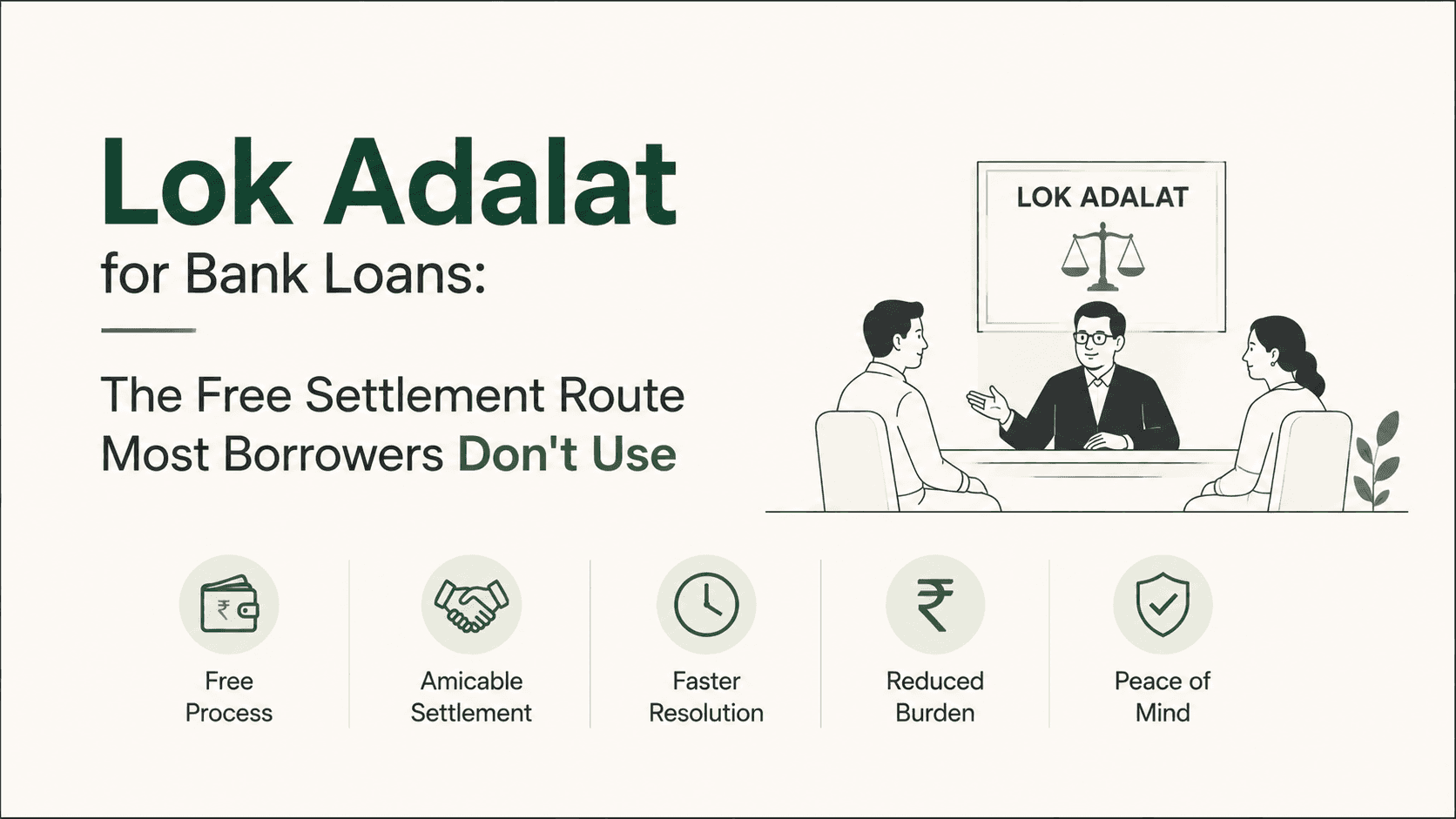
A Lok Adalat is a "people's court" constituted under the Legal Services Authorities Act, 1987. It is presided over by a sitting or retired judge, but functions less like a courtroom and more like a structured settlement camp.
Three things make it unusual.
There is no court fee. Existing court fees, if any, are refunded if the case is settled.
The award has decree value. A settlement signed at a Lok Adalat is binding, final, and non-appealable. The bank cannot later come back for the deficit.
The conciliation is led by the judge. Banks send authorised officers with pre-approved settlement bands. Borrowers are encouraged to discuss directly.
Tamil Nadu holds the largest number of Lok Adalats in the country — over a thousand pre-litigation Lok Adalats and National Lok Adalats every year, organised by the Tamil Nadu State Legal Services Authority (TNSLSA) and the District Legal Services Authorities (DLSAs).
Which loans actually go to Lok Adalat?
Almost all retail and small-business loan disputes — credit cards, personal loans, education loans, vehicle loans, gold loans, MSME working-capital limits, and small home loans (typically below ₹20 lakh).
Larger commercial loans and active SARFAESI cases tend to go through Debt Recovery Tribunals instead. But pre-SARFAESI disputes can be and often are taken up at Lok Adalats with the same effect.
Where the settlement actually settles?
The pre-decided bands banks bring to Lok Adalats are usually more generous than what their internal recovery cells would offer in private. Why? Because the alternative is a multi-year DRT process the bank does not want to fund either.
A reasonable range for unsecured retail loans at Lok Adalat — 45% to 60% of outstanding. For secured loans (gold, vehicle, small property) — 65% to 80%. For genuine hardship cases (medical, job loss with documentation), banks have settled at lower numbers.
The award is signed on the spot. The bank issues a no-dues certificate within 30–45 days. The closure is reported to all four credit bureaus as "Closed" — not "Settled" — which is the most powerful protection a Lok Adalat offers over a private settlement.
How to get your case into a Lok Adalat?
There are three routes.
1. The bank refers it. If your account is in the recovery pipeline, ask the recovery officer in writing — "please refer this account to the next Lok Adalat." Banks frequently agree because a Lok Adalat closure counts toward their recovery targets.
2. You request the DLSA directly. Walk into the District Legal Services Authority office in your district headquarters. There is no fee. Submit a simple application with the loan details and ask for the case to be listed at the next sitting.
3. You appear at a National Lok Adalat. These are held quarterly across India (usually March, June, September, December). Schedules are published on the NALSA and TNSLSA websites two weeks in advance. Walk-in disputes are accepted in many districts.
Three mistakes that wreck a Lok Adalat outcome
Going without your account statement. The bank brings theirs; if you can't dispute their number, the settlement anchors on it.
Signing the award before reading the closure clause. It must explicitly say "full and final settlement of all dues, no further claims, no legal proceedings." If it doesn't, ask the judge to insert the words.
Not collecting the no-dues certificate within 45 days. The award is the agreement. The NDC is what you show the bureau and future lenders. Both matter.
The bottom line. Banks fight expensively in courts they don't want to be in. Lok Adalat is the room where both sides can finally exhale. The borrowers who lose the most in Indian debt recovery aren't the ones who can't pay — they're the ones who didn't show up on Saturday morning.
A 41-year-old auto-parts shop owner in Hosur, Krishnamoorthy, owed a public-sector bank ₹6.4 lakh on a working-capital loan. The bank's recovery officer had been calling for months. He'd been quoted ₹4.2 lakh as a settlement, but the lawyer was talking about ₹40,000 in fees and a six-month process. Then a notice arrived from the bank, his case had been "referred to Lok Adalat" on a Saturday three weeks away.
He almost didn't go. Most borrowers don't. And that is the single biggest unforced error in Indian debt recovery.
Krishnamoorthy walked out of the Hosur court complex that Saturday afternoon with his loan closed at ₹3.1 lakh, no further dues, no lawyer fee, and a signed award that carries the weight of a civil-court decree.
What a Lok Adalat actually is?
A Lok Adalat is a "people's court" constituted under the Legal Services Authorities Act, 1987. It is presided over by a sitting or retired judge, but functions less like a courtroom and more like a structured settlement camp.
Three things make it unusual.
There is no court fee. Existing court fees, if any, are refunded if the case is settled.
The award has decree value. A settlement signed at a Lok Adalat is binding, final, and non-appealable. The bank cannot later come back for the deficit.
The conciliation is led by the judge. Banks send authorised officers with pre-approved settlement bands. Borrowers are encouraged to discuss directly.
Tamil Nadu holds the largest number of Lok Adalats in the country — over a thousand pre-litigation Lok Adalats and National Lok Adalats every year, organised by the Tamil Nadu State Legal Services Authority (TNSLSA) and the District Legal Services Authorities (DLSAs).
Which loans actually go to Lok Adalat?
Almost all retail and small-business loan disputes — credit cards, personal loans, education loans, vehicle loans, gold loans, MSME working-capital limits, and small home loans (typically below ₹20 lakh).
Larger commercial loans and active SARFAESI cases tend to go through Debt Recovery Tribunals instead. But pre-SARFAESI disputes can be and often are taken up at Lok Adalats with the same effect.
Where the settlement actually settles?
The pre-decided bands banks bring to Lok Adalats are usually more generous than what their internal recovery cells would offer in private. Why? Because the alternative is a multi-year DRT process the bank does not want to fund either.
A reasonable range for unsecured retail loans at Lok Adalat — 45% to 60% of outstanding. For secured loans (gold, vehicle, small property) — 65% to 80%. For genuine hardship cases (medical, job loss with documentation), banks have settled at lower numbers.
The award is signed on the spot. The bank issues a no-dues certificate within 30–45 days. The closure is reported to all four credit bureaus as "Closed" — not "Settled" — which is the most powerful protection a Lok Adalat offers over a private settlement.
How to get your case into a Lok Adalat?
There are three routes.
1. The bank refers it. If your account is in the recovery pipeline, ask the recovery officer in writing — "please refer this account to the next Lok Adalat." Banks frequently agree because a Lok Adalat closure counts toward their recovery targets.
2. You request the DLSA directly. Walk into the District Legal Services Authority office in your district headquarters. There is no fee. Submit a simple application with the loan details and ask for the case to be listed at the next sitting.
3. You appear at a National Lok Adalat. These are held quarterly across India (usually March, June, September, December). Schedules are published on the NALSA and TNSLSA websites two weeks in advance. Walk-in disputes are accepted in many districts.
Three mistakes that wreck a Lok Adalat outcome
Going without your account statement. The bank brings theirs; if you can't dispute their number, the settlement anchors on it.
Signing the award before reading the closure clause. It must explicitly say "full and final settlement of all dues, no further claims, no legal proceedings." If it doesn't, ask the judge to insert the words.
Not collecting the no-dues certificate within 45 days. The award is the agreement. The NDC is what you show the bureau and future lenders. Both matter.
The bottom line. Banks fight expensively in courts they don't want to be in. Lok Adalat is the room where both sides can finally exhale. The borrowers who lose the most in Indian debt recovery aren't the ones who can't pay — they're the ones who didn't show up on Saturday morning.