


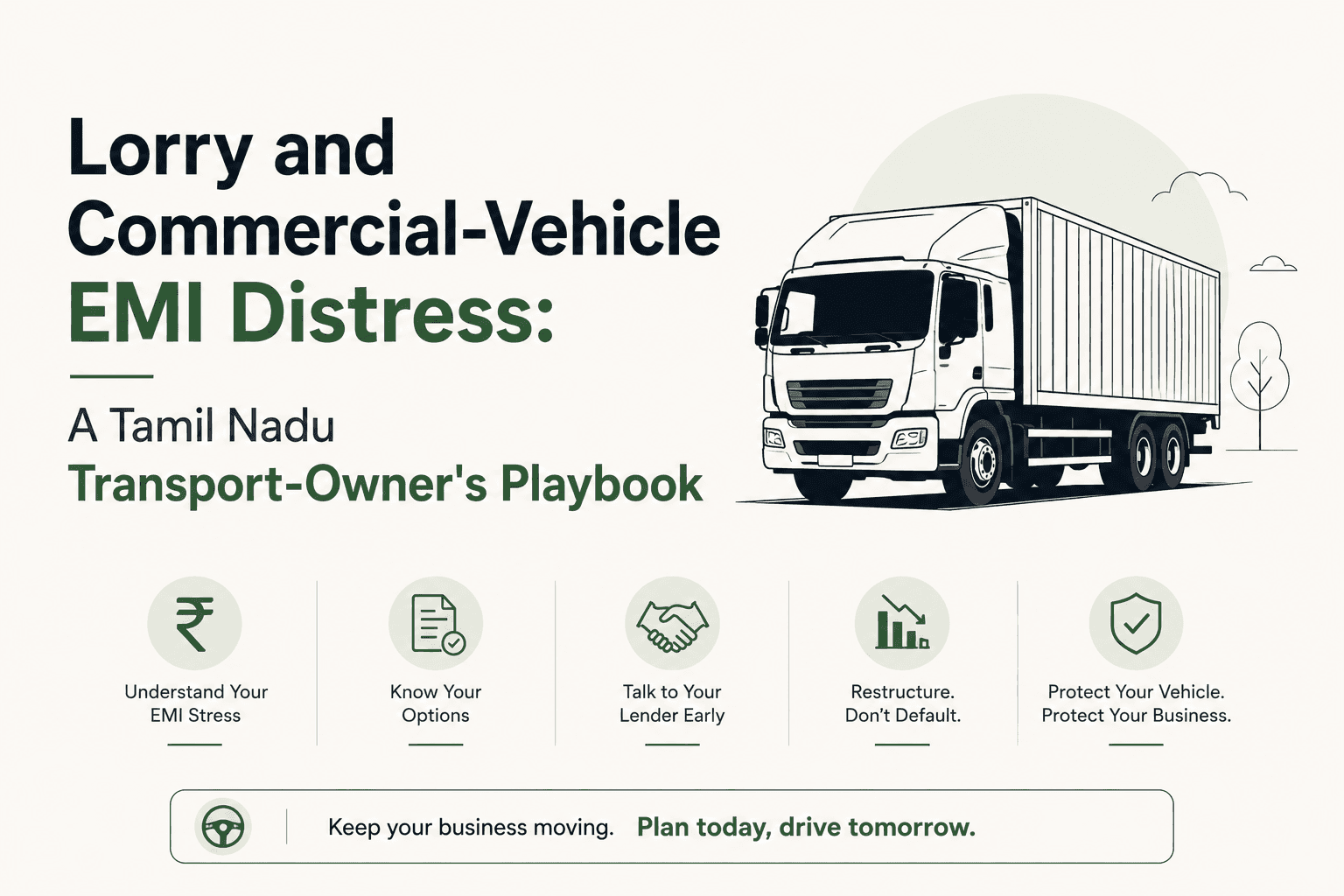
Sundaram, a 38-year-old lorry-owner from Namakkal, runs two ten-wheel trucks on the Bengaluru–Salem–Madurai run. Bookings are down. Diesel is up. Two of his drivers quit because the toll plazas now cost half a day. He has missed three EMIs on the second truck, bought eighteen months ago through a leading NBFC at ₹47,000 a month over four years.
The recovery officer came to the parking yard last week. He took a photograph of the truck, asked for the keys, and left without them. The next visit is "soon."
Namakkal alone has around 1.5 lakh trucks. Hosur has another large fleet. Sivakasi runs its own chemical-and-fireworks transport ecosystem. Tamil Nadu's commercial-vehicle economy is one of the country's largest — and over the last two years, EMI distress in this sector has quietly become the most under-discussed form of business loan stress in the State.
Here is what the law actually says about a financier coming for your truck, and the playbook that works.
The rule, applied to commercial vehicles
A commercial vehicle financed by a bank or NBFC is hypothecated, the financier's name appears on the RC as the registered hypothecation holder. The vehicle is the security; the borrower remains the legal owner until the financier exercises possession lawfully.
The rules around lawful possession of a hypothecated vehicle were set out by the Supreme Court in Citicorp Maruti Finance v. S. Vijayalaxmi (2012) and reaffirmed several times since. They apply equally to a delivery scooter and a ten-wheel lorry. In summary:
The borrower must be in default and must have been given written notice of the default and an opportunity to cure it.
Possession must be taken by a trained, identified, authorised agent carrying written authorisation from the lender.
The borrower must be present, or the possession must follow a proper notice; agents cannot break locks, use duplicate keys, or take the vehicle covertly.
An inventory of items left in the vehicle must be prepared and signed.
The borrower has a right of redemption, payment of overdue dues plus costs within a stated window before the vehicle is auctioned.
Most CV repossessions today still follow this framework on paper. The question is what happens at the yard or the highway when the agent arrives.
Why CV repossession is unique
A commercial vehicle is not a car. Three differences change the playbook.
The vehicle is also the business. Repossession of a personal car costs the borrower mobility. Repossession of a truck costs the borrower all future EMI-paying ability. The financier knows this. It is the reason CV lenders are often more willing to restructure than personal-vehicle lenders — repossession destroys the cash flow that would have repaid the loan.
There is a national permit, route bookings, and an FASTag. Repossession with a load on board, or without de-tagging the FASTag, creates legal complications for the financier as well. This is leverage that personal-vehicle borrowers don't have.
There is a transport-owner ecosystem. State-level associations — the Tamil Nadu Lorry Owners' Federation among them, frequently intervene in repossession disputes, sometimes successfully negotiating with the financier on the borrower's behalf. Borrowers who are members have a network that solo personal-loan borrowers don't.
If you've missed two or three EMIs and the recovery calls have started
Move now, not later. The window to restructure on favourable terms shrinks rapidly after the third missed EMI.
1. Pull together a 60-day cash-flow projection. Honest revenue projection — bookings confirmed, average rates, expected idle days. Honest cost projection, diesel, tolls, driver wages, maintenance, EMIs. Lenders restructure on the basis of demonstrated future cash flow, not on emotion.
2. Send the recovery desk a formal restructuring request. Reference the cash flow. Propose a specific change- extended tenure, reduced EMI, or a three-month moratorium followed by stepped-up payments. CV lenders have internal restructuring policies; ask the recovery officer to put your case to the policy committee.
3. Don't wait for the third demand notice. The third demand notice typically precedes possession action. Engaging after it is sent shifts the lender into "recovery" mode, where the appetite for restructuring drops.
If the recovery agent has already shown up
Three immediate steps.
1. Demand the written authorisation and the notice trail. The agent must carry written authorisation. The lender must have sent at least one pre-possession notice. Absence of either is a procedural defect you can use later.
2. Do not surrender the vehicle on the road or at the toll plaza. Repossession at unsafe locations is itself a procedural defect. Insist that any possession be at the lender's notified yard or your registered address, in your presence.
3. If possession has been taken, redeem with overdue EMIs, not full loan. Most lenders accept overdue EMIs plus repo charges (typically ₹15,000–₹35,000 for a CV) plus yard storage to release the truck. This buys time to restructure the underlying loan.
If continuing the vehicle is not financially possible
This is the harder situation. Two options work; one usually doesn't.
Voluntary surrender, in writing. Tell the lender, formally, that you cannot continue and request voluntary surrender. The vehicle is collected with dignity, sold at the lender's auction or through a sale platform, the proceeds adjusted against the loan, and the borrower notified of any shortfall. This usually preserves a "Closed" status on the credit report.
Private sale to a known buyer. Find a buyer at fair market price. The buyer pays the lender directly. The lender clears its hypothecation lien with the RTO. The balance is paid to you, or you pay the shortfall. This typically fetches 15–25% more than auction value because dealer auctions discount aggressively.
What rarely works: letting the lender repossess, then ignoring the shortfall notice. The shortfall claim survives the seizure. Under the Negotiable Instruments Act, post-dated cheques the financier holds can be triggered. The DRT can pursue the shortfall directly. None of this goes away by ignoring it.
A note on the wider stress
CV stress in Tamil Nadu is not entirely the individual borrower's fault. Diesel prices have stayed elevated. Toll plaza density has increased. Manufacturing output in some sectors has been uneven. The lenders know this. The borrowers who get the best restructuring outcomes are the ones who present the macro context alongside their own cash-flow projection, not as an excuse, but as the explanation that helps a recovery officer say yes to a longer tenure.
The bottom line. A truck is not a car. The lender knows that taking it back kills the cash flow that was supposed to repay the loan. That asymmetry is your leverage. Use it before the agent arrives at the yard, and the conversation is about tenure. Use it after, and the conversation is about possession. Same vehicle, very different conversations.
Sundaram, a 38-year-old lorry-owner from Namakkal, runs two ten-wheel trucks on the Bengaluru–Salem–Madurai run. Bookings are down. Diesel is up. Two of his drivers quit because the toll plazas now cost half a day. He has missed three EMIs on the second truck, bought eighteen months ago through a leading NBFC at ₹47,000 a month over four years.
The recovery officer came to the parking yard last week. He took a photograph of the truck, asked for the keys, and left without them. The next visit is "soon."
Namakkal alone has around 1.5 lakh trucks. Hosur has another large fleet. Sivakasi runs its own chemical-and-fireworks transport ecosystem. Tamil Nadu's commercial-vehicle economy is one of the country's largest — and over the last two years, EMI distress in this sector has quietly become the most under-discussed form of business loan stress in the State.
Here is what the law actually says about a financier coming for your truck, and the playbook that works.
The rule, applied to commercial vehicles
A commercial vehicle financed by a bank or NBFC is hypothecated, the financier's name appears on the RC as the registered hypothecation holder. The vehicle is the security; the borrower remains the legal owner until the financier exercises possession lawfully.
The rules around lawful possession of a hypothecated vehicle were set out by the Supreme Court in Citicorp Maruti Finance v. S. Vijayalaxmi (2012) and reaffirmed several times since. They apply equally to a delivery scooter and a ten-wheel lorry. In summary:
The borrower must be in default and must have been given written notice of the default and an opportunity to cure it.
Possession must be taken by a trained, identified, authorised agent carrying written authorisation from the lender.
The borrower must be present, or the possession must follow a proper notice; agents cannot break locks, use duplicate keys, or take the vehicle covertly.
An inventory of items left in the vehicle must be prepared and signed.
The borrower has a right of redemption, payment of overdue dues plus costs within a stated window before the vehicle is auctioned.
Most CV repossessions today still follow this framework on paper. The question is what happens at the yard or the highway when the agent arrives.
Why CV repossession is unique
A commercial vehicle is not a car. Three differences change the playbook.
The vehicle is also the business. Repossession of a personal car costs the borrower mobility. Repossession of a truck costs the borrower all future EMI-paying ability. The financier knows this. It is the reason CV lenders are often more willing to restructure than personal-vehicle lenders — repossession destroys the cash flow that would have repaid the loan.
There is a national permit, route bookings, and an FASTag. Repossession with a load on board, or without de-tagging the FASTag, creates legal complications for the financier as well. This is leverage that personal-vehicle borrowers don't have.
There is a transport-owner ecosystem. State-level associations — the Tamil Nadu Lorry Owners' Federation among them, frequently intervene in repossession disputes, sometimes successfully negotiating with the financier on the borrower's behalf. Borrowers who are members have a network that solo personal-loan borrowers don't.
If you've missed two or three EMIs and the recovery calls have started
Move now, not later. The window to restructure on favourable terms shrinks rapidly after the third missed EMI.
1. Pull together a 60-day cash-flow projection. Honest revenue projection — bookings confirmed, average rates, expected idle days. Honest cost projection, diesel, tolls, driver wages, maintenance, EMIs. Lenders restructure on the basis of demonstrated future cash flow, not on emotion.
2. Send the recovery desk a formal restructuring request. Reference the cash flow. Propose a specific change- extended tenure, reduced EMI, or a three-month moratorium followed by stepped-up payments. CV lenders have internal restructuring policies; ask the recovery officer to put your case to the policy committee.
3. Don't wait for the third demand notice. The third demand notice typically precedes possession action. Engaging after it is sent shifts the lender into "recovery" mode, where the appetite for restructuring drops.
If the recovery agent has already shown up
Three immediate steps.
1. Demand the written authorisation and the notice trail. The agent must carry written authorisation. The lender must have sent at least one pre-possession notice. Absence of either is a procedural defect you can use later.
2. Do not surrender the vehicle on the road or at the toll plaza. Repossession at unsafe locations is itself a procedural defect. Insist that any possession be at the lender's notified yard or your registered address, in your presence.
3. If possession has been taken, redeem with overdue EMIs, not full loan. Most lenders accept overdue EMIs plus repo charges (typically ₹15,000–₹35,000 for a CV) plus yard storage to release the truck. This buys time to restructure the underlying loan.
If continuing the vehicle is not financially possible
This is the harder situation. Two options work; one usually doesn't.
Voluntary surrender, in writing. Tell the lender, formally, that you cannot continue and request voluntary surrender. The vehicle is collected with dignity, sold at the lender's auction or through a sale platform, the proceeds adjusted against the loan, and the borrower notified of any shortfall. This usually preserves a "Closed" status on the credit report.
Private sale to a known buyer. Find a buyer at fair market price. The buyer pays the lender directly. The lender clears its hypothecation lien with the RTO. The balance is paid to you, or you pay the shortfall. This typically fetches 15–25% more than auction value because dealer auctions discount aggressively.
What rarely works: letting the lender repossess, then ignoring the shortfall notice. The shortfall claim survives the seizure. Under the Negotiable Instruments Act, post-dated cheques the financier holds can be triggered. The DRT can pursue the shortfall directly. None of this goes away by ignoring it.
A note on the wider stress
CV stress in Tamil Nadu is not entirely the individual borrower's fault. Diesel prices have stayed elevated. Toll plaza density has increased. Manufacturing output in some sectors has been uneven. The lenders know this. The borrowers who get the best restructuring outcomes are the ones who present the macro context alongside their own cash-flow projection, not as an excuse, but as the explanation that helps a recovery officer say yes to a longer tenure.
The bottom line. A truck is not a car. The lender knows that taking it back kills the cash flow that was supposed to repay the loan. That asymmetry is your leverage. Use it before the agent arrives at the yard, and the conversation is about tenure. Use it after, and the conversation is about possession. Same vehicle, very different conversations.