


A 31-year-old salaried engineer in Tambaram, Chennai applied for a personal loan last month. ₹4 lakh, three-year tenure, to fund a small renovation. His income comfortably supported the EMI. His employment was stable. His existing EMIs were minimal. He was confident the loan would be sanctioned.
The application was declined. The reason on the letter - "credit score below required threshold."
He checked. His credit score was 692. He had assumed that anything above the rumoured 650 mark was fine. He had not realised that "above 650" and "above the bank's threshold for this product" were two very different questions.
The widely-quoted "minimum Credit score" numbers are widely misunderstood. Here is what the actual landscape looks like in 2026.
A quick refresher on what a credit score is?
A credit score is a three-digit number, between 300 and 900, that represents your credit history. Four credit bureaus issue scores in India: CIBIL TransUnion, Experian, Equifax, and CRIF Highmark - each using its own model but broadly similar inputs.
What goes into the score:
Repayment history (the largest factor). Whether you have paid past EMIs and credit-card bills on time.
Credit utilisation. How much of your available credit limits you are currently using.
Length of credit history. How long you have held credit accounts.
Credit mix. Whether you have a balance of secured (home, auto) and unsecured (personal, credit card) credit.
Recent enquiries. How many lenders have pulled your report in the recent past.
The score updates monthly. Improvements you make today usually reflect on the report within 30-45 days.
The threshold landscape, in plain numbers
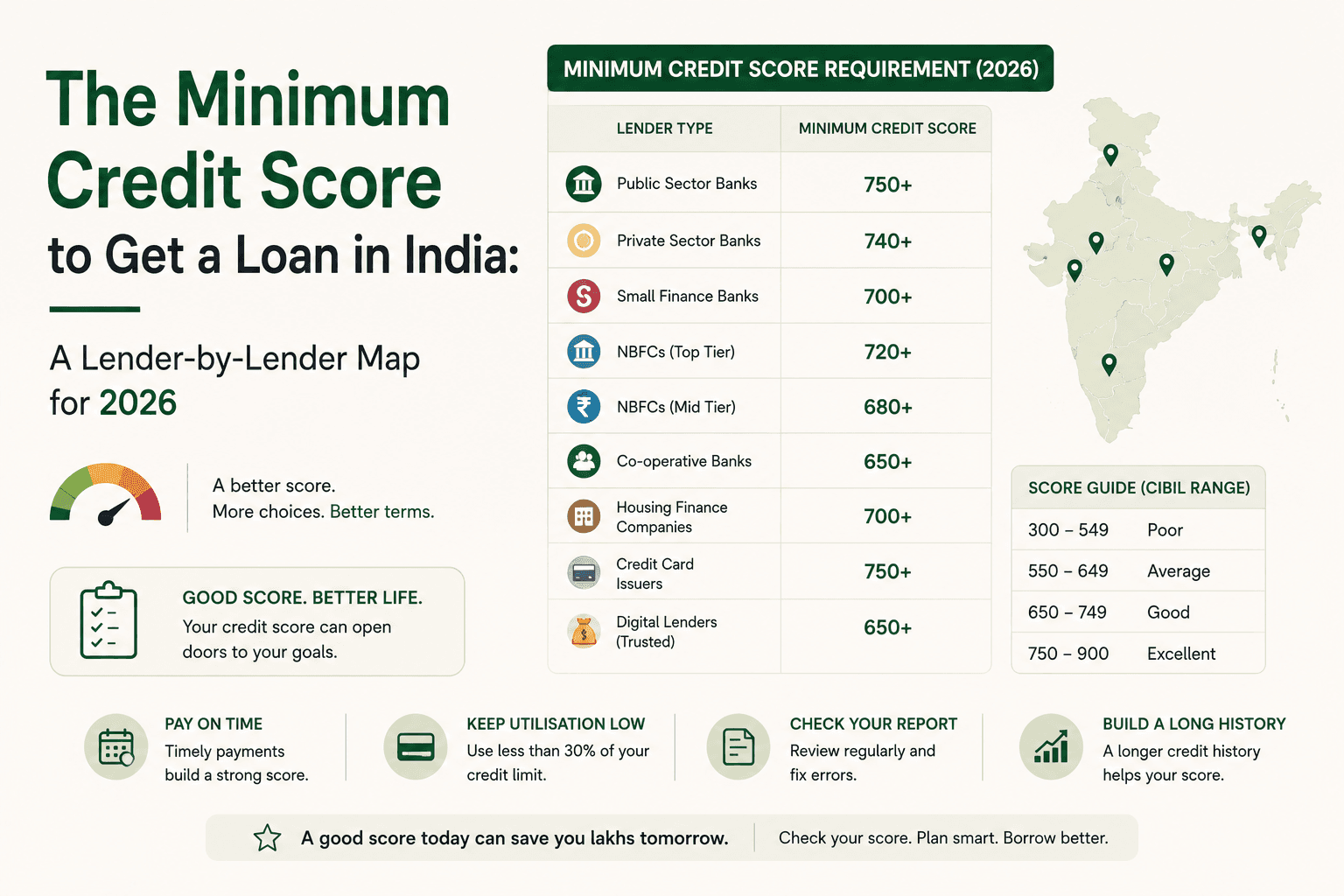
There is no single "minimum credit score" in India. There is a layered set of thresholds, by lender type and by product. Here is the practical map as of 2026.
Product / Lender type | Approximate minimum to get approved | Score for the best terms |
|---|---|---|
Credit card from a large private bank | 720+ | 750+ |
Credit card from a public-sector bank | 700+ | 750+ |
Credit card with a secured FD backing | No minimum (FD is the security) | — |
Personal loan from a large private/PSU bank | 720+ | 750+ |
Personal loan from a smaller bank or NBFC | 680–700 | 720+ |
Personal loan from a fintech-app NBFC | 650+, sometimes lower | 700+ |
Home loan from a PSU bank | 700+ (usually 720+) | 750+ |
Home loan from a private bank | 720+ | 760+ |
Home loan from a housing finance company | 680–700 | 720+ |
Vehicle loan (car/two-wheeler) from a captive lender | Often 650+ | 720+ |
Gold loan from a bank or NBFC | No score required (gold is the security) | — |
Loan-against-FD or insurance policy | No score required | — |
Three things follow from this table.
1. The number that matters is your lender's threshold, not "the" minimum. "Above 650" or "above 700" headlines are averages. Each lender publishes its own threshold internally. Two banks looking at the same applicant can reach different decisions.
2. NBFCs and fintechs accept lower scores but price higher. A personal loan at a Credit score of 660 from a fintech may be sanctioned - at 18% per annum instead of the 11-12% available to a 750+ applicant from a bank. The score affects the cost of the loan as much as the access to it.
3. Secured loans bypass the credit score. Gold loans, loans against FD, loans against insurance policy surrender value - these don't need a credit score because the asset is the security. For a household with an immediate cash need and a damaged score, these are often the most sensible bridge.
The honest 12-month plan to move from 650 to 750
If your score is currently below the threshold for the product you need, here is a calibrated plan that has worked for most borrowers. None of this is a quick fix; all of it adds up.
Month 1: Pull all four reports and clean them up.
Every Indian adult is entitled to one free credit report per year from each of the four bureaus under the Credit Information Companies (Regulation) Act, 2005. Pull all four. Lenders report to different bureaus; an entry missing on CIBIL often appears on Experian or vice versa.
Read carefully. Dispute any entry that is wrong - a closed loan still showing open, an account that isn't yours, a settled loan still showing overdue. The bureau has 30 days to investigate.
Months 2-3: Bring credit-card utilisation under 30%.
Credit utilisation is the percentage of your total credit-card limits that you currently owe. The single most powerful short-term lever on your score.
If you have a ₹2 lakh total credit limit across cards and ₹1.5 lakh outstanding (75% utilisation), bringing the outstanding to ₹60,000 (30% utilisation) typically lifts the score by 30-70 points within two months.
The two ways to do this - pay down the outstanding, or request a credit-limit increase from the bank. The ratio matters, not the absolute number.
Months 3-6: Pay every EMI and credit-card statement on time, in full.
The score model penalises a missed EMI heavily — and rewards consistent on-time payment over the following months. Auto-debit on every loan EMI and credit-card statement is the simplest safeguard.
If you have an overdue account that you can clear, do so now. A "Overdue" status on the report, once cleared and updated to "Closed", visibly improves the score over the next two cycles.
Months 6-12: Avoid new applications. Let the existing accounts age.
Each new loan or credit-card application creates a "hard enquiry" on your report. Three or more hard enquiries in six months is a red flag. Avoid new applications until you actually need them.
A modest but useful step — if you have an unused old credit card with a clean history, keep it open. Closing an old account shortens the average age of your credit history, which can quietly hurt the score.
A practical note on "loan against FD" and secured cards
For someone whose score is below threshold and who needs to demonstrate credit behaviour to rebuild — a secured credit card backed by a fixed deposit, or a loan against FD, is the single most useful tool in Indian retail credit.
Secured cards are issued by most major banks against an FD of ₹15,000-25,000. The FD continues to earn interest. The card reports to bureaus exactly like a regular card. Using it for small monthly purchases (₹2,000-5,000), paying the full statement on time for six to nine months, typically lifts a score from 650-680 to 720+ in that window. After 12-18 months, the bank often offers to upgrade to a regular unsecured card and return the FD.
This is the closest thing to a guaranteed credit-rebuild mechanism that exists in India. It is widely available and widely under-used.
What the score does not say?
A common misconception worth correcting- your credit score is not a measure of your character, your income, or your worth as a borrower. It is a measure of your past credit behaviour, narrowly. Many high-income, financially responsible Indians have low scores simply because they have never held a credit card or a loan ("NH" / "no history" status). Many lower-income borrowers have excellent scores because they have managed a small EMI cleanly for years.
If your score is currently low — for any reason — the path back is mechanical, well-documented, and works for almost every borrower who applies it patiently. There is nothing about a low score that says anything about you. There is only what the next six to twelve months can build.
The bottom line. The minimum credit score to get a loan in India is not a single number- it is a layered set of thresholds by product, by lender, and by the cost the borrower is willing to pay. Knowing where you stand on your own report, then making a few mechanical improvements over six to twelve months, lifts both access and price meaningfully. The score is a tool. The borrower remains the person.
This article is for educational purposes only and does not constitute financial, legal, tax, immigration or investment advice. Specific facts vary by case. For credit and loan-related decisions, work directly with an RBI-regulated lender or an RBI-recognised credit counsellor. For emigration and visa-related steps, consult the Ministry of External Affairs' eMigrate portal and the Protector of Emigrants. Statutes, rules and scheme parameters referenced here are accurate as of June 2026 and may be amended later — always verify with the primary source before acting.
A 31-year-old salaried engineer in Tambaram, Chennai applied for a personal loan last month. ₹4 lakh, three-year tenure, to fund a small renovation. His income comfortably supported the EMI. His employment was stable. His existing EMIs were minimal. He was confident the loan would be sanctioned.
The application was declined. The reason on the letter - "credit score below required threshold."
He checked. His credit score was 692. He had assumed that anything above the rumoured 650 mark was fine. He had not realised that "above 650" and "above the bank's threshold for this product" were two very different questions.
The widely-quoted "minimum Credit score" numbers are widely misunderstood. Here is what the actual landscape looks like in 2026.
A quick refresher on what a credit score is?
A credit score is a three-digit number, between 300 and 900, that represents your credit history. Four credit bureaus issue scores in India: CIBIL TransUnion, Experian, Equifax, and CRIF Highmark - each using its own model but broadly similar inputs.
What goes into the score:
Repayment history (the largest factor). Whether you have paid past EMIs and credit-card bills on time.
Credit utilisation. How much of your available credit limits you are currently using.
Length of credit history. How long you have held credit accounts.
Credit mix. Whether you have a balance of secured (home, auto) and unsecured (personal, credit card) credit.
Recent enquiries. How many lenders have pulled your report in the recent past.
The score updates monthly. Improvements you make today usually reflect on the report within 30-45 days.
The threshold landscape, in plain numbers
There is no single "minimum credit score" in India. There is a layered set of thresholds, by lender type and by product. Here is the practical map as of 2026.
Product / Lender type | Approximate minimum to get approved | Score for the best terms |
|---|---|---|
Credit card from a large private bank | 720+ | 750+ |
Credit card from a public-sector bank | 700+ | 750+ |
Credit card with a secured FD backing | No minimum (FD is the security) | — |
Personal loan from a large private/PSU bank | 720+ | 750+ |
Personal loan from a smaller bank or NBFC | 680–700 | 720+ |
Personal loan from a fintech-app NBFC | 650+, sometimes lower | 700+ |
Home loan from a PSU bank | 700+ (usually 720+) | 750+ |
Home loan from a private bank | 720+ | 760+ |
Home loan from a housing finance company | 680–700 | 720+ |
Vehicle loan (car/two-wheeler) from a captive lender | Often 650+ | 720+ |
Gold loan from a bank or NBFC | No score required (gold is the security) | — |
Loan-against-FD or insurance policy | No score required | — |
Three things follow from this table.
1. The number that matters is your lender's threshold, not "the" minimum. "Above 650" or "above 700" headlines are averages. Each lender publishes its own threshold internally. Two banks looking at the same applicant can reach different decisions.
2. NBFCs and fintechs accept lower scores but price higher. A personal loan at a Credit score of 660 from a fintech may be sanctioned - at 18% per annum instead of the 11-12% available to a 750+ applicant from a bank. The score affects the cost of the loan as much as the access to it.
3. Secured loans bypass the credit score. Gold loans, loans against FD, loans against insurance policy surrender value - these don't need a credit score because the asset is the security. For a household with an immediate cash need and a damaged score, these are often the most sensible bridge.
The honest 12-month plan to move from 650 to 750
If your score is currently below the threshold for the product you need, here is a calibrated plan that has worked for most borrowers. None of this is a quick fix; all of it adds up.
Month 1: Pull all four reports and clean them up.
Every Indian adult is entitled to one free credit report per year from each of the four bureaus under the Credit Information Companies (Regulation) Act, 2005. Pull all four. Lenders report to different bureaus; an entry missing on CIBIL often appears on Experian or vice versa.
Read carefully. Dispute any entry that is wrong - a closed loan still showing open, an account that isn't yours, a settled loan still showing overdue. The bureau has 30 days to investigate.
Months 2-3: Bring credit-card utilisation under 30%.
Credit utilisation is the percentage of your total credit-card limits that you currently owe. The single most powerful short-term lever on your score.
If you have a ₹2 lakh total credit limit across cards and ₹1.5 lakh outstanding (75% utilisation), bringing the outstanding to ₹60,000 (30% utilisation) typically lifts the score by 30-70 points within two months.
The two ways to do this - pay down the outstanding, or request a credit-limit increase from the bank. The ratio matters, not the absolute number.
Months 3-6: Pay every EMI and credit-card statement on time, in full.
The score model penalises a missed EMI heavily — and rewards consistent on-time payment over the following months. Auto-debit on every loan EMI and credit-card statement is the simplest safeguard.
If you have an overdue account that you can clear, do so now. A "Overdue" status on the report, once cleared and updated to "Closed", visibly improves the score over the next two cycles.
Months 6-12: Avoid new applications. Let the existing accounts age.
Each new loan or credit-card application creates a "hard enquiry" on your report. Three or more hard enquiries in six months is a red flag. Avoid new applications until you actually need them.
A modest but useful step — if you have an unused old credit card with a clean history, keep it open. Closing an old account shortens the average age of your credit history, which can quietly hurt the score.
A practical note on "loan against FD" and secured cards
For someone whose score is below threshold and who needs to demonstrate credit behaviour to rebuild — a secured credit card backed by a fixed deposit, or a loan against FD, is the single most useful tool in Indian retail credit.
Secured cards are issued by most major banks against an FD of ₹15,000-25,000. The FD continues to earn interest. The card reports to bureaus exactly like a regular card. Using it for small monthly purchases (₹2,000-5,000), paying the full statement on time for six to nine months, typically lifts a score from 650-680 to 720+ in that window. After 12-18 months, the bank often offers to upgrade to a regular unsecured card and return the FD.
This is the closest thing to a guaranteed credit-rebuild mechanism that exists in India. It is widely available and widely under-used.
What the score does not say?
A common misconception worth correcting- your credit score is not a measure of your character, your income, or your worth as a borrower. It is a measure of your past credit behaviour, narrowly. Many high-income, financially responsible Indians have low scores simply because they have never held a credit card or a loan ("NH" / "no history" status). Many lower-income borrowers have excellent scores because they have managed a small EMI cleanly for years.
If your score is currently low — for any reason — the path back is mechanical, well-documented, and works for almost every borrower who applies it patiently. There is nothing about a low score that says anything about you. There is only what the next six to twelve months can build.
The bottom line. The minimum credit score to get a loan in India is not a single number- it is a layered set of thresholds by product, by lender, and by the cost the borrower is willing to pay. Knowing where you stand on your own report, then making a few mechanical improvements over six to twelve months, lifts both access and price meaningfully. The score is a tool. The borrower remains the person.
This article is for educational purposes only and does not constitute financial, legal, tax, immigration or investment advice. Specific facts vary by case. For credit and loan-related decisions, work directly with an RBI-regulated lender or an RBI-recognised credit counsellor. For emigration and visa-related steps, consult the Ministry of External Affairs' eMigrate portal and the Protector of Emigrants. Statutes, rules and scheme parameters referenced here are accurate as of June 2026 and may be amended later — always verify with the primary source before acting.