


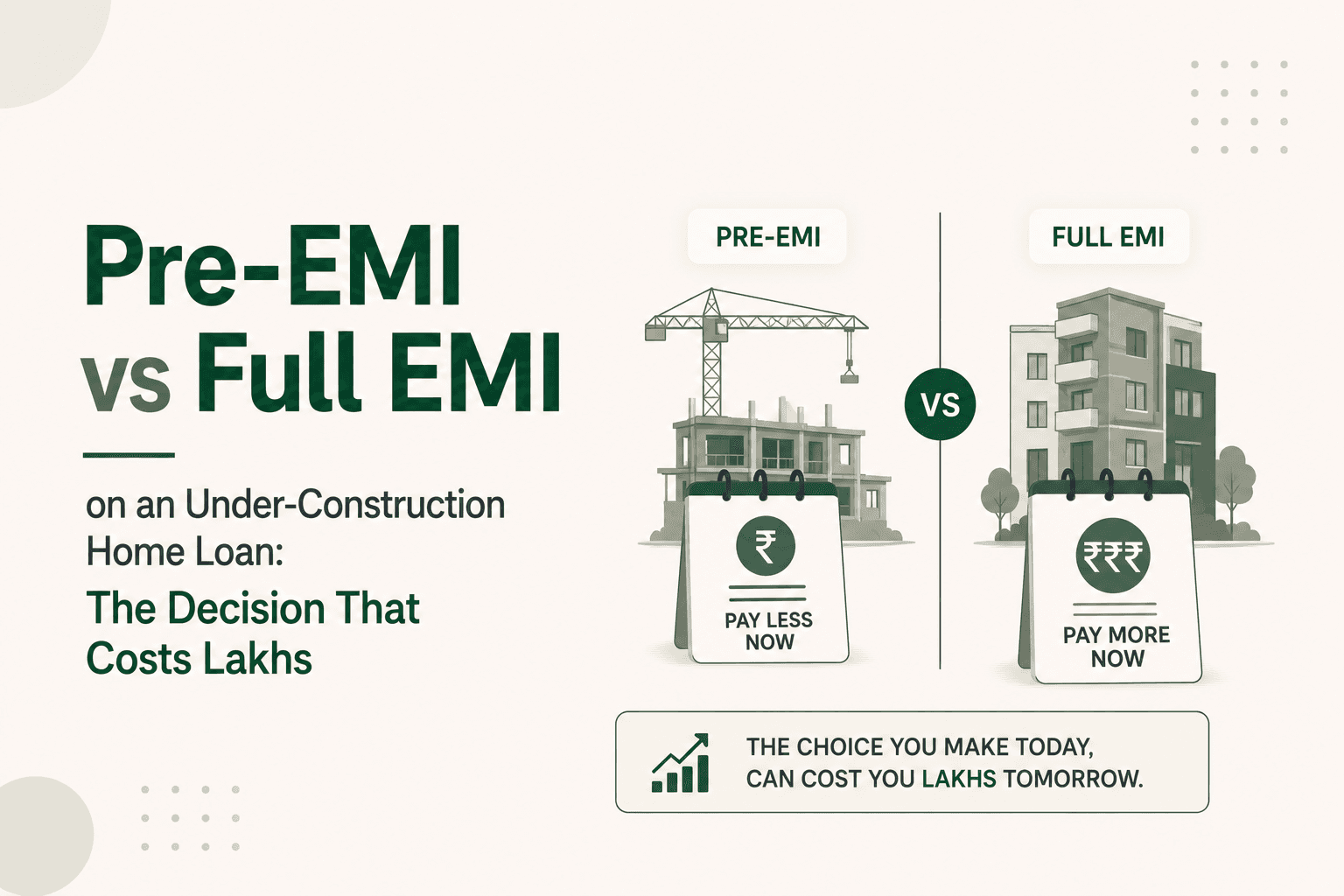
A 35-year-old IT professional in Pune booked an under-construction 2BHK in late 2023. ₹78 lakh apartment, ₹62 lakh home loan, builder-promised possession in March 2026. The loan agreement offered two options at the time of sanction. Pre-EMI: pay only the interest on the disbursed portion until possession. Full EMI, start paying the full EMI from day one of disbursement.
The relationship manager recommended Pre-EMI. "Lower monthly outflow, cash flow comfortable." The buyer signed. For 28 months, he paid only the interest portion as the builder drew down the loan tranche by tranche. The principal did not reduce. The tenure did not shorten. The interest paid during the construction window - roughly ₹9 lakh - was not deductible in those years.
Possession came in mid-2026. The full EMI now started, on the entire ₹62 lakh principal, for the full 20-year tenure. The ₹9 lakh of construction-period interest will be claimed under Section 24(b), in five equal installments, starting from the year of possession, subject to the overall ₹2 lakh annual cap. Some of the deduction will be wasted because the cap was already being hit by current-year interest.
Pre-EMI was not the wrong choice for him. It also wasn't obviously the right choice. The comparison is one of the most consequential decisions an Indian under-construction-property buyer makes, and most relationship managers don't walk through the math.
Here is the math.
What the two options actually are?
For an under-construction home loan, the lender disburses the loan amount in tranches as construction milestones are hit. Until possession, the full loan is not outstanding — only the amount drawn so far. The two options are:
Pre-EMI. Until possession, the borrower pays only the interest on the cumulative amount disbursed so far. No principal is repaid in this period. Once possession happens, full EMI begins on the entire loan amount.
Full EMI. From the day of the first disbursement, the borrower pays the full EMI as if the entire loan were already outstanding. Even though only a portion is disbursed, the EMI reflects the full sanctioned amount.
Both options have the same total loan to repay. The difference is when the principal repayment begins, and that difference cascades into cash flow, total interest paid, and tax benefits.
The four real differences
1. Cash outflow during the construction window.
Pre-EMI is dramatically lighter. For the Pune buyer above, Pre-EMI on the disbursed portion was around ₹26,000-₹32,000 a month during the 28-month construction window. The Full EMI on the same loan would have been ₹52,000 a month from day one. For a household running a rental on top of the EMI, that cash-flow difference is real and material.
2. Total interest paid over the life of the loan.
Full EMI is materially cheaper. Because principal repayment starts immediately, the loan amortises faster, and the total interest paid over the tenure is meaningfully lower. On a ₹62 lakh loan at 8.5% over 20 years, the difference can be ₹6-9 lakh in total interest, depending on the construction window length.
3. Tax treatment of construction-period interest.
Under Section 24(b) of the Income-Tax Act, 1961, interest paid during the pre-possession period is not deductible in the year it is paid. It is accumulated and deductible in five equal installments starting from the year of possession. The overall ₹2 lakh annual cap (for self-occupied property) still applies in each of those years.
This creates a quiet trap. If your post-possession interest is already at or near the ₹2 lakh cap, the deferred construction-period interest gets partially or fully wasted - there is no room in the cap to absorb it. For high-loan-amount buyers, this can mean ₹1.5-3 lakh of construction-period interest never produces a tax benefit at all.
Under Full EMI, the interest paid in any year is current-year interest, fully deductible in that year (within the ₹2 lakh cap). If a portion of the loan amount has been disbursed and full EMI is being paid, the interest portion of the EMI in that year is deductible in that year, assuming the property is occupied or rented after possession.
For a salaried buyer in the old tax regime with a loan large enough to exceed the ₹2 lakh annual cap, Full EMI captures more of the available tax benefit. For a buyer in the new regime, the tax treatment is mostly moot since most home-loan deductions are not available regardless.
4. Possession risk.
This is the underdiscussed factor. India's real-estate market has a long history of delayed possession. RERA (Real Estate Regulation Act, 2016) has improved the situation but not eliminated it. If your property is delayed by 12-24 months — which is genuinely common — Pre-EMI extends the construction window correspondingly, total interest paid balloons, and the tax-benefit accumulation worsens.
Full EMI is more punishing to the cash flow during the delay, but at least principal repayment is happening. The borrower in a Pre-EMI structure with a 3-year delay has paid ₹18-25 lakh of interest with zero principal reduction.
When Pre-EMI is genuinely the right choice
Three situations.
You are renting on top of the EMI. If you are currently paying rent at your job location and the EMI is for a property in your home city (or vice versa), the cash-flow strain of Full EMI may be unsustainable. Pre-EMI keeps you solvent through the construction window.
The construction period is short and known. If the property is genuinely at the final stage — 6-12 months from possession — the savings of Pre-EMI are small and the trade-off in total interest is modest. Pre-EMI works fine.
You are in the new tax regime. Since home-loan deductions on self-occupied property are largely unavailable under the new regime, the deferred-interest issue under Pre-EMI is less consequential. The choice becomes a pure cash-flow vs total-interest decision.
When Full EMI is the right choice?
Three situations.
You can afford the cash outflow. If your household income comfortably supports the full EMI alongside other commitments, take Full EMI. The total interest savings are real, the principal reduction starts day one, and the tax benefit (under the old regime) is captured currently.
You are in the old tax regime and the loan is large enough to exceed the ₹2 lakh annual cap. Full EMI captures the deduction year-on-year. Pre-EMI defers it into a cap that will likely be over-full when it arrives.
You suspect possession delay risk. Builder-promised dates in India have a meaningful slippage rate. Full EMI protects you by amortising the loan regardless of delay.
The structured EMI hybrid
A small but useful detail- many lenders offer a "Tranched EMI" or "Structured Full EMI" variant. As each tranche is disbursed, the EMI steps up proportionally. By the time the final tranche is disbursed at possession, you are paying the full EMI. This hybrid often captures most of the Full-EMI benefit without the day-one cash strain. Worth asking the lender about specifically — the relationship manager rarely volunteers it.
What to do in the next 30 days (if you have signed Pre-EMI but possession is still away)
Most lenders allow a mid-loan switch from Pre-EMI to Full EMI on written request. There is usually no fee, but the documentation takes 2-4 weeks. If your cash flow has improved since the original signing, and possession is still 12+ months away, this switch can save ₹3-6 lakh of total interest on a meaningful loan size. Worth the paperwork.
The bottom line. Pre-EMI looks gentler. It is also, for most buyers in the old tax regime with a meaningful loan amount, materially more expensive over the life of the loan and the tax benefit it defers often arrives in a year where the cap is already full. The honest decision needs four numbers: cash flow today, total interest over tenure, tax treatment under your regime, and possession-delay risk. Most relationship managers walk through one of the four.
This article is for educational purposes only and does not constitute financial, legal, tax or investment advice. Specific facts vary by case. For credit and loan-related decisions, work directly with an RBI-regulated lender or an RBI-recognised credit counsellor. For tax positions, consult a qualified chartered accountant. Statutes, RBI circulars, and tax provisions referenced are accurate as of June 2026 and may be amended later — always verify with the primary source before acting.
A 35-year-old IT professional in Pune booked an under-construction 2BHK in late 2023. ₹78 lakh apartment, ₹62 lakh home loan, builder-promised possession in March 2026. The loan agreement offered two options at the time of sanction. Pre-EMI: pay only the interest on the disbursed portion until possession. Full EMI, start paying the full EMI from day one of disbursement.
The relationship manager recommended Pre-EMI. "Lower monthly outflow, cash flow comfortable." The buyer signed. For 28 months, he paid only the interest portion as the builder drew down the loan tranche by tranche. The principal did not reduce. The tenure did not shorten. The interest paid during the construction window - roughly ₹9 lakh - was not deductible in those years.
Possession came in mid-2026. The full EMI now started, on the entire ₹62 lakh principal, for the full 20-year tenure. The ₹9 lakh of construction-period interest will be claimed under Section 24(b), in five equal installments, starting from the year of possession, subject to the overall ₹2 lakh annual cap. Some of the deduction will be wasted because the cap was already being hit by current-year interest.
Pre-EMI was not the wrong choice for him. It also wasn't obviously the right choice. The comparison is one of the most consequential decisions an Indian under-construction-property buyer makes, and most relationship managers don't walk through the math.
Here is the math.
What the two options actually are?
For an under-construction home loan, the lender disburses the loan amount in tranches as construction milestones are hit. Until possession, the full loan is not outstanding — only the amount drawn so far. The two options are:
Pre-EMI. Until possession, the borrower pays only the interest on the cumulative amount disbursed so far. No principal is repaid in this period. Once possession happens, full EMI begins on the entire loan amount.
Full EMI. From the day of the first disbursement, the borrower pays the full EMI as if the entire loan were already outstanding. Even though only a portion is disbursed, the EMI reflects the full sanctioned amount.
Both options have the same total loan to repay. The difference is when the principal repayment begins, and that difference cascades into cash flow, total interest paid, and tax benefits.
The four real differences
1. Cash outflow during the construction window.
Pre-EMI is dramatically lighter. For the Pune buyer above, Pre-EMI on the disbursed portion was around ₹26,000-₹32,000 a month during the 28-month construction window. The Full EMI on the same loan would have been ₹52,000 a month from day one. For a household running a rental on top of the EMI, that cash-flow difference is real and material.
2. Total interest paid over the life of the loan.
Full EMI is materially cheaper. Because principal repayment starts immediately, the loan amortises faster, and the total interest paid over the tenure is meaningfully lower. On a ₹62 lakh loan at 8.5% over 20 years, the difference can be ₹6-9 lakh in total interest, depending on the construction window length.
3. Tax treatment of construction-period interest.
Under Section 24(b) of the Income-Tax Act, 1961, interest paid during the pre-possession period is not deductible in the year it is paid. It is accumulated and deductible in five equal installments starting from the year of possession. The overall ₹2 lakh annual cap (for self-occupied property) still applies in each of those years.
This creates a quiet trap. If your post-possession interest is already at or near the ₹2 lakh cap, the deferred construction-period interest gets partially or fully wasted - there is no room in the cap to absorb it. For high-loan-amount buyers, this can mean ₹1.5-3 lakh of construction-period interest never produces a tax benefit at all.
Under Full EMI, the interest paid in any year is current-year interest, fully deductible in that year (within the ₹2 lakh cap). If a portion of the loan amount has been disbursed and full EMI is being paid, the interest portion of the EMI in that year is deductible in that year, assuming the property is occupied or rented after possession.
For a salaried buyer in the old tax regime with a loan large enough to exceed the ₹2 lakh annual cap, Full EMI captures more of the available tax benefit. For a buyer in the new regime, the tax treatment is mostly moot since most home-loan deductions are not available regardless.
4. Possession risk.
This is the underdiscussed factor. India's real-estate market has a long history of delayed possession. RERA (Real Estate Regulation Act, 2016) has improved the situation but not eliminated it. If your property is delayed by 12-24 months — which is genuinely common — Pre-EMI extends the construction window correspondingly, total interest paid balloons, and the tax-benefit accumulation worsens.
Full EMI is more punishing to the cash flow during the delay, but at least principal repayment is happening. The borrower in a Pre-EMI structure with a 3-year delay has paid ₹18-25 lakh of interest with zero principal reduction.
When Pre-EMI is genuinely the right choice
Three situations.
You are renting on top of the EMI. If you are currently paying rent at your job location and the EMI is for a property in your home city (or vice versa), the cash-flow strain of Full EMI may be unsustainable. Pre-EMI keeps you solvent through the construction window.
The construction period is short and known. If the property is genuinely at the final stage — 6-12 months from possession — the savings of Pre-EMI are small and the trade-off in total interest is modest. Pre-EMI works fine.
You are in the new tax regime. Since home-loan deductions on self-occupied property are largely unavailable under the new regime, the deferred-interest issue under Pre-EMI is less consequential. The choice becomes a pure cash-flow vs total-interest decision.
When Full EMI is the right choice?
Three situations.
You can afford the cash outflow. If your household income comfortably supports the full EMI alongside other commitments, take Full EMI. The total interest savings are real, the principal reduction starts day one, and the tax benefit (under the old regime) is captured currently.
You are in the old tax regime and the loan is large enough to exceed the ₹2 lakh annual cap. Full EMI captures the deduction year-on-year. Pre-EMI defers it into a cap that will likely be over-full when it arrives.
You suspect possession delay risk. Builder-promised dates in India have a meaningful slippage rate. Full EMI protects you by amortising the loan regardless of delay.
The structured EMI hybrid
A small but useful detail- many lenders offer a "Tranched EMI" or "Structured Full EMI" variant. As each tranche is disbursed, the EMI steps up proportionally. By the time the final tranche is disbursed at possession, you are paying the full EMI. This hybrid often captures most of the Full-EMI benefit without the day-one cash strain. Worth asking the lender about specifically — the relationship manager rarely volunteers it.
What to do in the next 30 days (if you have signed Pre-EMI but possession is still away)
Most lenders allow a mid-loan switch from Pre-EMI to Full EMI on written request. There is usually no fee, but the documentation takes 2-4 weeks. If your cash flow has improved since the original signing, and possession is still 12+ months away, this switch can save ₹3-6 lakh of total interest on a meaningful loan size. Worth the paperwork.
The bottom line. Pre-EMI looks gentler. It is also, for most buyers in the old tax regime with a meaningful loan amount, materially more expensive over the life of the loan and the tax benefit it defers often arrives in a year where the cap is already full. The honest decision needs four numbers: cash flow today, total interest over tenure, tax treatment under your regime, and possession-delay risk. Most relationship managers walk through one of the four.
This article is for educational purposes only and does not constitute financial, legal, tax or investment advice. Specific facts vary by case. For credit and loan-related decisions, work directly with an RBI-regulated lender or an RBI-recognised credit counsellor. For tax positions, consult a qualified chartered accountant. Statutes, RBI circulars, and tax provisions referenced are accurate as of June 2026 and may be amended later — always verify with the primary source before acting.