


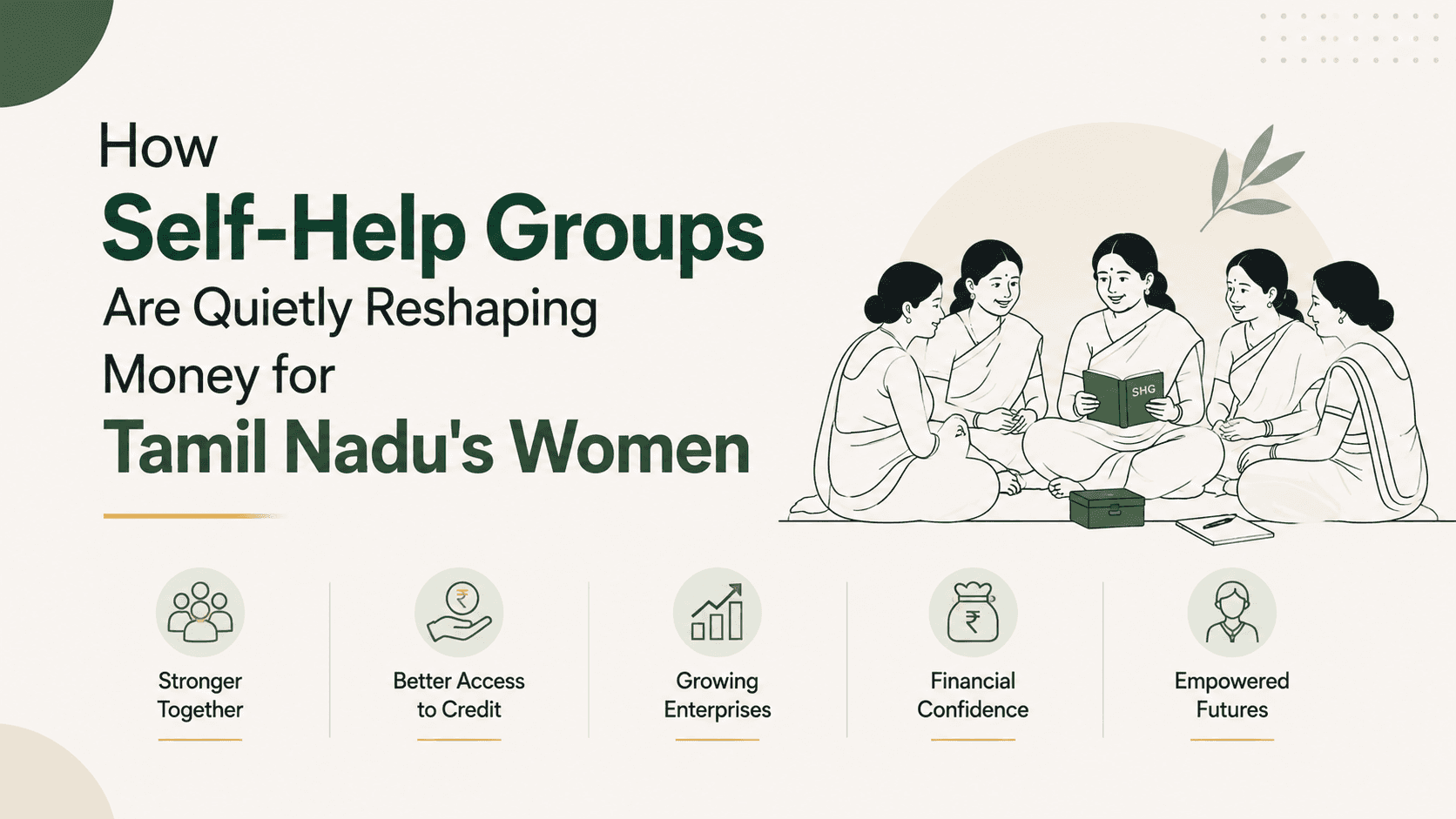
If you grew up in a Tamil Nadu village or small town, chances are your mother, aunt, or a neighbour belongs to one. They call it "sangam." Bankers call it an SHG. Either way, it is one of the quietest, most successful financial-inclusion stories in India — and almost nobody outside the system fully appreciates it.
This is a plain-English walkthrough of what SHGs are, what they actually do for women in Tamil Nadu, and what to know before joining one.
What a Self-Help Group really is
An SHG is a group of 10 to 20 women from the same neighbourhood, of similar economic background, who agree to save together every month, lend to each other from the pooled savings, and — once the group has built a track record — borrow as a unit from a bank.
That last bit is the magic. Banks don't traditionally lend to a woman with no salary slip and no collateral. But banks will lend to a group that has saved consistently for six months, kept clean records, and rotated internal loans without default. The group becomes the credit history.
The Tamil Nadu story
The SHG movement in TN runs through one body — the Tamil Nadu Corporation for Development of Women (TNCDW), which administers Mahalir Thittam. Mahalir Thittam was launched in 1997-98, scaled district-by-district, and is today one of the largest women's SHG networks in India, with over a crore women across more than 9 lakh groups.
Layered on top is the central government's NRLM (National Rural Livelihoods Mission), run in TN as TNSRLM. NRLM provides interest subvention — when an SHG borrows from a bank at 7%, the central scheme reimburses the difference if the loan is paid on time, effectively bringing the cost to as low as 4%. That is cheaper than almost any other credit a woman in a Tamil Nadu village can access.
What an SHG actually does for a woman
The financial benefits are the obvious headline:
Cheap, formal credit: bank linkage at 4–7%, instead of 24–36% from an MFI or 60%+ from a moneylender.
A real savings habit: even ₹50 a week, compounded over five years, becomes a buffer the household didn't have.
A credit history: when a woman later wants a personal loan or a gold loan in her own name, the SHG record helps.
Government scheme access: Magalir Urimai Thogai, Mudra, livelihood grants, skill training — most of these flow through the SHG roster.
But ask any field officer and they'll tell you the bigger benefits are quieter, a weekly reason to leave the house and sit in a room with other women, practice signing your name and reading a passbook, a network for everything from a sick child to a daughter who wants to study further. These don't show up on any balance sheet. They are the reason SHG members consistently report higher life satisfaction than non-members, even when household income looks similar.
Three pitfalls nobody talks about enough
1. MFI piggybacking. Microfinance companies sometimes lend to SHG members individually on top of the group's bank loan. Two or three MFI loans plus the SHG loan plus a gold loan stacks up fast. The household ends up paying ₹8,000 in monthly EMIs on ₹15,000 of income.
2. Joint liability stress. When one member defaults, the rest are pressured to cover. That's the point — it's what makes the model work for the bank, but it can strain relationships in the group.
3. Election-cycle loans. Cheap credit gets pushed harder before elections. The discipline of "we only borrow what we can repay" sometimes slips.
If you're already in an SHG and the household is stretched, the same playbook applies as for any other loan — talk to the bank's recovery desk early, restructure before you default, and never settle without a written letter.
How to join and what to ask before you do?
If you're not yet in an SHG and want to join, walk into the nearest Anganwadi, Panchayat office, or Mahalir Thittam district office and ask for the nearest active group. You can also visit the TNCDW office in your district headquarters. A new group usually takes six months to qualify for bank linkage.
Before you sign on, ask four things - how much do members save each week, what's the internal interest rate when a member borrows, has the group already taken a bank loan and what's the repayment track record, and who keeps the books. Good groups answer all four without hesitation. Wobbly groups don't.
The bottom line. An SHG is the cheapest, most forgiving, most dignified form of credit available to a woman in Tamil Nadu. The number on the passbook matters. What matters more is the room itself, and the woman who walks out of it with her name signed in her own hand.
If you grew up in a Tamil Nadu village or small town, chances are your mother, aunt, or a neighbour belongs to one. They call it "sangam." Bankers call it an SHG. Either way, it is one of the quietest, most successful financial-inclusion stories in India — and almost nobody outside the system fully appreciates it.
This is a plain-English walkthrough of what SHGs are, what they actually do for women in Tamil Nadu, and what to know before joining one.
What a Self-Help Group really is
An SHG is a group of 10 to 20 women from the same neighbourhood, of similar economic background, who agree to save together every month, lend to each other from the pooled savings, and — once the group has built a track record — borrow as a unit from a bank.
That last bit is the magic. Banks don't traditionally lend to a woman with no salary slip and no collateral. But banks will lend to a group that has saved consistently for six months, kept clean records, and rotated internal loans without default. The group becomes the credit history.
The Tamil Nadu story
The SHG movement in TN runs through one body — the Tamil Nadu Corporation for Development of Women (TNCDW), which administers Mahalir Thittam. Mahalir Thittam was launched in 1997-98, scaled district-by-district, and is today one of the largest women's SHG networks in India, with over a crore women across more than 9 lakh groups.
Layered on top is the central government's NRLM (National Rural Livelihoods Mission), run in TN as TNSRLM. NRLM provides interest subvention — when an SHG borrows from a bank at 7%, the central scheme reimburses the difference if the loan is paid on time, effectively bringing the cost to as low as 4%. That is cheaper than almost any other credit a woman in a Tamil Nadu village can access.
What an SHG actually does for a woman
The financial benefits are the obvious headline:
Cheap, formal credit: bank linkage at 4–7%, instead of 24–36% from an MFI or 60%+ from a moneylender.
A real savings habit: even ₹50 a week, compounded over five years, becomes a buffer the household didn't have.
A credit history: when a woman later wants a personal loan or a gold loan in her own name, the SHG record helps.
Government scheme access: Magalir Urimai Thogai, Mudra, livelihood grants, skill training — most of these flow through the SHG roster.
But ask any field officer and they'll tell you the bigger benefits are quieter, a weekly reason to leave the house and sit in a room with other women, practice signing your name and reading a passbook, a network for everything from a sick child to a daughter who wants to study further. These don't show up on any balance sheet. They are the reason SHG members consistently report higher life satisfaction than non-members, even when household income looks similar.
Three pitfalls nobody talks about enough
1. MFI piggybacking. Microfinance companies sometimes lend to SHG members individually on top of the group's bank loan. Two or three MFI loans plus the SHG loan plus a gold loan stacks up fast. The household ends up paying ₹8,000 in monthly EMIs on ₹15,000 of income.
2. Joint liability stress. When one member defaults, the rest are pressured to cover. That's the point — it's what makes the model work for the bank, but it can strain relationships in the group.
3. Election-cycle loans. Cheap credit gets pushed harder before elections. The discipline of "we only borrow what we can repay" sometimes slips.
If you're already in an SHG and the household is stretched, the same playbook applies as for any other loan — talk to the bank's recovery desk early, restructure before you default, and never settle without a written letter.
How to join and what to ask before you do?
If you're not yet in an SHG and want to join, walk into the nearest Anganwadi, Panchayat office, or Mahalir Thittam district office and ask for the nearest active group. You can also visit the TNCDW office in your district headquarters. A new group usually takes six months to qualify for bank linkage.
Before you sign on, ask four things - how much do members save each week, what's the internal interest rate when a member borrows, has the group already taken a bank loan and what's the repayment track record, and who keeps the books. Good groups answer all four without hesitation. Wobbly groups don't.
The bottom line. An SHG is the cheapest, most forgiving, most dignified form of credit available to a woman in Tamil Nadu. The number on the passbook matters. What matters more is the room itself, and the woman who walks out of it with her name signed in her own hand.