


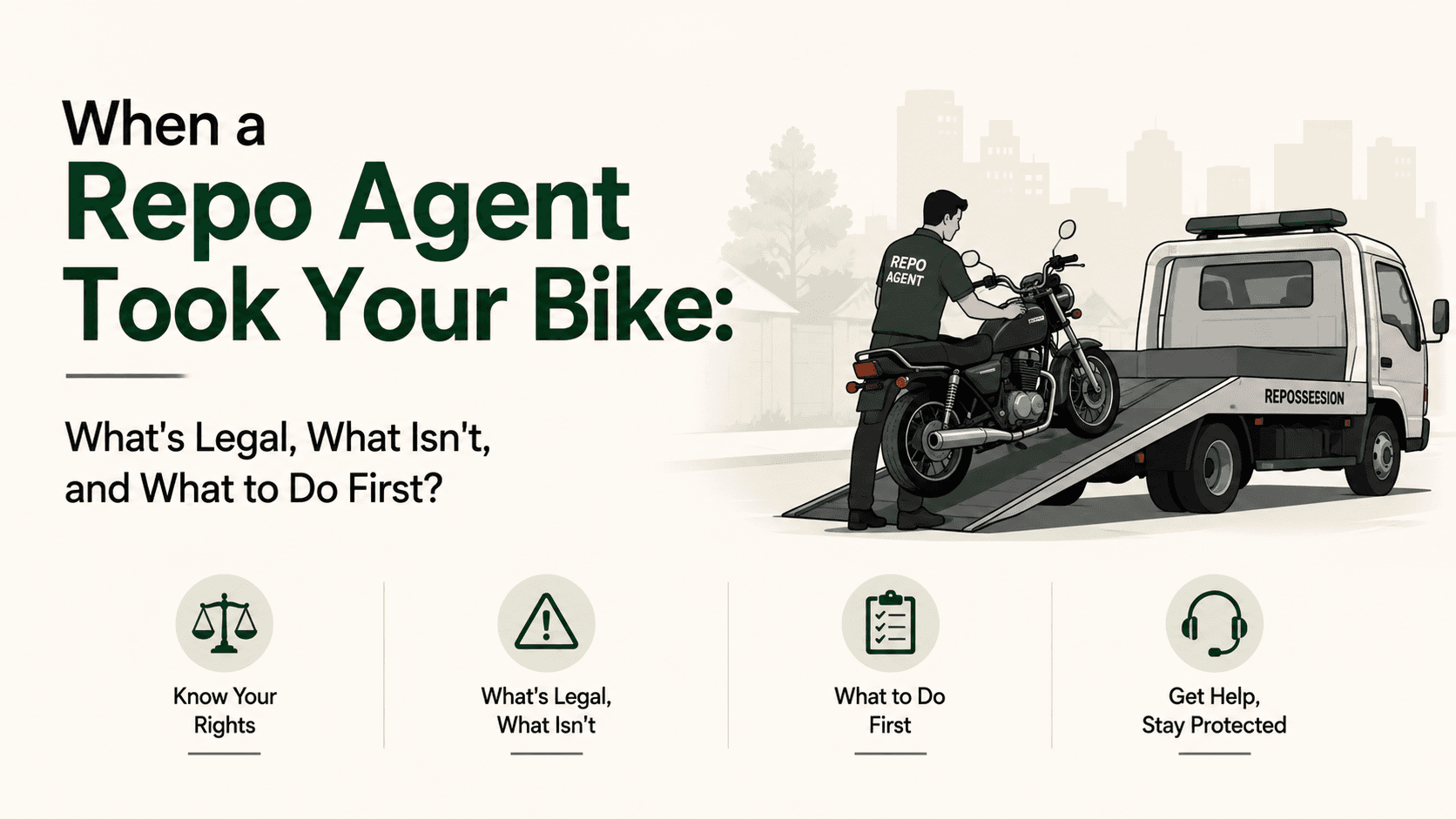
A Bajaj Pulsar parked outside an apartment block in Chrompet, Chennai. The owner, Vignesh, a 26-year-old delivery rider had stepped in for lunch. When he came back twenty minutes later, the bike was gone. No call. No notice on the door. Just gone.
He hadn't paid an EMI in three months. His finance company had hired a repossession agent. The agent had used a duplicate key, started the bike, and ridden it away in broad daylight. Vignesh assumed it had been stolen and went to file an FIR before someone at the showroom told him what had actually happened.
This is happening more and more, in every Tamil Nadu city — and almost every borrower it happens to doesn't know that most of what was done to them was illegal.
The rule, in one line
A hypothecated vehicle (i.e. one with a loan on it where the lender's name is on the RC) cannot be repossessed without due process - even by the very lender whose money paid for it.
This is the rule from the Supreme Court in Citicorp Maruti Finance v. S. Vijayalaxmi (2012) and reaffirmed since: a financier must follow the procedure laid out in the loan agreement and the RBI Fair Practices Code. Specifically — written notice, an opportunity to cure the default, and possession only by a trained, identified, properly authorised agent.
A repossession agent who shows up without a notice, uses a duplicate key, or seizes the vehicle while the borrower is not present commits in the eyes of the law trespass, criminal force, and possibly theft. The Court has repeatedly awarded compensation to borrowers in such cases.
What a lawful repossession actually looks like
If the lender is doing it right:
The account is overdue by 60–90 days; the bank or NBFC has sent statutory demand notices.
A pre-possession notice is issued giving the borrower 7–15 days to pay or come to an arrangement.
If no response, an authorised repossession agent arrives, with ID, written authorisation, and a vehicle inventory form.
The borrower is present, identified, and given an inventory of items left inside the vehicle.
The vehicle is taken to a designated yard. The borrower has the right to redeem by paying overdue EMIs plus costs within a stated window (usually 30 days) before the vehicle is auctioned.
Almost none of these steps happened in Vignesh's case. That matters.
If your vehicle has just been taken
The first 72 hours decide most outcomes. In order:
1. Confirm who took it. Call the finance company immediately. Ask for the repo notice, the agent's authorisation, and the yard location. Get all of it in writing or email.
2. File a police complaint as "improper seizure", not theft. If the lender confirms the repossession, the FIR is unnecessary, but a written police note documenting the seizure date is valuable later.
3. Get the inventory list. Anything left inside the vehicle (helmet, raincoat, documents, tools) must be returned. Demand the inventory form the agent should have prepared.
4. Pay overdue EMIs (not the entire loan) to redeem. Most lenders accept overdue EMIs + repo charges (₹2,500–₹5,000) + yard storage to release the vehicle. Do this through a bank channel, not cash to the agent.
5. If the seizure was improper, write to the lender's grievance officer. Mention the absence of pre-possession notice, absence of authorised agent ID, or seizure without the borrower's presence. The RBI Integrated Ombudsman accepts this complaint after 30 days.
If you genuinely cannot afford to keep the vehicle
This is more common than borrowers admit. Three options, in order of preference.
Option A: Voluntary surrender. Tell the lender, in writing, that you cannot continue and request voluntary surrender. The vehicle is collected with dignity, sold at auction, the proceeds adjusted against the loan, and the borrower notified of any shortfall. This usually preserves a "Closed" status on the credit report instead of "Written-off."
Option B: Private sale with bank's consent. Find a buyer at a fair market price; the buyer pays the lender directly; the lender clears its lien on the RC; the balance is paid to you (or you pay the shortfall). This typically fetches 20–30% more than auction value.
Option C: Settle and keep. If a family member can step in with a lump sum, banks settle vehicle loans at 65–80% of outstanding, transfer the RC to clean, and close the loan.
The one option that ends badly every time — letting the lender repossess without engagement, then ignoring the shortfall notice. The shortfall claim survives the seizure, and it can be enforced through the DRT.
The bottom line. A hypothecated vehicle still belongs to you, not the bank, until due process is followed. Repossession agents bet on borrowers not knowing this. The borrowers who lose the least are the ones who knew the rules before the bike disappeared from the parking lot.
A Bajaj Pulsar parked outside an apartment block in Chrompet, Chennai. The owner, Vignesh, a 26-year-old delivery rider had stepped in for lunch. When he came back twenty minutes later, the bike was gone. No call. No notice on the door. Just gone.
He hadn't paid an EMI in three months. His finance company had hired a repossession agent. The agent had used a duplicate key, started the bike, and ridden it away in broad daylight. Vignesh assumed it had been stolen and went to file an FIR before someone at the showroom told him what had actually happened.
This is happening more and more, in every Tamil Nadu city — and almost every borrower it happens to doesn't know that most of what was done to them was illegal.
The rule, in one line
A hypothecated vehicle (i.e. one with a loan on it where the lender's name is on the RC) cannot be repossessed without due process - even by the very lender whose money paid for it.
This is the rule from the Supreme Court in Citicorp Maruti Finance v. S. Vijayalaxmi (2012) and reaffirmed since: a financier must follow the procedure laid out in the loan agreement and the RBI Fair Practices Code. Specifically — written notice, an opportunity to cure the default, and possession only by a trained, identified, properly authorised agent.
A repossession agent who shows up without a notice, uses a duplicate key, or seizes the vehicle while the borrower is not present commits in the eyes of the law trespass, criminal force, and possibly theft. The Court has repeatedly awarded compensation to borrowers in such cases.
What a lawful repossession actually looks like
If the lender is doing it right:
The account is overdue by 60–90 days; the bank or NBFC has sent statutory demand notices.
A pre-possession notice is issued giving the borrower 7–15 days to pay or come to an arrangement.
If no response, an authorised repossession agent arrives, with ID, written authorisation, and a vehicle inventory form.
The borrower is present, identified, and given an inventory of items left inside the vehicle.
The vehicle is taken to a designated yard. The borrower has the right to redeem by paying overdue EMIs plus costs within a stated window (usually 30 days) before the vehicle is auctioned.
Almost none of these steps happened in Vignesh's case. That matters.
If your vehicle has just been taken
The first 72 hours decide most outcomes. In order:
1. Confirm who took it. Call the finance company immediately. Ask for the repo notice, the agent's authorisation, and the yard location. Get all of it in writing or email.
2. File a police complaint as "improper seizure", not theft. If the lender confirms the repossession, the FIR is unnecessary, but a written police note documenting the seizure date is valuable later.
3. Get the inventory list. Anything left inside the vehicle (helmet, raincoat, documents, tools) must be returned. Demand the inventory form the agent should have prepared.
4. Pay overdue EMIs (not the entire loan) to redeem. Most lenders accept overdue EMIs + repo charges (₹2,500–₹5,000) + yard storage to release the vehicle. Do this through a bank channel, not cash to the agent.
5. If the seizure was improper, write to the lender's grievance officer. Mention the absence of pre-possession notice, absence of authorised agent ID, or seizure without the borrower's presence. The RBI Integrated Ombudsman accepts this complaint after 30 days.
If you genuinely cannot afford to keep the vehicle
This is more common than borrowers admit. Three options, in order of preference.
Option A: Voluntary surrender. Tell the lender, in writing, that you cannot continue and request voluntary surrender. The vehicle is collected with dignity, sold at auction, the proceeds adjusted against the loan, and the borrower notified of any shortfall. This usually preserves a "Closed" status on the credit report instead of "Written-off."
Option B: Private sale with bank's consent. Find a buyer at a fair market price; the buyer pays the lender directly; the lender clears its lien on the RC; the balance is paid to you (or you pay the shortfall). This typically fetches 20–30% more than auction value.
Option C: Settle and keep. If a family member can step in with a lump sum, banks settle vehicle loans at 65–80% of outstanding, transfer the RC to clean, and close the loan.
The one option that ends badly every time — letting the lender repossess without engagement, then ignoring the shortfall notice. The shortfall claim survives the seizure, and it can be enforced through the DRT.
The bottom line. A hypothecated vehicle still belongs to you, not the bank, until due process is followed. Repossession agents bet on borrowers not knowing this. The borrowers who lose the least are the ones who knew the rules before the bike disappeared from the parking lot.